Cheryl Lawther, Rachel Killean, and Lauren Dempster join JiC for this post on sites of ‘dark tourism’ in Cambodia. Cheryl, Rachel, and Lauren are Lecturers at the School of Law, Queen’s University Belfast. Their post draws on a period of fieldwork in Cambodia conducted by them in January 2018, with the team carrying out over 30 interviews with survivors, members of staff at Tuol Sleng and Choeung-Ek, representatives of NGOs and other stakeholders to examine how victims and survivors are represented at these sites. In addition to Tuol Sleng and Choeung-Ek, the team visited a number of former prison sites in the provinces. Using a transitional justice lens and drawing on the interviews conducted, this blog examines how these sites can be argued to be, and be critiqued as, spaces of: truth, justice, and reparations.
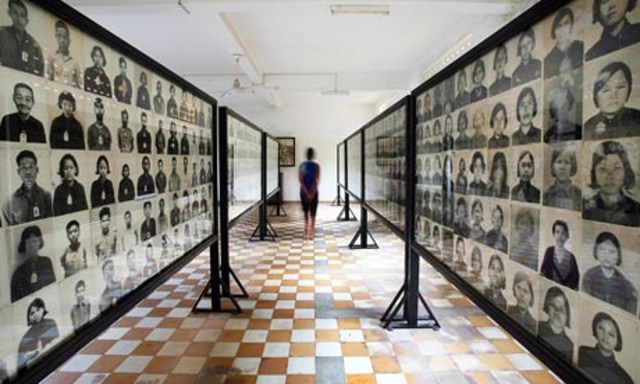
A visit walks past photographs of some of those killed in Prison 21, now the Tuol Sleng Genocide Musem (Photo: Tang Chhin Sothy / AFP / Getty Images)
The practice of ‘dark tourism’, whereby members of the public visit sites associated with atrocity and violence, has received growing attention in recent years. Thousands of visitors travel to Auschwitz, Cambodia’s ‘Killing Fields,’ ports used in the global slave trade, and to other sites of mass atrocity. While these sites appeal to (some) tourists, how do those impacted by the violence perpetrated in these places view them? And what do these sites say – or not say – about those harmed there? Focussing on two sites associated with such activity in Cambodia, Tuol Sleng Genocide Museum and the ‘killing fields’ of Choeung-Ek, this blog post explores how transitional justice can provide a framework for analysing the value of these sites to survivors of the genocide, and for unpicking whose, and what, experiences are represented there.
Tuol Sleng Genocide Museum in Phnom Penh is a former site of torture and detention run by the Khmer Rouge regime between 1975 and 1979. Those detained at Tuol Sleng were transported to Choeung-Ek, a site to the south of the city, where they were executed and buried in mass graves. Both sites have become popular places for tourists to visit.
Sites of Truth
For many interviewees, Tuol Sleng and Choeung-Ek are considered to be places where the truth of past harms is acknowledged. Tuol Sleng is used as a space of truth-telling by survivors, often working with NGOs and victim support organisations. Survivors at the sites spoke of the importance of telling their stories, of theirrole as ‘living documents’ of what had happened, and in some cases of feeling a ‘duty’ to share their stories with researchers and visitors. At a more instrumental level, Tuol Sleng’s iconic photographic exhibition of former detainees has been a place where relatives of those killed in the detention centre can learn the fate of their loved ones. One survivor told us of visiting Tuol Sleng in order to ‘search for the truth.’
While playing an important truth telling function, neither site is viewed as telling the ‘full’ ‘truth’ about Cambodia’s past. For example, some interviewees drew attention to the fact that many of those tortured at Tuol Sleng and subsequently killed at Choeung-Ek were themselves former Khmer Rouge cadres subsequently detained by the regime. We found thatsuch complexities of victimhood are not fully engaged with at the sites. Increased representation of the ‘shades of grey’ of victims and perpetrators might facilitate the telling of a more comprehensive and nuanced truth. Others drew attention to the harms that are less visible within the sites, such as the widespread death caused by overwork, exhaustion and starvation during the regime. Some suggested that the development of other sites associated with the regime might help highlight these abuses. We found that the sites created a hierarchy of harm which prioritised violent death, rather than exposing a more comprehensive truth of the harms experienced during the regime. A number of interviewees expressed a desire for these stories to be amplified.
Sites of Justice
The sites are very much viewed as places of evidence, where the proof of past crimes is preserved and presented. The role of these sites as repositories of evidence was raised by interviewees in two ways. Firstly, many of our respondents emphasised the importance of these sites in authenticating the experience of those who suffered under the Khmer Rouge regime and ‘showing the world’ what happened. One interviewee described the sites as ‘the best place to show the public about the crime committed during the Khmer Rouge regime.’ Continue reading