Daniel Marín López and Aaron Acosta join JiC for this post on the legal and political causes and implications of the joint referral of Venezuela to the International Criminal Court (ICC). Daniel is a researcher and Aaron is a Fellow at Dejusticia, a Colombia-based research and advocacy organization dedicated to the strengthening of the rule of law and the promotion of social justice and human rights in Colombia and the Global South.
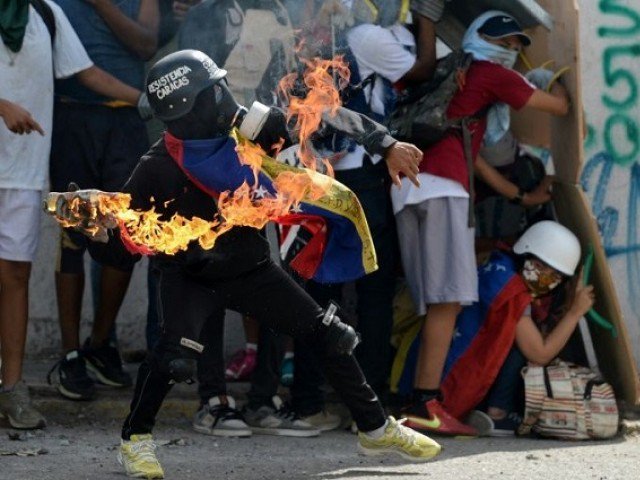
Opposition activists clash with police in Caracas, Venezuela in July 2017 (Photo: AFP)
Political events like that of today honor the memory of the murdered and restore the hope of justice for the tortured, the political prisoners and their families, the forcibly exiled and all the Venezuelans who suffer, who go hungry, who are forced to search for food in the garbage, who lack access to medicine…
Those were the words uttered by the Secretary General of the Organization of American States (OAS), Luis Almagro, when six countries (Argentina, Colombia, Chile, Paraguay, Peru, and Canada) sent a referral to the Prosecutor of the International Criminal Court (ICC) on 27 September 2018 urging her to open an investigation in Venezuela. Similar to the sentiment expressed by Almagro, the international community also reacted with excited approval. Media sources from across the globe repeatedly highlighted the historical significance of this referral – this was the first time that States Parties to the Rome Statute referred a situation to the Prosecutor concerning a situation in the territory of another State Party.
Yet, amidst the commentary concerning the novelty of the referral, a greater momentous occasion was largely missed. The referral, which involved five Latin American countries, marks a momentous shift in Latin American regional politics and diplomacy. Indeed, Mr. Almagro was correct to call this move a “political event.” Breaking from the regional norm of the principle of nonintervention and the unspoken culture of fraternity among countries, these five Latin American countries have opened the door to a new wave of visceral politics in the region. With the rise of right-wing presidents in Latin America, measures like the referral can be abused by such governments to advance their political agendas in the region, thereby delegitimizing the crucial cause of seeking justice for victims in Venezuela as a common goal. The Prosecutor of the ICC should keep these regional concerns in mind before she decides to open an investigation in Venezuela.
The Referral: A Legally Undisputable Opportunity to Investigate Grave Crimes in Venezuela
The referral appears to be a response to a 29 May 2018 report by the OAS regarding alleged crimes against humanity committed in Venezuela. In a set of recommendations issued by the report, the independent experts appointed by the OAS and who wrote the report recommended that Almagro invite States Parties to the Rome Statute to refer the situation in Venezuela to the ICC for alleged crimes against humanity committed since at least 2014.
To date, the Venezuelan government has not publicly reacted to the referral itself, but has instead, focused on insulting countries like France and Costa Rica, who have subsequently supported the referral. However, on 2 October 2018, the National Assembly of Venezuela, the government organ that once held legislative power until the Maduro government controversially reassigned power to the Constituent National Assembly, approved an accord which supported the referral of the situation in Venezuela to the ICC.
As a result of the referral, the legal character of the ICC’s preliminary examination, which the Prosecutor opened on 8 February 2018, remains unchanged. In other words, the referral does not automatically result in the opening of an official investigation. However, an Article 14 referral does eliminate the requirement that the Prosecutor receive judicial approval before proceeding to open an investigation, thus giving her the sole discretion in deciding whether to open an investigation in Venezuela.
With this in mind, it is necessary to present some of the legal challenges that have been discussed concerning head of state immunity and the problems presented if Venezuela were to withdraw from the Rome Statute, a situation which Venezuela has not yet expressed, but may occur, especially considering Venezuela´s 25 April 2018 decision to withdraw from the OAS.
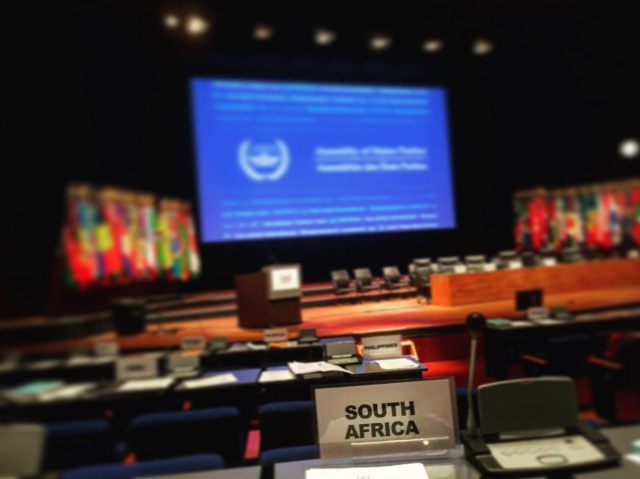
With regard to head of state immunity, the concerns that an indictment of President Maduro would cause the same problems as did the indictment of President Omar Al-Bashir in the ICC’s situation in Sudan are unfounded. In its decision on South Africa’s noncompliance, the ICC emphasized that “[b]y ratifying the Statute, States Parties have in fact accepted the irrelevance of immunities based on official capacity, including those that they may otherwise possess under international law.” Unlike Sudan, which is not a State Party to the Rome Statute, Venezuela has ratified the Rome Statute, and has therefore surrendered any claim to immunity before the ICC.
With regard to the withdrawal issue, the legal concerns are similarly without a basis. According to Article 127 of the Rome Statute, a State Party may withdraw from the Rome Statute, which becomes effective 1 year after the notice of withdrawal. However, the ICC still retains criminal jurisdiction over crimes committed during the period of time the State was a party to the Rome Statute.
Having dispelled these legal concerns, it is important to emphasize that the significant challenges for the ICC would be more practical rather than legal, including the difficulty of gaining custody of the accused. Continue reading →