
Carlos Fonseca Sánchez continues our ongoing symposium on peace and justice in Colombia after the referendum. Carlos is a researcher in international criminal law, humanitarian law and human rights law. Adv. LL.M graduate in Public International Law from Leiden University. He was previously a stand-by Defence Legal Intern in The Prosecutor v. Radovan Karadzic at the International Criminal Tribunal for the Former Yugoslavia.
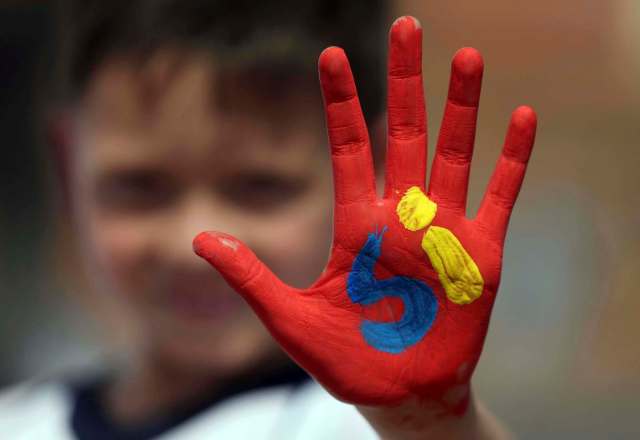
A young “yes” campaigner. (Photo: Fernando Vergara / Associated Press)
“Do you support the Final Agreement for the Termination of the Conflict and the Construction of a Stable and Lasting Peace?”
On 2 October 2016, that was the question that 6,432,376 people in Colombia answered. In doing so, they voted, by a tiny margin, against the agreement between the Colombian government and the Colombian Armed Revolutionary Forces – People’s Army (FARC-EP). Did this amount of people have the intention to reject a peaceful solution to the Colombian 52 year-long armed conflict with Latin America’s oldest guerrilla group? Obviously not. The plebiscite did not ask Colombians whether they wanted a military solution to the armed conflict. In fact, when the current government sought its reelection, two years ago, the negotiated settlement became its rallying flag. In the end, the support of a coalition comprising the government and opposition parties (but not the one created by former president Alvaro Uribe who lead the ‘no’ campaign) and the goal of peace ensured the reelection of President Juan Manuel Santos. That day, 15 June 2014, more than 7.8 million people supported Santos and the peace process that had started two years earlier, incidentally more than a million than the turnout for the referendum.
Many of the headlines following the referendum stated that the Colombian people rejected peace and, logically, preferred war with the FARC-EP. Although the government and many supporters of the agreement argued that a renegotiation of the agreements wasn’t possible, today the cease-fire remains, and both those for and against the agreement have showed signs of calm. Both the Colombian and the international community were shocked by the result, especially with surveys pointing for a clear win for the “yes”. But the overall coverage of the peace negotiations, referendum and its results painted a sloppy, and inaccurate picture of realities on the ground.
Between Reality and Fiction
Although the international media and the international community’s support of the agreement was well-meaning, it failed to recognize the complexities of the agreement, the polarization of Colombian society and the disconnection many of the voters had with the plebiscite.
The 297 page-long peace agreement covered a multiplicity of issues such as a comprehensive rural reform, the political participation of the former combatants, the conditions for the final ceasefire and dereliction of weapons, the reincorporation of the former FARC combatants to civilian life, the creation of a multiplicity of bodies that would ensure the implementation of the agreement, provide protection to political minorities and prosecute the successors of paramilitaries. Perhaps the most polemic issue was the one related to the victims of the armed conflict. The agreement created what it called a “Comprehensive System of Truth, Justice, Reparation and Non-repetition” that integrated a Truth Commission, a Unit for the Search of Missing Persons, a Special Jurisdiction for Peace, Measures on Comprehensive Reparation, and Guarantees of Non-Repetition. The implementation of the agreement would require the creation of a separate judicial entity, the Special Jurisdiction for Peace, that would have the power to review all the prior judicial decisions related to the conflict.
Before the vote, the negotiators and the government constantly repeated that the agreement was imperfect, but that it was the best one possible. The final text of the agreement was released on 24 august 2016, merely one month before the plebiscite. Most of the voters wouldn’t have the time to carefully read the agreement.
Since most wouldn’t read the agreement, many relied upon the media and the opposing sides to communicate the advantages and disadvantages of the peace deal. Since the negotiations were private, people also couldn’t tell how the negotiations had proceeded or which proposals were incorporated, discarded or not even presented. The role of the media and the main political leaders was crucial. As has happened on previous occasions around the world, they presented a combination of lies mixed with reality. Continue reading

 Justice in Conflict