Laura Nacyte joins JiC for this post on need for accountability for the use of child soldiers in Iraq. Laura is an MSc graduate of Global Security from the University of Glasgow where she wrote the dissertation “The Copenhagen School Meets International Law: Has the International Criminal Court Impeded the Securitisation of Sexual and Gender-Based Violence?”. She has previously written for JiC on the the limits of the conception of gender under the Rome Statute of the International Criminal Court.
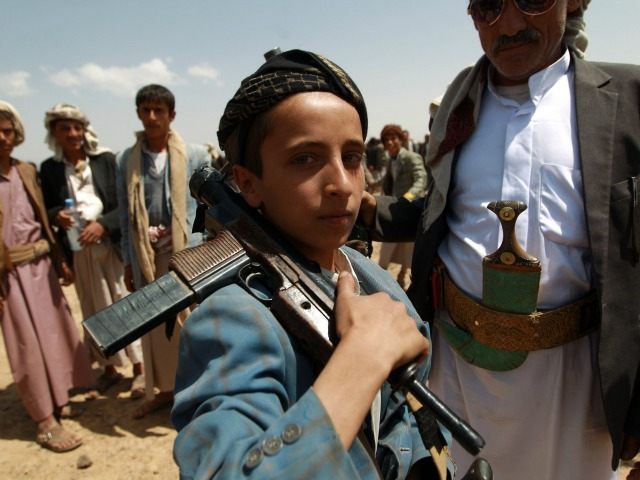
Groups, including Shiite militias, have been accused of using child soldiers in Iraq (Photo: Getty Images)
The issues pertaining to child soldiering have occupied much attention in recent global justice debates. In Colombia, minors were released from the rebel group of the Revolutionary Armed Forces. Their reintegration is beset with difficulties. At the International Criminal Court, a former child soldier Dominic Ongwen is tried for atrocities committed in Uganda. Indeed, children’s involvement in military activities poses the dilemma of their victimhood and agency.
The dilemma is likewise acute in Iraq, where the number of minors incorporated into diverse armed groups has surged following the emergence of the so-called Islamic State of Iraq and al-Sham (ISIS) in 2014. Despite the accession to the Optional Protocol on the Involvement of Children in Armed Conflict, which forbids the conscription of persons under 18 years of age, the Iraqi government failed to fully implement it. As a result, minors entered military groups and have engaged in wrongdoing.
Systematic recruitment, as well as children’s heightened vulnerability, diminish — although does not exclude — accountability of Iraqi child soldiers. Therefore, its determination by the means of juvenile justice in Iraq is defective. As the remainder of the post shows, it is politically biased and disregards limited minors’ agency. An alternative might be a truth and reconciliation commission; a national inquiry body concerned with past human rights abuses and restoration of social relationships. As ISIS declines in power, the creation of such commission appears both desirable and plausible.
The Flawed Iraqi Regulations of Child Soldiering
Under Iraqi law, children’s recruitment and use in armed conflict is not a criminal offence. The minimum age for voluntary recruitment is 18 years; nevertheless, the age verification system is not reliable.
Currently, the only robust safeguards for minors are set down in laws determining the status and conduct of non-state armed groups. The 2005 Iraqi Constitution prohibits the formation of such entities. The 1969 Iraqi Criminal Code and the 2005 Terrorism Act foresee sentences for those who conscript other persons, including children, into forces outside state control.
While important, these mechanisms are nonetheless problematic. They may offer a substantial protection against ISIS, the major Sunni-dominated recruiter of minors, but they simultaneously enable forces loyal to the Iraqi government to employ children with impunity. The Popular Mobilisation Forces, a Shia militia, is an emblematic example. Operating under the command of Iraq’s prime minister, it enlists children, some as young as 10 years old, on account of a religious duty. Other pro-government forces include the Kurdish Workers Party and self-defence groups.
Absent specific, child-orientated national policies, underage Iraqi soldiers tend to bear a high degree of personal responsibility for the acts of political violence. Pursuant to the 1983 Juvenile Welfare Act of Iraq, 9-17-year-olds affiliated with armed opposition groups are treated as juveniles. Once arrested, they are placed into an observational centre to undergo a physical, mental and social study of their behaviour. If convicted — typically on charges of terrorism — juveniles are sent to a correctional facility. Continue reading