Astrid Jamar joins JiC for this guest-post on recent developments regarding transitional and international criminal justice in Burundi. Astrid is a Research Assistant in Political Settlements Research Programmes at the University of Edinburgh’s School of Law.
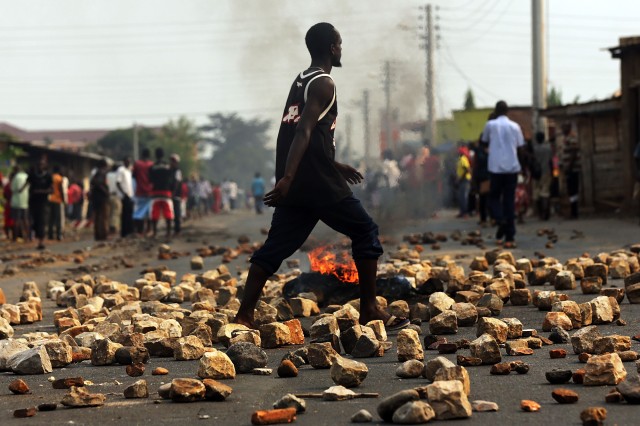
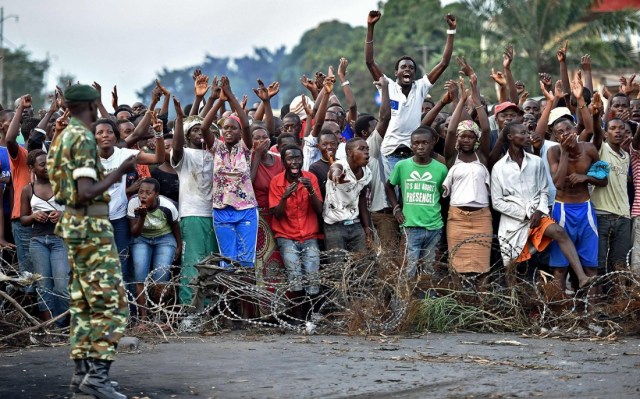
Political violence erupted when President Pierre Nkurunziza sought a third term. (Photo: BBC / Getty)
Transitional justice has been taken a number of worrying steps in Burundi. While the Truth and Reconciliation Commission is preparing for public hearings addressing crimes committed between 1962 and 2008, Burundi has been engulfed in political conflict since the controversial candidacy of Pierre Nkurunziza and his re-election for a third presidential mandate in 2015. From the beginning of the crisis, gross human rights violations have been widely reported, making the problem of impunity even more serious. Two decisions from the Burundian authorities over the past week illustrate their attitude towards the problem of impunity in relation to ongoing crimes: the Burundian government’s declaration that the UN human rights investigators are persona non grata in Burundi after the publication of their report on Burundi; and a law has been adopted to withdraw from the International Criminal Court (ICC).
These decisions are in line with other rejections by Burundian authorities of international involvement in the crisis. This includes the refusal of an African Prevention and Protection Mission in Burundi – MAPROBU from the African Union – or a UN Police Mission to be deployed, refusal to engage in the East African Community-led dialogue with the armed oppositions. They also demonstrate the failure of international initiatives to effectively promote human rights and the international justice agenda. Despite rhetorical and policy commitments towards transitional justice and human rights from Burundian authorities and international donors, the human rights situation has severely deteriorated over the past few years. This piece aims to place these recent developments in the context of the national and international political battles in play, and underlines the crucial need to refocus the debate on the implications for Burundians.
Old and Recent Problems of Impunity
The problem of impunity is not new to Burundi. In 2000, the Arusha Peace Agreements provided for truth-seeking and judicial mechanisms to address the legacies of four decades of violence. None of them has yet been fully implemented. After long and difficult negotiations, a truth and reconciliation commission (TRC) was established in 2014 and its implementation was launched in March 2016. Even before the current crisis emerged, most scholars assessing transitional justice in Burundi agreed that there were limited prospects for accountability. Given the current situation and the departure of many critical voices from the country, the potential contributions of the TRC are even more questionable.
In parallel, a United Nations Independent Investigation on Burundi (UNIIB) was established in December 2015, among other regional and international responses to the ongoing crisis. Three independent experts were appointed. They initially planned four visits to Burundi. Only two missions could take place due to political and security problems.
Published on 20 September 2016, the experts’ final report concludes that, even if no exact overview of the situation could be established given the security risks in investigating these crimes, more than one thousand people have been killed, thousands have reportedly been tortured, unknown numbers of women have been victims of various forms of sexual crimes, hundreds of people have disappeared, and thousands remain in illegal detention. From April 2015 to August 2016, 286,036 sought refuge in neighbouring countries, according to the UN HCR. Overall, the 23-page report clearly denounces the political and targeted nature of crimes committed by security forces. It acknowledges third parties also committed gross human rights violations. However, the report notes “the responsibility for the vast majority of these violations should be laid at the door of the Government”.
Political Battles Around Ongoing Problems of Impunity
On several occasions, the investigators denounced the “blanket denial of all violations”, the lack of responses to numerous communications and the refusal of most suggestions from the authorities, and non-existent mechanisms of accountability by the government, resulting in a situation where impunity is endemic. As a result of the report, the UN OCHR Council created a commission of inquiry to conduct “investigation into human rights violations and abuses in Burundi since April 2015, and to identify alleged perpetrators”. For people keeping a close eye on Burundi, the content of the report is not necessarily revealing new elements. Of course, it provides a more authoritative voice to denounce the alarming situation. The reactions from Burundian authorities, including key actors in charge of human rights and rule of law matters, are leading to political battles with critical voices, including the UN, and representation battles about what is happening in Burundi rather than addressing the situation. Continue reading