Sophie Haspeslagh joins JiC for this first installment in our symposium on Peace and Justice in Colombia. Sophie is conducting research the engagement of armed groups and the effects of proscription on peace processes at the London School of Economics and Political Science. She has been working on Colombia as a researcher and peace practitioner for over a decade with the International Crisis Group, ABColombia and Conciliation Resources. Sophie has previously published at JiC on the importance of finding balance on transitional justice in Colombia.
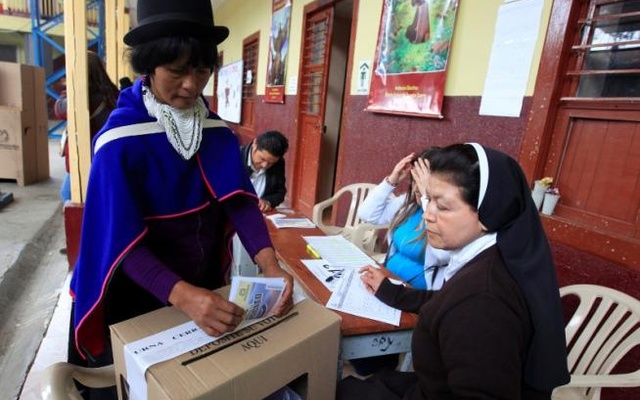
An indigenous woman votes in the referendum to determine whether the peace deal between the government and the FARC would be adopted. (Photo: Reuters)
On October 2nd, the peace deal in Colombia was rejected by a narrow margin, throwing the peace process between the Colombian government and the FARC (Fuerzas Armadas Revolucionarias de Colombia) off the rails. To comprehend what this could mean for the future of the peace process we first have to understand where this ‘No’ vote came from.
The Geography of the ‘No’ Vote
This result took everyone by surprise. But looking at the geography of the vote, it is clear that those who voted against it live in the inland regions of Colombia that are more densely populated and have not been directly affected by FARC-related violence in recent years. People in the regions most affected by the conflict, in the peripheries of Colombia, voted overwhelmingly in favour of the deal. In the town of Bojayá, where more than a hundred people were killed by a FARC mortar bomb against a church, 96 per cent of residents voted for the peace deal. The victims of the conflict, and specifically of FARC violence, were much more open to compromise than those who have just followed it remotely from their TV screens and have less to lose if the war keeps raging.
Polarisation and Responsibility
The leading figure of the ‘No’ campaign, ex-President Álvaro Uribe, focused his presidency on defeating the FARC militarily and framing the war as a fight against terrorists. This framing allowed for a simplification of how the Colombian conflict is understood, labelling the FARC as the only threat and perpetrator of violence. Uribe succeeded in his endeavour, digging a deep breach in Colombian society, increasing polarisation and making the FARC hugely unpopular.
Of course, the FARC is responsible for its own undoing. It is abhorred by a majority of Colombians for becoming involved in the drugs trade and committing human rights violations such as attacks against civilians and infrastructure, the use of landmines, and kidnapping. But the part of the story that is often left untold is that they are only responsible for a minority of the killings in the Colombian conflict. The majority of the 220,000 victims who lost their lives were killed by paramilitary groups, often aligned with state security forces.
In the context of this heightened rhetoric, the two main complaints of the ‘No’ camp are what they see as judicial leniency towards the FARC in the deal – particularly the absence of jail terms – and allowing the FARC to participate in politics. But these two points – restorative rather than punitive justice and the FARC’s future participation in politics – are the backbone of the agreement, so how can Colombians now square the circle?
What’s next for peace? The Pessimist’s Perspective
The agreement signed in Cartagena between President Juan Manuel Santos and the FARC is a good agreement. It was carefully crafted over a period of four years with much innovation and had already been widely hailed as an example of successful conflict resolution. It succeeded in breaking a number of deadlocks and is the expression of deep compromises on both sides that were hardly imaginable just a few years back. It is hard to see how the FARC would now accept backtracking on the assurances they have received, particularly on guarantees that they would not be jailed. In fact, a number of FARC leaders have taken to social media to say that the signed agreement can no longer be modified. Continue reading