
 Perhaps you’re a journalist with an unfortunate penchant for referring to the ICC as “the World Court” (sorry, that’s the ICJ) or suggesting that it will hear cases related to decades-ago atrocities (nope, temporal jurisdiction is a thing). Or maybe you’re a student with a term paper to write on how international institutions affect conflict dynamics (nobody knows). Possibly you just wish you could impress your friends with snarky complementarity-themed jokes (which everyone definitely, definitely loves).
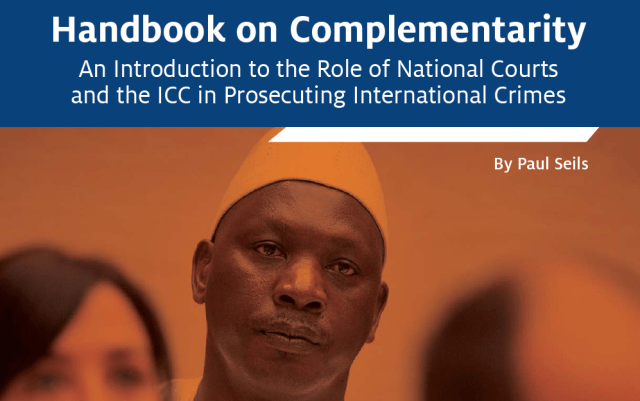
If any of these sound like you, the International Center for Transitional Justice has your back. Their new “Handbook on Complementarity” provides, as advertised, a comprehensive (>100 pages!) overview of the role of the ICC and domestic courts in prosecuting atrocity crimes. It’s also a surprisingly good read.
Written by Paul Seils, the Handbook goes ALL IN on the nitty gritty of how complementarity is designed to operate and how the ICC has implemented it so far. Even for relatively well-informed court-watchers, there’s new information. I learned, for instance, that although the prosecutor ordinarily has to wait until the investigation phase to take testimony, in “exceptional cases” where future access to a witness is threatened, she can request authorization from the Pre-Trial Chamber to take testimony during the preliminary examination. Neat! (That’s Rule 47 of the Rules of Procedure and Evidence for those of you following along at home.)
I also discovered that I have been promulgating an inadequate definition of complementarity. (Sorry everyone!) Check it:
 In fact, per the Trial Chamber in the Katanga case, the question of whether a case is admissible before the ICC requires a two-stage inquiry: The initial question is whether a national jurisdiction is pursuing the same case as the ICC. It’s only if the answer is yes that the issue of “willing and able” comes up. So I guess we’re all going to have to rewrite our lectures.
A couple of broader themes worth highlighting emerge from this bonanza of information:
- If you think “is a national jurisdiction pursuing the same case as the ICC” sounds like a simple question, you’re very, very wrong. The meaning of “case” in this context turns out to be a bit of a fraught question, and to have kind of a weird, Heisenberg Uncertainty Principle flavor to it. As a definitional matter, for something to be the same case, it must cover the same suspects, incidents, and conduct. But those elements can remain in flux through several rounds of ICC proceedings. Consequently, a state may be disadvantaged by challenging admissibility before charges are confirmed.
- One of the effects of the court’s relative youth, along with its resource and jurisdictional constraints, is that anomalous cases can have outsize precedential effect. (And frankly, they’re all pretty anomalous at this point.) With such a limited docket, every ruling provides an important signal about what the court might do in the future. So, for example: “Many people might feel that if the Colombian peace process successfully establishes a justice program with very light sentences that other countries will be able to cite it as a precedent in the future, thus undermining the aims of the ICC.” I am one of these people, and I suspect this is exactly what would happen.


 Justice in Conflict
Luis Moreno-Ocampo (Photo: Jerry Lampen / Reuters)
One of the most rewarding aspects of writing in the public domain is the feedback and commentary it generates — even, perhaps especially, when it’s critical. In response to my earlier post on former chief Prosecutor Luis Moreno-Ocampo’s record at the International Criminal Court (ICC), a few commentators have replied that there is far more that needs to be included for any accurate judgement to be made of the first decade of the Court’s existence than Moreno-Ocampo’s role alone.
Errol Mendes, a professor of law at the University of Ottawa, for example, commented that “while I agree with much of what you say, the failures of the ICC [are] also due to lack of co-op[eration] by states, UN etc.” I completely agree and should have clarified that the original post was not intended to produce an authoritative account of all of the reasons that explain the troubles the ICC faced in its first decade, but rather to assess one part of that record: the role and responsibility of the chief Prosecutor. There are no doubt structural constraints and limitations that the ICC confronts — and JiC posts raise them regularly, certainly far more often than commentary on Moreno-Ocampo — but the ICC is the type of institution that is deeply affected by the personalities at its helm. Moreno-Ocampo’s tenure is a case in point.
The initial blog post also generated an important and insightful comment from Wanda Boker, who worked as Moreno-Ocampo’s outreach advisor at the ICC from 2003-2004, in defence of Moreno-Ocampo’s tenure. Like Mendes, Boker is absolutely correct in her argument that any authoritative account of the failings (and, I would add, successes) of the ICC must look beyond attempts to discredit Moreno-Ocampo. Her comment deals with the alleged failures of ICC investigators and other staff to understand the situations they were working as well as the wider context in which the Court functions. Boker’s response is important and should be highlighted. So here it is, in full and without edit: