In the first piece for JiC’s symposium on The Dominic Ongwen Trial and the Prosecution of Child Soldiers, Ledio Cakaj joins JiC for this fascinating account of the life of LRA commander and former child soldier, Dominic Ongwen. Ledio is a researcher working on conflict in East and Central Africa. His book, When the Walking Defeats You; One Man’s Journey as Joseph Kony’s Bodyguard, will be published in November 2016 by Zed Books.
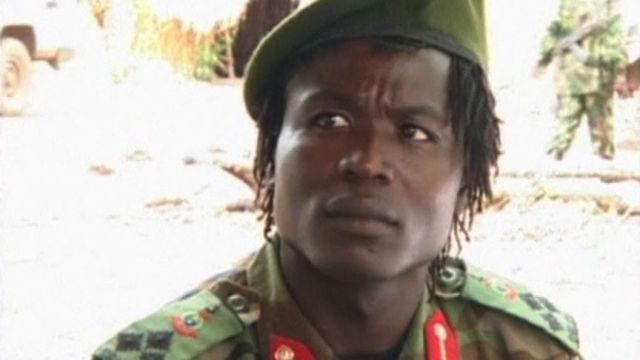
Dominic Ongwen
It must be strange being in Dominic Ongwen’s shoes. Suited up in a large room in a foreign country with fancy lawyers and judges staring him down, accusing him of unspeakable crimes. No wonder he seems amused, bewildered and confused. The legal proceedings must be particularly outlandish to a man, who, snatched from his family as a child, tried to excel at whatever life threw at him, only for life to change the script over and over again. And it must be particularly frustrating for him to be compared to Joseph Kony, a man whose clutches Ongwen has tried to escape for at least the last decade.
At ten or so, Ongwen excelled at school and was expected to go far, become a teacher like his parents, a lawyer or a doctor. When fighters from the Lord’s Resistance Army (LRA) abducted him in the early 1990s, he was too small to walk long distances or fight, even though children already fought in the LRA ranks. It was Ongwen’s perseverance and his desire to do well and make the adults proud that saw him not only survive the hostile environment but also become a noted fighter. Had the country of its birth provided him with basic security, he might have become a noted lawyer or perhaps a doctor.
At fifteen Ongwen was exposed to – and allegedly forced to participate in – the massacre of over 300 people in the village of Atiak, masterminded by Vincent Otti, Ongwen’s mentor in the LRA. Under Otti’s guidance, Ongwen had to punish civilians who did not help the LRA, fight Ugandan soldiers, and abduct more youths to fill the ranks. Refusal brought beatings and death.
While in the first years of his life as a rebel Ongwen might have acted under duress, he was taught, and likely convinced, that the LRA’s struggle was just. Kony addressed assemblies of LRA members in true Sunday Mass style saying that the LRA fought for the rights of the Acholi people, who were abused by the Ugandan army. He swore that the Holy Spirit had forced him to save the Acholi. Kony was fond of a line from the Old Testament: “If you are led by the Spirit, you are not under the law.”
Apart from fighting for his people, Ongwen was also told he was lamony — a soldier. The world that Ongwen-the-soldier inhabited was different to the one Ongwen-the-child left behind. Being alive was contingent on killing others. To take their food, clothes, or their ability to shoot back. Survival chances increased with promotion into officer ranks as low-level fighters were the first to die from bullets or pervasive shortages of food. Ongwen obeyed orders, fought hard, and excelled in the way of the rebels. By his late teens he was a commander with bodyguards, ‘wives’ and young servants.
Ongwen was good at fighting and killing. But he never was a top commander, certainly not on par with those who had joined Kony from the start, like Kenneth Banya, Vincent Otti or Okot Odhiambo. Sadly, there were many others like Ongwen in the LRA, young men abducted as children who were eager to please the Lapwony Madit (Big Teacher) Kony. Many of them like, Ochan Bunia, Vincent ‘Binany,’ or Otim ‘Ferry,’ have died fighting for Kony. Others, like Patrick Agweng or Jon Bosco Kibwola were killed on Kony’s orders, mostly as sacrifices to appease his ego. Of the surviving ones, Okot George ‘Odek,’ who left the LRA in February 2016, told me, he worried he would be charged by the ‘World Court (a reference to the International Criminal Court (ICC)),’ like Ongwen. Similarly, Opiyo Sam, another LRA commander who returned to Uganda two years ago, claimed he does not know or understand why Ongwen was singled out by the ICC. Continue reading


 Justice in Conflict
