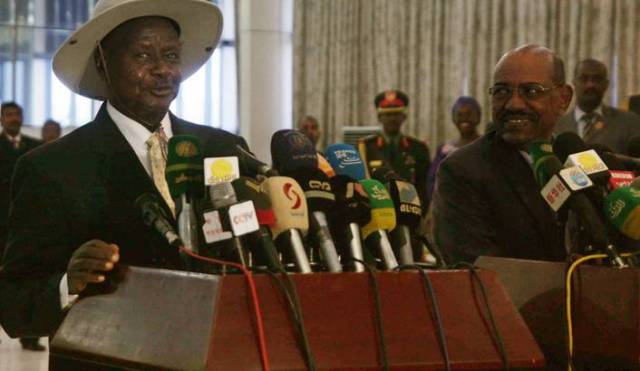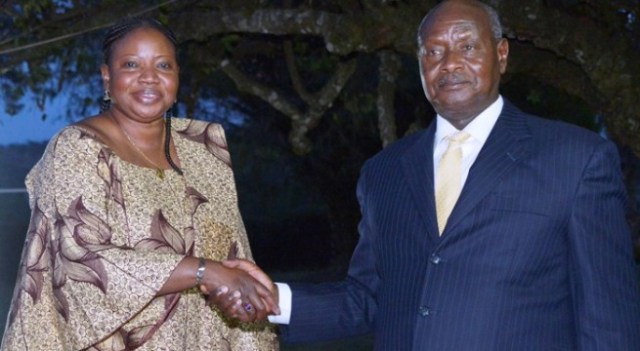
ICC Chief Prosecutor Fatou Bensouda with Ugandan President Yoweri Museveni during a meeting in 2015 (Photo: Daily Post)
The Office of the Prosecutor and the Government of Uganda have always had a close, if at times strained and uncomfortable, relationship. There is little love lost between senior officials but they have been awkward bedfellows for fifteen years. Early on in the ICC’s existence, Court officials and the Government of President Yoweri Museveni engaged in close negotiations with the aim of providing the ICC with jurisdiction to target senior commanders of the Lord’s Resistance Army (LRA). In 2003, then-Chief Prosecutor Luis Moreno-Ocampo infamously held a joint-press conference with Museveni in London to announce that Uganda had referred the LRA to the ICC (later amended to “the situation in northern Uganda” because referring the LRA alone was legally bonkers, even if it more closely reflected reality). For critics and proponents of the ICC alike, this signaled Moreno-Ocampo’s intention to target the LRA and only the LRA. His appearance with Museveni, a staggering demonstration of bias towards the government and its military forces, was no accident; Moreno-Ocampo was not oblivious to the implications of buddying up with the Ugandan leader.
Fast-forward ten years, and the ICC has still not investigated, and is increasingly unlikely to investigate, alleged crimes perpetrated by the Government and the Uganda People’s Defence Force (UPDF). Originally, Moreno-Ocampo insisted that LRA atrocities were of such greater “gravity” compared to alleged UPDF crimes that investigators had to start with the LRA. Perhaps for this reason, William Schabas has written that “[t]he gravity language strikes the observer as little more than obfuscation, a laboured attempt to make the determinations look more judicial than they really are… to take a political decision while making it look judicial.”
In the end, skeptics were right: the ICC has not investigated any crimes by the Government or the UPDF. The bigger question is: why?
One possible answer is that the Government did not commit any crimes under the jurisdiction of the ICC — i.e war crimes or crimes against humanity — in northern Uganda. A recent statement by Mochochoko Phakiso, head of the Jurisdiction, Complementarity and Cooperation Division in the ICC’s Office of the Prosecutor, suggests that investigators simply don’t have the evidence to go after the UPDF: “It’s false propaganda that the ICC is only after the LRA. We have not received any evidence against the UPDF.” Setting aside the rather insulting insinuation that many, perhaps even the majority, of northern Ugandans spread and believe in “false propaganda”, could this be true? It is desperately hard to believe.
For anyone who has traveled to northern Uganda and spoken to the people there, it is impossible not to be told of UPDF and government crimes. Even those who believe that the ICC’s prosecutions of senior LRA rebels are appropriate also insist that the ICC should likewise prosecute members of the government and UPDF who committed unspeakable crimes. The fact that the UPDF has been let off the hook is confusing to many. This anecdotal evidence of UPDF crimes is supported by heaps of substantive evidence and research. The following excerpt from my forthcoming book* is but a small snippet of the troves of documents and evidence of the Governments crimes:
A crucial but oft-neglected cause of the war was the response and behaviour the NRM/A (later the UPDF) in northern Uganda and, in particular, its direct responsibility for mass human rights violations and its unwillingness to provide protection for civilians from LRA violence. Human Rights Watch (2003a; 2003b, 19-21; 2005) has catalogued cases of torture, murder, rape by government soldiers and even the recruitment of child soldiers into government forces – the same allegations levied against the LRA. At the same time, the Government of Uganda (GoU) seemed uninterested in defeating the rebels or providing adequate protection for civilians. As Adam Branch (2010b, 38) writes, “the NRA has generally abandoned the population to rebel violence letting it continue as a kind of collective punishment by proxy”. The result was that the people of northern Uganda were trapped as victims of violence perpetrated by the rebels and the violence perpetrated by the GoU. They were “caught between the fire and the frying pan: a hostile army of occupation and a ‘terrorist’ rebel group.” (Mwenda 2010, 55).
UPDF violence was, however, not only direct. In response to the rebellion, the GoU propagated and imposed a system of structural violence on the people of northern Uganda. As violence in northern Uganda spread and intensified in the 1990s, the Government began to herd civilians into IDP camps, a process that began in late 1996 (Dolan 2009, 46). By 2002, 800,000 civilians had been displaced. Some civilians chose to relocate to the camps but many others were coerced into doing so. In 2002, for example, the UPDF ordered all citizens from the districts of Kitgum, Pader and Gulu to relocate to the IDP camps. Refusing to do so meant being identified as a rebel collaborator and being targeted by the UPDF (see Rodriguez 2009, 102). Chris Dolan (2009) captures the dynamic of northern Ugandan civilians stuck in the cross-fire of the LRA and GoU in his book, Social Torture. Dolan persuasively argues that the war is “a form of mass torture, whose principal victims are the population within the ‘war zone’, and whose ultimate function is the subordinate inclusion of the population in northern Uganda.” The primary locus of ‘social torture’ was the IDP camps, named “protection villages” by the GoU, although more akin to “concentration camps” according to Rodriguez (2009, 104), Branch (2007a, 181) and Mwenda (2010, 55). In these camps, Dolan (2009, 1) finds the symptoms and tactics of mass torture: “widespread violation, dread, disorientation, dependency, debilitation and humiliation”. Finnstrom (2008, 133) makes a similar argument suggesting that the IDP camps constituted a form of structural violence against the people of northern Uganda, wherein “cultural and social agency diminish as the logic of domination and violence enter the most private spheres of everyday life.” Human rights groups have tended to agree. One report, prepared for United Nations Office for the Coordination of Humanitarian Affairs (UNOCHA), concluded that “the overall picture is one of severe destitution” (Weeks 2002, 5; see also Dolan 2009, 221) and, moreover, while direct violations of rights were commonplace, the camps’ “most damaging achievement of all has been to inflict economic and social paralysis on an entire society, which has thereby been reduced to destitution and dependency.” (Weeks 2002, 4). Some suggest that upwards of 1,000 people died per week, not from rebel attacks but as a result of the squalid conditions within the camps themselves (Mwenda 2010, 56; see also The Republic of Uganda Ministry of Health 2005). This represented a death toll that far exceeded what the rebels did or could achieve (Mwenda 2010, 56).
GoU violence against civilians was also direct. UPDF soldiers, sometimes disguised as LRA commanders, regularly abused civilians. And while some officers were held to account, this typically only occurred when cases received attention from notable citizens (Dolan 2009, 147). The camps appeared to be a tactical strategy wrapped in a ruse: the ‘good’ Government as a protector of civilians against the ‘evil’ LRA. “For from the day they were initiated in the name of protecting the civilian population, these villages instead became sites of their abuse… In fact, the ‘protected villages’ violated all major categories of rights, and just about all the UN’s ‘Guiding Principles on International Displacement’.” (Ibid. 151).
The UPDF forced civilians into the IDP camps not, as the title “protection villages” would suggest, for their ultimate benefit, but as part of its broader military strategy. In the midst of ongoing suspicions that the Acholi people were rebel sympathizers and collaborators, the use of camps to dominate and control northern Ugandans was a useful arrangement for the UPDF (Finnstrom 2008. 141-144). Eichstaedt (2009, 260) describes the government’s approach as “calculated neglect” which “allowed Kony and his rebels to wage a bloody and inhumane war against his own people and then abused these same people it claimed to protect.” (see also Branch 2011, 90-118). Finnstrom (2008, 158) adds that foreign humanitarian aid agencies have been complicit in this process “as a parallel partner to the army”. The forced encampment has since been followed with forced resettlement. The process of forced resettlement, however, “has also been enforced domination and an effort to control the population”, with the GoU “imposing its rule by regulating everyday life” (Finnstrom 2008, 145).
This barely scratches the surface of allegations against the Government and UPDF. Yet there is, in fact, no evidence that the ICC has ever conducted an effective or thorough investigation of UPDF crimes. And if they have, Phakiso may actually be right: investigators have not “received any evidence against the UPDF.” The real question is: how often and strenuously have they asked for such evidence — and from whom? And what explains such recalcitrance to investigate UPDF and government crimes? Continue reading →