
Continuing our symposium on the trial of Dominic Ongwen and the prosecution of child soldiers, Adam Branch joins JiC for this piece on how the Ongwen trial fits within the dominant narratives of the war. Adam is a Lecturer in the Department of Politics and International Studies at the University of Cambridge. He is author of Displacing Human Rights: War and Intervention in Northern Uganda (Oxford, 2011) and Africa Uprising: Popular Protest and Political Change (Zed, 2015; co-authored with Zachariah Mampilly). From 2011-2014, he was Senior Research Fellow at the Makerere Institute of Social Research in Kampala, Uganda.
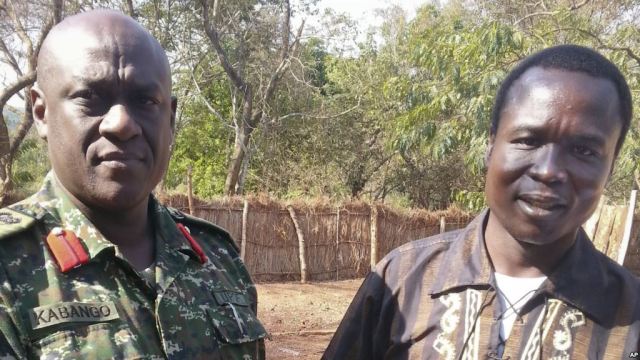
Col Michael Kabango of the UPDF stands with Dominic Ongwen shortly after coming into Ugandan custody (Photo: AP)
Every international criminal trial is a contest between competing narratives constructed by the prosecution and the defense, between contrasting histories and the moral and political judgments made of the actors in those histories.
The Ongwen trial, of course, has received notoriety because of an inescapable tension that has produced precisely such contrasting narratives: Ongwen’s status as a so-called “victim-perpetrator.” The defense, in an effort to absolve Ongwen of the very possibility of criminal responsibility, has focused on the first part of the dichotomy, while the prosecution, fearful of having the ground swept out from under the trial of anyone who could be cast, even in part, as a victim, has emphasized the second.
Here, I turn to another pair of contrasting narratives espoused by the prosecution and defense: their divergent portrayals of the violence used during the war. These narratives can illuminate unexpected possibilities for justice arising from the trial, I believe, irrespective of what the final decision is concerning Ongwen’s guilt or innocence.
When the ICC first got involved in northern Uganda in the mid-2000s, there was already a firmly established discourse on the conflict. According to this dominant narrative, the LRA was, in a word, ‘‘bizarre,’’ and LRA violence defied understanding. LRA motivations were summed up in the endlessly iterated declaration that the rebels had “no clear political agenda but want the country governed in accordance with the Ten Commandments.” The Ugandan government, for its part, was portrayed as waging a desperate struggle against the LRA in a well-intentioned, though short-handed, effort to protect civilians. And so the government’s violent counterinsurgency was cast unambiguously as humanitarian and rational, the LRA’s violence as inhuman and beyond comprehension.
This narrative of an evil LRA and a good Ugandan government was instrumental to the massive regime of Western intervention into the conflict. It also suited the Ugandan government fine: being a favorite of foreign donors and an enthusiastic participant in the US War on Terror, Uganda used the narrative of a terrorist LRA without a political agenda as an excuse for refusing peace talks, for securing Western support, and for pursuing an endless “military solution” without regard for the civilian consequences. The narrative even allowed the government to forcibly displace the entire civilian population of Acholiland – over a million people – into horrific internment camps, which led to a massive humanitarian crisis. Uganda’s Western donors, instead of denouncing these acts as war crimes, were complicit with them as they managed the camps on behalf of the government.
When the ICC intervened over ten years ago, it made its move on the back of this narrative. The Ugandan government effectively became a partner in the investigation against the LRA instead of being itself a target of investigation for possible crimes. Meanwhile, the LRA was denounced as a “criminal organization” with no political agenda by then Chief Prosecutor Luis Moreno-Ocampo.
At Ongwen’s confirmation of charges hearing in January, however, the Prosecution’s story had changed. The Prosecution had reversed its portrayal of the LRA and now insisted categorically that the LRA always had a clear political agenda, a firm organization and hierarchy, and a strategic rationality to its violence. In the words of prosecutor Benjamin Gumpert, the LRA “aimed to overthrow the government of Yoweri Museveni, the President of Uganda, then as now.” No mention was made, as it had been a decade earlier, of the Ten Commandments or Kony’s spirits. Instead, because the prosecution is seeking to convict Ongwen under the doctrine of command responsibility, because war crimes require a real war and not irrational violence, and because crimes against humanity need to be “part of a widespread or systematic attack,” the prosecution has had to turn the LRA into a regular rebel group with a regular political agenda. Continue reading

 Justice in Conflict
