Both Israel and Hamas have a Responsibility to Protect Civilians

This is the sixth and final post in our symposium on Palestine, Israel and the Responsibility to Protect. The other contributions can be found here, here, herehere, and here. Simon Adams is the Executive Director of the Global Centre for the Responsibility to Protect.

R2P Israel Palestine Gaza

(Photo: Amir Farshad Ebrahimi / Creative Commons)

There is arguably no conflict in the world as politically polarising as the one between Israel and Palestine. While the conflict has been on the agenda of the United Nations since at least 1947, it wasn’t until 2005, at the UN World Summit – the largest assembly of heads of state and government ever convened – that the “Responsibility to Protect” (R2P) was unanimously adopted as a means of protecting people from four mass atrocity crimes – genocide, crimes against humanity, war crimes and ethnic cleansing. The current crisis in Gaza has posed difficult and proximate questions for some of R2P’s advocates, raising awkward issues regarding selectivity, sovereignty and responsibility in Israel and the Palestinian Territories.

At the heart of R2P is a global commitment to protect people, regardless of ethnicity, religion or statehood (or lack thereof), from crimes that offend and diminish us all as human beings. This means, as UN Secretary-General Ban Ki-Moon insists, that the Responsibility to Protect applies everywhere and at all times. That includes Israel and Gaza.

But there is also a requirement for political and legal precision. As the Gaza crisis escalated in mid-July, the Global Centre for the Responsibility to Protect began closely monitoring the situation and assessing whether the human rights abuses being perpetrated had elevated to the level of mass atrocity crimes. When we released a public statement on Thursday 17 July, right as the temporary five-hour “humanitarian ceasefire” ended in Gaza and armed hostilities between Israel and Hamas resumed, we argued that attacks on civilians and civilian property in Gaza and Israel violate international humanitarian law and may constitute war crimes.

The distinction between military and civilian targets is central to international humanitarian law and must be adhered to regardless of where a conflict is occurring, or whom it is occurring between. With ongoing rocket attacks on Israel and unrelenting retaliatory airstrikes in densely populated parts of Gaza, both Hamas and the Israeli government appeared to be potentially violating the fundamental laws of war.

At the time of our statement, Palestinian armed groups operating in Gaza had launched more than a thousand rockets into Israel, with most aimed towards residential areas. These rocket attacks were indiscriminate and fired with the deliberate intention of killing or wounding civilians and destroying civilian infrastructure. As such they were war crimes, despite the fact that the inaccuracy of the rockets and the effectiveness of the Israeli “Iron Dome” defence system had kept Israeli civilian fatalities to a minimum. Responsibility for the rockets lay with Hamas, which is clearly the controlling authority in Gaza and is culpable for the attacks.

In our statement we also addressed the issue of Israel’s ongoing military operations in Gaza and the grave consequences for Palestinians living there:
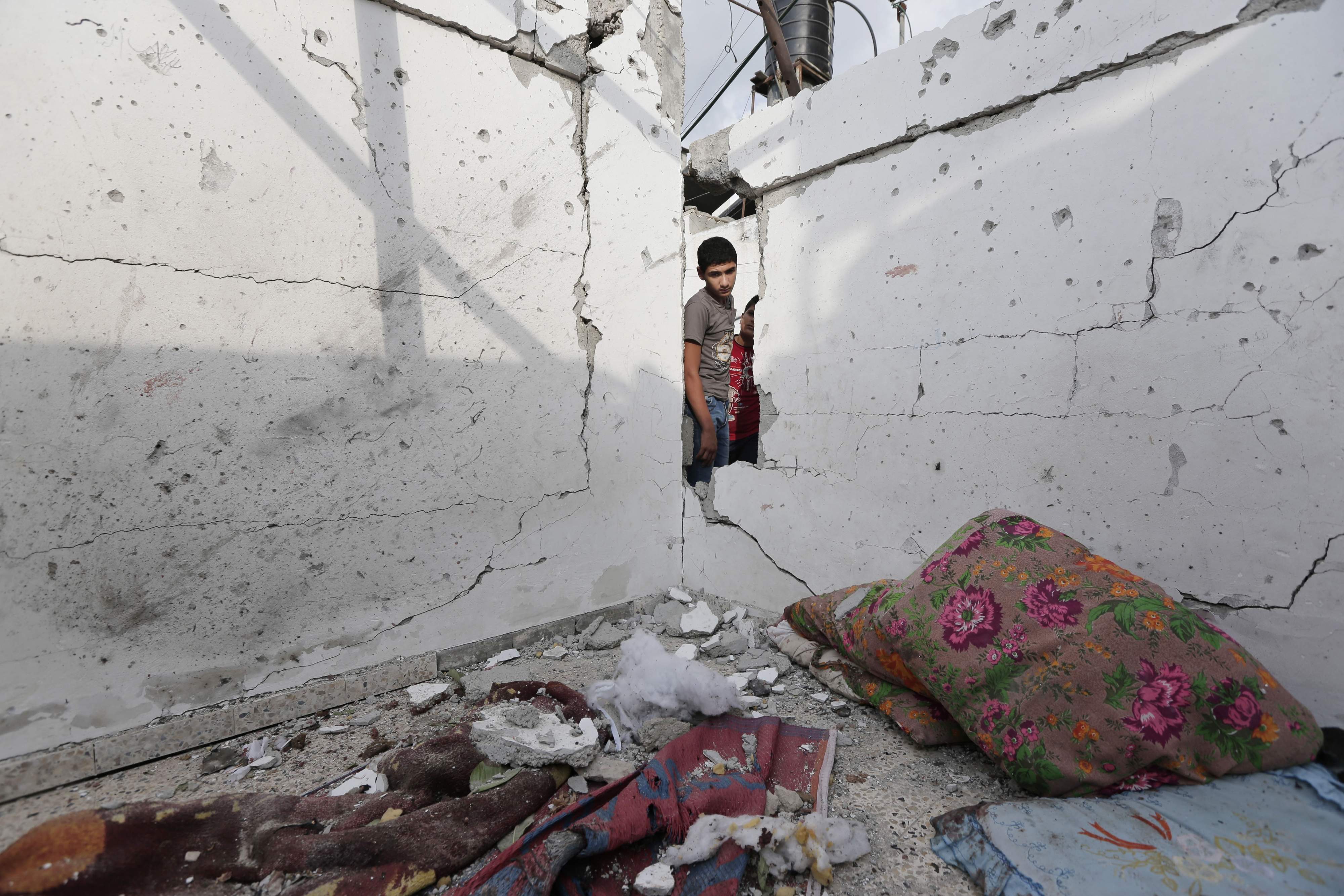
“In declared retaliation for these rocket attacks the Israeli Defense Forces (IDF) appear to have imposed collective punishment upon the people of Gaza, with more than a week of sustained airstrikes killing at least 160 civilians and wounding 1,500 people. At least 44 children have been killed and more than 430 injured. More than 1,600 homes have been destroyed and 79 schools damaged. The UN estimates at least 22,600 Palestinian civilians are now sheltering in UN facilities in Gaza.”

Israel’s response to the rocket attacks appeared to be unlawful and was clearly inflicting extreme hardship and death upon Palestinian civilians. While Israel had a right to defend itself against rockets raining down upon its cities, issues of proportionality and distinction (discriminating between civilian and military targets), appeared to have been repeatedly violated by the IDF. Although Hamas and its allies were using some civilian structures to hide rockets and launch attacks, international law still required that the IDF strike at Hamas and other Palestinian armed groups in a way that intentionally minimised the loss of civilian life. Israel insisted that it was exercising due care, but the mounting civilian death toll, including the sickening deaths of four boys innocently playing soccer on a Gaza beach, seemed to indicate recklessness rather than precaution and precision. Continue reading

Posted in Israel, Palestine, Palestine and R2P Symposium, Responsibiltiy to Protect (R2P) | Tagged , , | 1 Comment

R2P Isn’t a Useful Framework for Gaza – Or Anything

This is the fifth part in our symposium on Israel, Palestine and the Responsibility to Protect. The other contributions can be found hereherehere, and hereDavid Rieff is a writer and journalist. He has authored dozens of articles and is the author of many books, including A Bed for the Night: Humanitarianism in Crisis (2003), Against Remembrance (2011) and The Reproach of Hunger (Forthcoming 2015). 

Israel Palestine R2P

An Israeli soldier and a reporter take cover from rocket fire in Sderot in 2008 (Photo: Amir Farshad Ebrahimi / Creative Commons)

It is important distinguish between two questions posed in this online symposium, the first being whether R2P is applicable to the war now going on in Gaza and the second being whether looking at the conflict through the lens of R2P is helpful or counter-productive?

There is simply no absolutely clear-cut answer to the ‘applicability’ question. R2P only applies to intra-state wars. However, as Gaza is part of the internationally-recognized State of Palestine, the conflict between Israel and Hamas is formally an inter-state conflict. On the other hand, since apart from the commerce that takes place through the smugglers’ tunnels under the Rafah border crossing with Egypt, Gaza is wholly cut off from the outside world as demanded by Israel. The Israeli government controls movement in and out by land, sea, and air, making the citizens of Gaza wholly dependent either on Israel directly or on essential goods and services trans-shipped through the Jewish State. A strong case can thus be made that Israel remains the de facto occupying power, even if it has no longer been the de jure one since it closed its military bases, dismantled its settlements, and ceased its participation in the joint Israeli-Palestinian Erez Industrial Zone in September, 2005.

Assuming R2P does apply, or at least could be applied without traducing the spirit of the 2005 World Summit Outcome Document, is that the same thing as saying that R2P is a helpful of way not just of framing the conflict but of trying to think through at least how to halt the atrocities and war crimes now being committed against civilians, mainly by Israel but by Hamas as well, or at least lessen their toll as the fighting continues? It is worth remembering that R2P was explicitly referred to in 2011 in United Nations Security Council Resolution 1970, which, along with a successor resolution (UNSC 1973) set the stage for the UN-authorized NATO intervention in Libya. While it may have begun as an ‘R2P compliant’ effort to protect civilians, NATO’s intervention in Libya soon became an exercise in regime change. All roads to hell are indeed paved with good intentions, but the particular road named R2P has already proven to be especially and opulently well paved with them!

Whatever the intentions, though, even assuming that R2P applies to the latest round of fighting in Gaza, the disadvantages of viewing events in Gaza through its prism should be obvious. It should be clear from the Israeli government’s dismissive responses to criticisms of the way it has conducted its assault in Gaza from the UN and from relief, development, and human rights NGOs, that the various non-military international responses and sanctions available under R2P would have no effect, even assuming the major EU governments would be prepared to join in them – which they most decidedly are not. As for the military response permitted under R2P, it could not fulfill the so-called reasonable prospect of success criterion that is one of the six threshold questions that all must be answered in the affirmative in order to justify a coercive intervention. Israel, lest it be forgotten, is a nuclear power. In any case, the question is purely academic since an armed intervention under R2P requires a UN Security Council resolution, which, in the infinitesimal chance that such a resolution were ever allowed to be put on the table would, without the slightest question or doubt, be vetoed by the United States.

To be sure, an advocate of invoking R2P with regard to what is now taking place in Gaza might argue that if its practical utility is nil, using it as a moral and legal frame for the conflict has a certain rhetorical value. But this seems quite far-fetched to me. Given the profusion of available images of what is going on in Gaza, many of which continue to appear on social media in real time, those who believe that Israel is committing mass atrocity crimes in Gaza have no need whatsoever of R2P to buttress their case. And it is hardly as if the relevant UN specialized agencies, most importantly UNRWA and the Office of the High Commissioner for Human Rights, but a number of others as well, or mainstream relief, development, and human rights NGOs need R2P in order to find the courage to denounce what is taking place. To the contrary, if there was a correlation between denunciation of war crimes and their cessation, the war would have been over days – or perhaps even years – ago. Continue reading

Posted in Israel, Palestine, Palestine and R2P Symposium, Responsibiltiy to Protect (R2P) | Tagged , , | 4 Comments

Gaza and Israel – A Case for International Humanitarian Law, Not R2P

This is the fourth contribution in our symposium on Palestine, Israel and the Responsibility to Protect. The first three can be found here, here and hereJames P. Rudolph is an attorney in Washington, D.C. and California where his work focuses on international law. He is a regular contributor to JiC. 

(Photo: IDF / Creative Commons 2.0)

(Photo: IDF / Creative Commons 2.0)

The Responsibility to Protect (R2P) initially appeared in the Report of the International Commission on Intervention and State Sovereignty. The goal was, and remains, the reconciliation of the traditional concept of sovereignty, which involves exclusive control and supremacy over a defined territory, and the more modern notion that the sovereignty of a state includes the primary responsibility to protect its own people.

This notion of sovereignty has, by and large, been adopted by the international community, and is now enshrined in the so-called “three pillars” of R2P. First, the State carries the primary responsibility for protecting populations from genocide, war crimes, crimes against humanity and ethnic cleansing; second, the international community has a responsibility to encourage and assist States in fulfilling this responsibility; and finally, the international community has a responsibility to use appropriate diplomatic, humanitarian and other means to protect populations from these crimes. If a State is manifestly failing to protect its populations, the international community must be prepared to take collective action in accordance with the Charter of the United Nations.

With respect to the ongoing conflict in Israel and Gaza and applying the first pillar, the issue is whether any of this is dispositive. Are we, in other words, witnessing genocide, war crimes, crimes against humanity or ethnic cleansing? If we are not, R2P does not apply. Notwithstanding comments from Turkish Prime Minister Recep Erdogan that Israel is “committing genocide”, most people would likely conclude that Israel is not engaged in any kind of genocidal behavior. In the same vein, it appears doubtful that anybody would seriously claim that ethnic cleansing is occurring. Thus, the question is whether Israel is (or has) engaged in war crimes or crimes against humanity, the two remaining crimes recognised under the R2P rubric.

A crime against humanity requires that certain acts — murder, enslavement, deportation, imprisonment, torture, rape — must be directed against a civilian population, and that they be part of a widespread or systematic attack.  Widespread means massive, large-scale action, whereas systematic means part of a preconceived policy. Israel’s response to the rockets from Gaza certainly has had consequences for Palestinian civilians, many of whom have been children. But none of these acts are occurring in Israel itself (if, indeed, they are occurring at all). R2P means that Israel has a responsibility to protect its own population from crimes against humanity. We are thus left with war crimes.

There may be a convincing argument that Israel’s self-defense has become excessive, and this would have ramifications under the laws of war (Geneva Conventions and customary international law). But, if anything, this is being directed at Hamas and Gaza.  Stated differently, neither Israel nor Gaza is engaging in excessive force against its own population, so R2P, while an attractive prism through which to view the conflict, seems not to apply.

With respect to pillar two, moreover, the international community has been assisting both Israel and the Palestinians to fulfill their obligations under R2P,as evidenced by the recent Egyptian-sponsored cease-fire that was rejected by Hamas. Interestingly, this assistance has included diplomatic, humanitarian and other means to protect populations from these crimes. Accordingly, the use of force, which is contemplated under pillar three, is altogether inappropriate at this juncture, as it is to be used as a last resort after the state has manifestly failed to protect its own population. This is all to say that R2P has not, and likely will not, be triggered by this recent conflict.

Who has the responsibility to protect civilians in this ongoing war?

Civilians are, of course, protected by R2P. Indeed, the raison d’être of R2P is the protection of civilians. But, as noted above, R2P probably does not apply to the current conflict in Israel and Gaza. This is not to say, however, that civilians are devoid of any protection. International humanitarian law, the purpose of which is the protection of those who do not or cannot take part in armed hostilities, is considered the human rights component of the law of war, and it is codified in the four Geneva Conventions of 1949 and the two 1977 Protocols Additional to these treaties. (These conventions are also considered customary international law). The Fourth Geneva Convention, to which Israel is a party, deals with the protection of civilians during war.  In each of the four Geneva Conventions, the High Contracting Parties assume a large number of obligations for the benefit of the protected persons. Article 33 of the Fourth Geneva Convention, for example, outlaws collective punishment, defined as mass punishment without an individual assessment of guilt. The Fourth Geneva Convention also imposes on signatories various due process requirements for trials and sentencing.  Furthermore, the Geneva Conventions provide for a system of supervision administered by the so-called Protecting Powers, which, by and large, means the International Committee of the Red Cross. Continue reading

Posted in Israel, Palestine, Palestine and R2P Symposium, Responsibiltiy to Protect (R2P) | Tagged , , | 4 Comments

In Palestine, R2P Isn’t Dead. It Could Never Have Existed.

This is the third post in our symposium on Palestine, Israel and the Responsibility to Protect (the others can be found here, here and here). Michael Kearney is a Lecturer in Law at the University of Sussex and has written extensively on Palestine and the International Criminal Court.

(Photo: AP / Creative Commons)

(Photo: AP / Creative Commons)

My response to students’ queries on the matter of Responsibility to Protect (R2P) has generally been that the whole narrative is a bit of a distraction: R2P merely repackages a principle that already existed, namely that states have a moral – and kind of legal – obligation to act in the face of genocide and widespread human rights abuses. The ultimate sanction against a state engaged in such abuses, the use of armed force in order to protect civilians at risk, is on the R2P table, but remains subject to Security Council approval. So, R2P gives us a significant statement of intent and principle on behalf of the international community, but means very little in practice and cannot be considered as having changed international law.

As a student when R2P became a hot topic, around 2003/4, most activists were focused on Palestine and Iraq, which we saw as major human rights issues. R2P, though clearly important, was generally perceived by us as a diversion from the immediate concerns. A non-confrontational, inherently establishment and liberal- friendly north American, ‘lets make the world nice’, kind of movement, not unlike the weird ‘Stop Kony’ fad of several years later. Rather than try and fight abuses by holding power to account, R2P proponents developed a safe ‘protest’ type discourse-conversation with neo-liberal governments, essentially limited to asking them to sort out the bad guys.

We are now asking why R2P isn’t being applied to Palestine today. In reality, it never was –not at its inception and not since. The second (al Aqsa) Palestinian intifada against Israeli occupation began in September 2000, while the original International Commission on Intervention and State Sovereignty (ICISS) report on R2P was published in December of that year. Throughout the second intifada, the invasion of Afghanistan and the invasion of Iraq, R2P supporters had nothing of consequence to say about any of this. Their enthusiasm and focus was squarely on Darfur, sometimes stretching to Burma and Zimbabwe. Those were, in keeping with the R2P paradigm, the classic bad guys. Those places were seen to have no veneer or hint of liberal democracy, unlike, for example, ‘very democratic Israel’.

I have done a search for ‘Palestine’ through the journal Global Responsibility to Protect. Only having access to issues from 2012, but Vols 1-3, 2009-11, I found a total of four mentions of ‘Palestine’ in ‘the premier journal for the study and practice of the responsibility to protect (R2P)’.

Forgive the speculative generalisation, but this capacity to not see certain massacres, while thinking that R2P could halt others, might be traced to a particular north American style liberalism, not entirely feasible in the culture on this side of the Atlantic. Such an approach can be seen in this statement made by Michael Ignatieff, academic and former leader of the Liberal Party in Canada, in which he frames the possibility and imagination of activism as so: ‘The best human rights activists can ever hope for is to keep democratic regimes honest and to shame undemocratic ones into being less brutal’.

Can political activists or legal scholars, reluctant to see the world in terms of a democratic/non-democratic binary, and who seek to further justice and human rights, think and imagine a little more broadly than this? One might suggest that the aims and purposes of the Boycott, Divestment, and Sanctions (BDS) movement against Israeli institutions allied to the occupation, actually chime nicely with the R2P narrative, i.e. placing sanctions on a state perpetrating widespread human rights abuses until such time as it lives up to its obligations under international law. It could then be that the function of R2P as per Palestine has operated for many years, and vigorously so, except under the grassroots BDS banner. This movement is distinguished from the formal, academic R2P set, insofar as it is aligned against power and the western liberal states, as well as against university managers and administrators, rather than being reliant on them1.

To speak of R2P as applying to Palestinians at all, one must accept that there is a need to protect a vulnerable population against genocide, war crimes, ethnic cleansing, or crimes against humanity. Many people and institutions, such as Canada, refuse to acknowledge that ethnic cleansing, apartheid, war crimes, or crimes against humanity are being, or could be, perpetrated by Israel. Continue reading

Posted in Israel, Palestine, Palestine and R2P Symposium, Responsibiltiy to Protect (R2P) | Tagged , , | 2 Comments

The Israeli-Gaza Crisis and the Responsibility to Protect: Does the Norm Apply?

This is the second post in our symposium on Israel, Palestine and the Responsibility to Protect. Other contributions can be found herehere and hereMegan Schmidt is a Senior Program Officer at the International Coalition for the Responsibility to Protect

(Photo: Al Jazeera English / Creative Commons)

(Photo: Al Jazeera English / Creative Commons)

The present conflict in Gaza between Israel and Hamas has revived the complex debate on the applicability of the Responsibility to Protect (R2P) to this crisis. The central questions that make the norm’s relevance murky are: What is the status of Gaza? What entities have governing authority over and responsibility for the people of Gaza? And what does said governing mean in practice?

Such questions are important because R2P is first and foremost a political commitment and obligation of states to protect their own populations. The issue of governing authority over Gaza is one of great complexity with arguments to support views on all sides, showing the many grey areas that exist. This article in no way attempts to make a clear determination on the status of the territory or who holds governing authority, but rather seeks to present if and how R2P could or could not apply to the present crisis based on the stance one takes over Gaza’s status. Still, R2P’s applicability in this crisis, or any situation for that matter, does not trump the legal obligations parties already have, including those under international humanitarian law (IHL) and customary international law. Rather, R2P’s application could provide an additional framework for understanding the crisis, as well as an additional tool for advocacy by actors seeking to prioritise civilian protection.

What does the Responsibility to Protect entail and who has this obligation?

In the 2005 UN World Summit Outcome Document, heads of state and governments made a historic commitment to protect their populations from genocide, war crimes, crimes against humanity, and ethnic cleansing. In addition to the primary responsibility of the state to prevent these crimes, including their incitement, R2P places an obligation on the international community to assist states in building their capacity for prevention. Should a state be unable or unwilling to protect their populations, or is in fact perpetrating the crimes itself, the international community has a responsibility to take timely and decisive action using a range of non-coercive and coercive measures, including force (as a last resort and only when authorised by the United Nations Security Council).

As the UN Secretary-General has stated, the emerging norm is narrow but deep – narrow in its limited scope to the four crimes and violations, but deep in the tools available for prevention and response. While not legally binding itself, R2P is grounded in existing legal doctrine and normative frameworks, with its added value resting in the re-framing of state sovereignty as not solely entailing the rights of the state but also its obligations to protect its people.

A last point critical in setting the stage for the discussion on Gaza and R2P is the norm’s relationship with international humanitarian law (IHL) – or the law of war. Rooted in international treaties and conventions, IHL sets out the legal obligations to parties in an armed conflict regardless of if that conflict is between states or happening internally, with violations of IHL amounting to war crimes. Such obligations are to protect civilians, as well as prisoners of war, the wounded or sick, and medical and religious personnel, among others. In addition to the protection of civilians, IHL sets out legal obligations to protect objects and infrastructure, including hospitals, cultural property, and ambulances. It also articulates the illegality of targeting infrastructure for the survival of the civilian population, such as water supplies. While mass atrocity crimes frequently occur during conflict, there are distinct differences with regards to scope and applicability of IHL and R2P. As stated earlier, the norm’s focus is restricted solely to the four crimes and violations and such atrocities can be committed in and outside of conflict, with IHL not applying to the latter. Additionally, while R2P includes war crimes as one of the four crimes and violations from which states are obligated to protect their populations, such crimes within the norm’s scope are limited to those directed against civilian populations and committed in a widespread and systematic manner. As such, crises will arise where IHL and R2P will both be applicable, but there will also be those in which R2P will not be relevant due to the nature of the conflict. This brings us to the question of the present crisis in Gaza.

The Question of Gaza’s status and R2P

Central to understanding R2P’s applicability in this present crisis is the question of Gaza’s standing as either an occupied or independent entity. This is in no way a clear-cut issue, and not one that this article seeks to determine. But what can be assessed is how the norm of the Responsibility to Protect could apply if one were to view the territory as occupied or not. A recent analysis by the International Coalition for the Responsibility to Protect reflects on the question of status and what this would mean for the obligations of parties involved.

To start, let us explore the argument of if Gaza were not considered an occupied territory. This position stems from the fact that, in 2005, Israel undertook a disengagement plan in which, some would argue, the state relinquished its occupation of Gaza. The territory was then seized by Hamas, which declared its authority as the governing entity. If one were to view Hamas as the governing authority, then under R2P, Hamas would have the obligation to protect its populations within its borders from the commission of the four crimes and violations, a responsibility that would also exist for Israel with regards to its populations residing within its territory. Such obligations would not, however, carry over into an inter-state crisis. As the ICRtoP states:

While both governing bodies would have the obligation under the Responsibility to Protect to prevent the commission of atrocity crimes within their borders, RtoP would not be applicable for the protection of civilians across borders in the crisis. IHL and the protection of civilians framework would be applicable in this context, legally obligating all parties to the conflict to ensure that civilians are not indiscriminately targeted or impacted.

Those obligations under IHL and customary law would place a range of legal restrictions on the actions of all parties to the conflict and include protections for populations from atrocity crimes, as well as from other violations. Continue reading

Posted in International Law, Israel, Palestine, Responsibiltiy to Protect (R2P) | Tagged , , | 2 Comments

Is Gaza in Israel? R2P and Inter-State Crises

This is the first post in our symposium on Israel, Palestine and the Responsibility to Protect. Other contributions can be found herehere and here.  Aidan Hehir is a Reader in International Relations at the University of Westminster and the author of The Responsibility to Protect: Rhetoric, Reality and the Future of Humanitarian Intervention. 

(Photo: UPI / Debbie Hill / Creative Commons)

(Photo: UPI / Debbie Hill / Creative Commons)

It is often noted that in times of war laws fall silent. But NGOs rarely do. When crises erupt – – or appear on the horizon – NGOs invariably take to conventional and, increasingly, social media to appeal for calm and/or highlight the suffering of innocents. On 15 July, I published a short article on E-IR in which I noted that the Global Centre for R2P (GCR2P), the International Coalition for RtoP (ICRtoP) and the Asia Pacific Centre for R2P (APCR2P) had afforded the crisis in Gaza negligible coverage since Israel’s “Operation Protective Edge” began a week earlier on the 8th of July. Collectively, the three organisations had only published two tweets during this period (both came from the ICRtoP and neither directly addressed key issues pertaining to the application of R2P). This was, I suggested, incongruous considering the huge international media attention and the shocking number of fatalities, injuries and displaced persons, but also because, during this seven-day period, the three organisations had highlighted numerous situations, many of which – such as class discrimination in Mexico – were very evidently of far less gravity.

In response to my article, the ICRtoP tweeted, “We are working on a Listserv highlighting situation in Gaza – stay tuned later this week”. The GCR2P likewise tweeted, “We have been monitoring the situation closely. A statement is forthcoming”. On the 17th both the ICRtoP and the GCR2P finally published statements. To date, the APCR2P has not replied to the article or issued a statement.

During the course of a Twitter exchange amongst R2P scholars and observers in the wake of my article, the question of R2P’s applicability was raised. Kyle Matthews of the Will to Intervene Project asked whether “the weakness of R2P is that it applies to atrocities committed within a state’s borders. Is Gaza in Israel?”. Obviously, “is Gaza in Israel?” is a contentious question; Gaza is within the “State of Palestine” which is recognised by 134 UN member states and thus a very plausible answer could well be “no”. The statement issued by ICRtoP indeed stated that if Gaza is not considered to be part of Israel “RtoP would not be applicable for the protection of civilians across borders in the crisis”. Thus, could there then be logic to the idea that R2P does not apply to the crisis in Gaza because it is an inter-state conflict, hence the lack of coverage from R2P groups? In my opinion this is not a convincing argument.

First, it is disingenuous to advance this legalistic argument in the context of a crisis that very obviously constitutes a situation of grave humanitarian concern. Can organisations established to promote a concept dedicated to the protection of civilians and the promotion of respect for human rights credibly avoid engaging with a crisis on a narrow technical interpretation of R2P’s remit? Indeed, in the past, these organisations have commentated on inter-state crises; for example, on March 31, the ICRtoP issued a statement on the Russian intervention in Crimea.

A second point to note is that Israel does not recognise the State of Palestine. Thus, this is not an unambiguous case of inter-state conflict. The ambiguity surrounding the status of the State of Palestine could be used – if there was sufficient will – to overcome the “R2P does not apply to inter-state crises” argument. The issue could, of course, be disputed by international lawyers and brings up myriad issues related to recognition, legitimate authority, de jure and de facto sovereignty, but the key point is that there is sufficient grounds for any R2P-orientated group to make a case for their right to, at least, discuss the crisis. Continue reading

Posted in International Law, Israel, Palestine, Responsibiltiy to Protect (R2P) | Tagged , , | 2 Comments

Palestine, Israel and R2P: A Symposium

(Original Photo: Ibrahim Abu Mustafa / Reuters / Creative Commons)

(Photo: Ibrahim Abu Mustafa / Reuters / Creative Commons)

For the fortunate, the doldrums of summer have kicked in. But thousands civilians in Gaza and parts of Israel have to settle for the drums of war. Hamas and Israeli defence forces are once again mired in a costly violent conflict. The result has been predictable: the tragic loss of civilian life.

The Responsibility to Protect (R2P) is a vocabulary, doctrine, norm and perhaps even an emerging legal principle intended to shape the obligations that states and the international community have towards populations under threat from international crimes and human rights abuses. The latest round of violence has led some observers to ask a host of questions regarding the protection of civilians in both Palestine and Israel:

Does the Responsibility to Protect (R2P) apply to civilians in Palestine and Israel?

Why has R2P been neglected in the context of the Israeli-Palestinian conflict?

Who has the responsibility to protect civilians in this ongoing war?

Is the asymmetrical loss of life between Israeli and Palestinian civilians relevant?

Is R2P a useful framing for the conflict?

To answer these questions, Justice in Conflict and the LSE Middle East Centre are co-hosting a symposium on R2P, Palestine and Israel. Over the next three days, we will host articles from Megan Schmidt, David Rieff, Aidan Hehir, Simon Adams, Michael Kearney, and James P. Rudolph.

This is an exercise in bringing together scholars and practitioners with a wealth of experience and a diversity of perspectives on R2P and the Israeli-Palestinian conflict. The opinions expressed over the next few days are those of the authors – and not of the Middle East Centre or Justice in Conflict. Above all, this symposium seeks to create an open and honest dialogue within a forum that respects the opinions of all participants.

Mark Kersten (Justice in Conflict) and Ribale Sleiman Haidar (LSE Middle East Centre)

***********************

List of Contributions

Both Israel and Hamas have a Responsibility to Protect Civilians, by Simon Adams

R2P Isn’t a Useful Framework for Gaza – Or Anything, by David Rieff 

Gaza and Israel – A Case for International Humanitarian Law, Not R2P, by James P. Rudolph

In Palestine, R2P Isn’t Dead. It Could Never Have Existed, by Michael Kearney

The Israeli-Gaza Crisis and the Responsibility to Protect: Does the Norm Apply?, by Megan Schmidt

Is Gaza in Israel? R2P and Inter-State Crises, by Aidan Hehir 

Posted in Israel, Palestine, Responsibiltiy to Protect (R2P) | Tagged , , , , , , , , | 3 Comments

Back Against the Wall: Libya Wants the ICC to Prosecute Wanton Militias

(Photo: Mahmud Turkia / AFP / Getty Images)

(Photo: Mahmud Turkia / AFP / Getty Images)

Not long ago, I suggested that the work of the International Criminal Court (ICC) in Libya might not be finished. My belief was that the Court would go after alleged international criminals residing outside Libya. They still might. But if the Libyan government has its way, the Court will actually prosecute militias currently causing violent ruckus and disarray within the country.

It is no secret that Libya is reaching a dire state. While the situation in the country has been overshadowed by events in Gaza and Eastern Ukraine, stability and order in Libya are being severely threatened. To those who have followed events in the country, that won’t come as much of a surprise. As report after report has shown, the country has been thrown into a political and security vacuum following the demise of the Gaddafi regime.

After forty years a civil society-less existence, Libyans were left with almost no fully functional state institutions. Militias, armed to the teeth from the civil war and now the flourishing arms routes (really more like highways) across the Maghreb and Sahel, moved to fill the security void. Some were supported by the government. Others, however, are responsible for ongoing violence and atrocity. Speaking to the United Nations Security Council last week, Libyan Foreign Minister Mohamed Abdelaziz even referred to his country as a potential “failed state” — three times. In an remarkably frank discussion indicative of the deteriorating situation, Abdelaziz also added that “Libya has no witness protection facilities” and that the country suffers from an “absence of a strong and effective and humane criminal justice system.”

Amidst intensifying violence, the government has decided to seek external help. Last week, Tripoli asked the United Nations Security Council to consider sending in a stabilization team. In truth, this should have happened in October 2011 when the regime of Muammar Gaddafi collapsed. But neither the Security Council (and especially NATO member states) nor the Libyan government had any appetite for an external force being deployed in-country. The current situation, however, has left Tripoli desperate. With its back against the wall, the government has dramatically altered its political calculus.

A check-point between Bani Walid and Misrata (Photo: Lopez Jean Baptiste / SIPA)

A check-point between Bani Walid and Misrata (Photo: Lopez Jean Baptiste / SIPA)

According to Moutaz Ali of the Libya Herald, Libyan officials are attempting to persuade the ICC’s Prosecutor to open an investigation into militias currently involved in violence around the capital:

Libya is looking into the possibility of allowing the International Criminal Court (ICC) to prosecute those responsible for the recent violence in Tripoli and elsewhere, notably the attacks on Tripoli International Airport.

The Minister of Justice, Salah Marghani, discussed the idea with the International Criminal Court’s chief prosecutor, Fatou Bensouda, in The Hague yesterday, according to the Prime Minister’s office.

The move represents an abrupt about turn. Previously the Libya authorities had rejected the ICC’s demands to hand over Saif Al-Islam Qaddafi and Abdullah Senoussi, both of whom have been indicted by the ICC, saying they were capable of trying them in Libya.

The ICC cannot initiate prosecutions by itself. But it can take them on if they have been referred to it by the UN Security Coucil (as was the case with Saif Al-Islam and Senoussi) or if the government of a country where the incidents took place asks it to do so because it is incapable of doing so itself.

The Ministry of Justice had warned earlier this week that it was in consultation with international and national legal bodies about prosecuting those military groups which had refused its order to immediately stop the fighting and the launching of missile attacks.

“The situation is serious and all parties must realise that no one is above the law. If not today, they will be prosecuted in the future,” Cabinet Secretary Ahmed Lamin told the Libya Herald. “They are damaging facilities owned by all Libyans” he said.

The decision to possibly transfer authority for prosecution to the ICC appears to be directed at both Misratan and Zintani forces, their commanders and those behind them.

Continue reading

Posted in International Criminal Court (ICC), Libya, Libya and the ICC | Tagged , , , | 3 Comments

The ICC in Palestine: Threat or Promise?

With the backdrop of growing tensions and violence in Gaza, the question of whether the International Criminal Court (ICC) will intervene in Palestine has come back to the fore. The following is an excerpt from my article, from yesterday, for the Monkey Cage blog at the Washington Post. You can read the full article here.

(Photo: Bernat Armangue / AP)

(Photo: Bernat Armangue / AP)

On July 6, Palestinian Authority President Mahmoud Abbas issued a stern warning: “Those who fear courts should refrain from committing crimes.” The intended target of this warning was obvious: Israel, which is in the midst of yet another military offensive in Gaza. The meaning of his statement was also clear: Palestine will not hesitate to ask the International Criminal Court (ICC) to intervene. Despite this rhetoric, international accountability for crimes in Palestine and Israel is as unlikely today as it has ever been. None of the key actors – the Palestinian Authority, Israel, Western states or the ICC itself – is able or willing to achieve justice for the victims and survivors of this intractable war.

Palestine’s interest in an ICC intervention is nothing new. The government initially referred Palestine to the ICC in January 2009. More than three years later, then-Chief Prosecutor Luis Moreno-Ocampo decided that the court could not investigate alleged crimes because it was unclear whether Palestine was a state – and therefore whether it could legally refer itself to the ICC. Whilst the majority of human rights advocates agreed that the court was right in ruling that it was not the appropriate venue to decide on Palestinian statehood, many were perplexed and even insulted that the prosecutor took so long to issue a handful of sentences on a subject with such legal and political gravitas.

In response to the prosecutor’s decision not to open an investigation, Palestine went on a statehood shopping spree, seeking ascension to various U.N. agencies. The General Assembly overwhelmingly voted to recognize Palestine as a state and granted it “Non-Member Observer State” status. The implication was clear: With recognized statehood Palestine could join the ICC and re-refer itself to the court.

Palestine’s efforts have been met with a wall of political obstruction. Western powers have attempted to coerce the Palestinian Authority into ceasing its pursuit of full statehood and a possible referral to the ICC. Much fuss has been made that seeking an ICC intervention would underminepeace talks brokered by U.S. Secretary of State John Kerry. During the negotiations, one U.S. officials suggested that so long as talks were ongoing, there was little threat of an ICC intervention. More recently, U.S. Ambassador to the United Nations Samantha Power was unequivocal,stating that the United States was “absolutely adamant” that Palestine should not join the ICC as the court “is something that really poses a profound threat to Israel.”

But an ICC intervention also poses a real threat to certain Palestinian groups. It is a common misconception that Palestinian authorities can “press charges” or refer Israel to the ICC for alleged crimes committed in their protracted, decades-long war. In reality, Palestine can only refer itself to the court and, if it did so, ICC investigators would be restricted to investigating crimes perpetrated on Palestinian territory – a territory that is, for purposes of criminal investigation, still unclear. Any alleged crimes perpetrated in Israel – including the construction of illegal settlements – would be inadmissible. Continue reading

Posted in International Criminal Court (ICC), Israel, Palestine, Palestine and the ICC, Peace Negotiations, United States | 3 Comments

What Gives? African Union Head of State Immunity

(Photo: AU)

(Photo: AU)

Last week, the African Union (AU) voted to grant immunity from prosecution to all African Heads of State and “senior officials” at the African Court of Justice and Human Rights. Predictably, the human rights and international justice world were up in arms. Some called it the “worst possible signal” to perpetrators of atrocities.

Members of the African Union have pushed for head of state immunity since Sudanese President Omar al-Bashir was first indicted by the International Criminal Court (ICC) in 2009. Their mission has only gathered steam since Kenyan President Uhuru Kenyatta, who is facing trial at the ICC, was elected in March 2013.

So what should we make of the AU’s efforts? Here are a few thoughts.

Not Just Ocampo-Justice

It would be easy, but generally wrong, to ascribe the AU’s motion to a bunch of cronies. There are cronies and they are leading the attack on the ICC. But ICC member-states in Africa aren’t exactly lining up to defend the Court. This seems symptomatic of a widening and deepening wave of discontent with international justice. And this frustration may yet grow amongst the citizenry of African states – ironically in part because the Court has been unable or unwilling to investigate and prosecute some African heads of state.

It wasn’t that long ago that Jean Ping stated that the AU was not against the ICC but “against Ocampo”, referring to the previous, often cavalier, former Chief Prosecutor of the ICC. Some had hoped that the election and tenure of Fatou Bensouda as new Prosecutor would help reconcile relations between African states. There is little evidence that it has and, for the Court and its proponents, that must be troubling.

Before any fervent human rights advocates rush to print placards declaring that African dictators are abandoning international justice, it behooves them to consider where the frustration of many African states comes from – and why it is so easy for generally pro-ICC states to stand idly by.  As I have argued before, there needs to be a re-imagination of that relationship from the Court’s side, along with new strategies for how the ICC communicates and prioritizes its relations with African states.

Small Group, Big Pull

While proponents of international criminal justice shouldn’t interpret the AU’s vote as the work of a group of despots, it is likewise wrong to suggest that the vote reflects the African Union as a whole – let alone ‘Africa’. As Samuel Oakford observes,

Though the AU often projects itself and is frequently reported as a singular voice, the vote reflected a concerted push on the part of a minority of leaders, two of whom have been charged by the ICC. Kenya’s president Uhuru Kenyatta has been accused of fomenting ethnic violence that marred the 2007 elections, and Sudan’s President Omar al-Bashir has been charged with orchestrating genocide in Darfur. Both angled to weaken the African court’s ability to pursue heads of state and high level official[s].

Notably, this small group of vehement anti-ICC figures is willing to put more resources into their cause than their pro-ICC colleagues who, it would seem, are passively content to allow bluster and rhetoric to flourish whilst knowing that little will likely come of it (see below).

In its own right, this is a bad sign for international criminal justice. The path of least resistance amongst AU states is to side with, and not against, immunity for heads of state and anti-ICC resolutions.

Kenyan President Uhuru Kenyatta arrives for an African Union Summit in October 2013 (Photo: Jacey Fortin)

Kenyan President Uhuru Kenyatta arrives for an African Union Summit in October 2013 (Photo: Jacey Fortin)

The Problem of International Justice is…

The problem with international justice is not that it does too much but that it is too limited: that there isn’t enough head of state accountability. Of course, this isn’t an issue that pertains specifically to the African continent, although it would be a welcome sign to see the likes of Uganda’s Yoweri Museveni (who insists that his list of sins is longer than Bashir’s), Rwanda’s Paul Kagame, and Zimbabwe’s Robert Mugabe held responsible for their alleged role in mass human rights violations. Former leaders like George W. Bush and Tony Blair are consensus candidates to be prosecuted for alleged crimes committed in Iraq and Afghanistan and very few proponents of international criminal justice would deny this.

Unfortunately, many dictators and despots around the world who long ago passed their democratic expiry dates can only gain an incentive from measures to ensure and protect head of state immunity. So too will “senior officials” who are covered by the AU’s resolution. That doesn’t sound like an particularly good recipe for democratic development. But maybe I’ve just read too much Chinua Achebe.

The new resolution warps the incentives of government leaders and senior officials to leave power. It thus not only hurts judicial accountability but undermines democratic accountability.

Rebel Justice

The AU’s resolution re-affirms a troubling pattern amongst those African states who have pursued international justice and accountability: justice is for their rebels adversaries and not for governments. This is also evident in essentially every self-referral by an African state to the ICC.

There is a striking correlation between self-referrals and the ICC targeting non-state actors. And it is equally notable that the most controversial cases for African states have come as a result of UN Security Council referrals which have primarily targeted governmental actors.

The AU’s amendment should thus be read not only as an attempt to grant government officials immunity but as a means to narrow the scope of retributive justice to those rebel groups that may threaten those African governments currently in power.

A primary problem of this uneven selection of targets is its effects on conflict resolution. The prosecution (or proscription) of one side and not the other when both are responsible for atrocities is unlikely to be conducive to peacemaking.

Continue reading

Posted in African Union (AU), ICC Prosecutor, International Criminal Court (ICC) | 4 Comments