

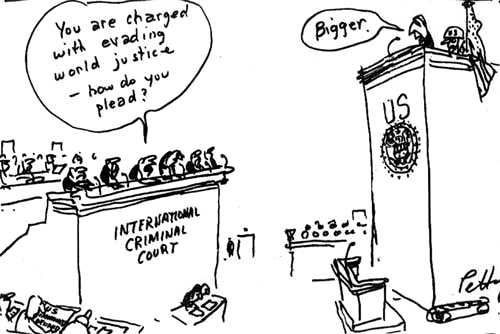
It wasn’t a surprise, but nevertheless, the Executive Order imposing sanctions on the International Criminal Court (ICC) are a deeply troubling development. As Amnesty International’s Agnes Callemard put it, the order “is vindictive. It is aggressive. It is a brutal step that seeks to undermine and destroy what the international community has painstakingly constructed over decades… The sanctions constitute another betrayal of our common humanity.”
It is difficult to know what to do when so much of what we care about and advocate for is under attack. What are we supposed to do? How do we protect the institutions that accountability advocates worked so hard to create – often against the odds? The threats posed by the Trump administration – whether punitive tariffs, arbitrary pauses on foreign aid, or attacks on the ICC – can leave us with a feeling of impending and paralyzing doom. But there are things that can be done to protect and promote institutions like the ICC. While far from perfect and undoubtedly in need of some reform, the Court is worthy of protection from efforts to kneecap and destroy it. In that spirit, here are some things that states and proponents of the institution can do as it faces a potentially existential threat from the U.S.
Hold firm. American decision-making often has the effect of taking all of the oxygen out of the room. President Trump, in particular, has a penchant for ‘flooding the field’: saying and doing multiple atrocious, racist, or hurtful things, in order to fragment media and diplomatic attention. But the ICC must not be deterred by the Trump administration’s bullying. While it may be easier said than done, the Court should not be deterred from continuing its work in the face of Washington’s threats. Its warrants for Israeli leaders are based on firm and compelling evidence. Its investigations into Palestine and Afghanistan are on solid ground. Backing down and showing weakness – especially against Trump – would only leave the Court more exposed to intimidation and vulnerable to interference.
The Court’s staff should likewise remember that when American frustration towards the ICC is at its greatest, that antipathy signals to the rest of the world – which, it should go without saying, matters as much as the United States – that the Court is challenging a political status quo where might is right and Washington can stomp on the rules-based international order when it so pleases. The fact that Trump and his sycophants are so hysterically and unreasonably upset with the ICC is a symptom of the Court’s success, not its failure.
Rally around the Court and its mission. The ICC is far from perfect. It is entirely legitimate and natural to criticize its decisions. But member-states and advocates need to remind themselves and others that the Court is a global achievement worth promoting and protecting, warts and all. It remains the only permanent international court capable of investigating and prosecuting international crimes. It has a role to play in contexts of political violence and it continues to have purchase for states whose civilians have faced atrocity crimes, as demonstrated by the recent decisions of Ukraine and Armenia to join the ICC.
Continue reading






 Justice in Conflict