
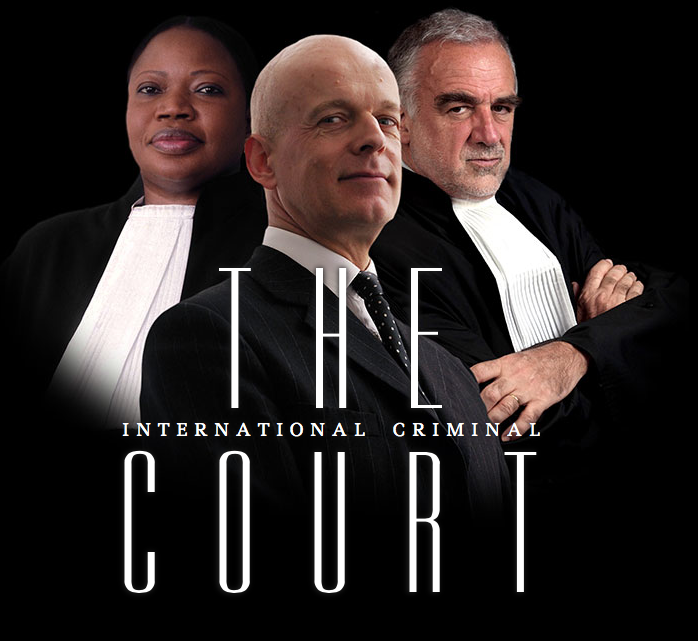
The Court, a documentary by Michele Gentile and Marcus Vetter.
To many, if not most, the International Criminal Court (ICC) still looms like an impenetrable institution where the decisions made and actions taken in The Hague subsequently reverberate around the world. This isn’t to say that it’s a murky world but rather that it remains a rare and privileged opportunity to glimpse how decisions at the Court are made, what life in the halls of the world’s first permanent international criminal tribunal is truly like, and what really makes the Court’s staff – from the judges and prosecutors to the investigators and defence lawyers – tick.
Remarkably, over a decade after its creation, there have been very few efforts to shed light into the turbulent political and legal world of the ICC. There is no ethnography of the Court. There isn’t even a biography of the Court’s first Prosecutor, Luis Moreno-Ocampo. As a result, very few people understand how the International Criminal Court (ICC) truly functions. Three years after dedicating much of my time and energy to this subject, I still don’t.
Given this, my curiosity was piqued when I was told by a friend about a new documentary entitled ‘The Court’ which she had seen screened in The Hague. To be honest, though, despite being intrigued, I was also quite skeptical. After all, many of the films made about the ICC to date have tended to be triumphalist and advocacy-oriented. So asked my friend the inevitable question: “When you watched the documentary, did you feel it shed a positive or negative light on the ICC?” Her response could not have been more promising: “I’m really not sure.”
‘The Court’ does many things effectively. Directors Michele Gentile and Marcus Vetter brilliantly and brutally juxtaposes the horrors of violent political conflict with the sterility of international criminal justice. In one frame we witness a woman being carried, a massive flesh wound on her thigh; the next, we watch Moreno-Ocampo preparing coffee and biting into a pastry. We witness a child being ripped apart from his family before shifting to scenes of banal Court proceedings. We hear the tortured cries of a Palestinian man who has just seen his daughters killed in an Israeli air raid before the film cuts to Moreno-Ocampo leaning back in his chair and pondering out loud whether or not he can investigate alleged crimes committed in Palestine.
One might criticize the film for how it decontextualizes the violence and brutality portrayed throughout the film. It is rarely clear against whom the violence portrayed is being waged, who the perpetrators are and where the violence is being done. Yet these scenes are also a subtle reflection of the way in which international criminal law itself decontextualizes the causes and dynamics of violence and conflict.
But, above all, what the ‘The Court’ offers is a unique glimpse into the life and work of one man: Moreno-Ocampo himself.
During his tenure as ICC Prosecutor, Moreno-Ocampo was a lightning rod for controversy. He was dogged by allegations of being overtly selective in his cases, for playing fast-and-loose with the law and for often speaking off the cuff, saying the wrong thing at the wrong time. He was also vociferously defended as having ‘put the ICC on the map’ of international relations, of establishing a permanent interest in in the functioning of the Court, of making the ICC a relevant institution.





 Justice in Conflict