
Mark Schenkel joins us for this insightful and thought-provoking guest-post on the expiry of Uganda’s Amnesty Act and its implications for transitional justice in northern Uganda. Mark is a Dutch journalist based in Kampala, Uganda. He covers developments in East Africa for various media in The Netherlands and Belgium. Enjoy!
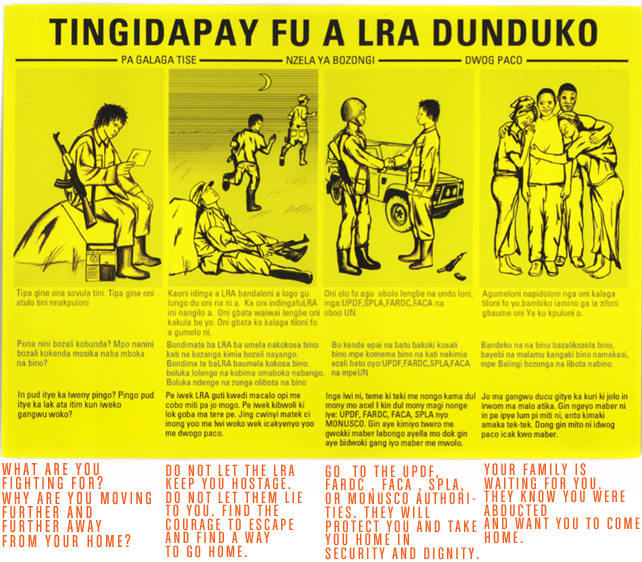
A pamphlet from the Ugandan Amnesty Commission encouraging rebels to defect from the LRA and return home in exchange for amnesty (Photo: Resolve)
The recent expiry of Uganda’s long-running amnesty provision for armed rebels has taken quite a number of observers by surprise. On May 23rd, the centerpiece of Uganda’s twelve year old Amnesty Act, whichprovides blanket amnesty to anyone who denounces armed rebellion, lapsed despite media reports and statements by politicians suggesting that the entire Act was going to be renewed. The expiry of the essential part of the Act clearly has far-reaching implications for the debate about whether to forgive or prosecute members of the notorious Lord’s Resistance Army (LRA).
Uganda has taken a new and major step on the path away from amnesty and towards prosecution of LRA rebels. But first let us look at how the confusion and surprisement surrounding the Amnesty Act’s partial ending came about.
The expiry of Part 2 of the Act – the one dealing with the actual amnesty – was reported on Monday May 28th in the government-owned newspaper New Vision. It was a brief piece, on page 3. As it turned out, minister of Internal Affairs Hilary Onek had used his mandate to renew only the three other parts of the Act, dealing mainly with resettlement and re-integration of former rebels. The various elements of the Act, which was put in place in 2000 during the height of the LRA insurgency to encourage rebels to lay down their weapons, can be renewed every six months.
The independent newspaper, Daily Monitor, apparently wasn’t aware of the developments yet. On Tuesday the 29th, it still carried a story about whether or not Ceaser Acellam is eligible for amnesty. Acellam, a high-ranking LRA-commander, had fallen into the hands of the Ugandan army in mid-May (some sources say Acellam surrendered and wasn’t ‘captured’, as the army insists). The Monitor didn’t refer to the lapse of Part 2 of the Amnesty Act the week before, whereas the lapse’s logical consequence is that Acellam is in no way eligible for amnesty (it has, to my knowledge, nowhere been officially declared that Acellam had applied for amnesty before the lapse of Part 2). Only on Sunday, June 3rd did the Monitor report about it. In the meantime, Uganda Radio Network had caught up on the news, just like several foreign media (Radio Netherlands Worldwide and the UN-subsidized IRIN).
Truth be told, initially I myself thought that the Amnesty Act would be renewed in its entirity. Journalists, legal observers, members of Uganda’s general public – most people were under the same impression. One possible explanation is that back on April 16th, Deputy Speaker of Parliament Jacob Oulanyah was quoted as saying that the Amnesty Act was going to be renewed. Oulanyah spoke in the Northern Ugandan town of Gulu, in front of thousands of people who had showed up for the public screening of KONY2012.
Another explanation for the widespread expectation that the Act was going to be renewed may lay in the government’s decision to let part of the Act lapse without parliamentary approval – technically, this approval is not required. The decision wasn’t debated among the Ugandan people’s representatives. In its own statement on the website of the Ugandan media centre – posted several days after the expiry of the Act’s part 2 – the government didn’t explicitly say that amnesty is no longer in existence.

Recently “captured” senior LRA commander, Caesar Achellam (Photo: AFP)
Lastly, an explanation may be that during the days before part 2 expired, the Directorate of Public Prosecution (DPP), the Amnesty Commission as well as lawyers were publicly debating Ceaser Acellam’s eligibility for amnesty. When I contacted them after the expiry had come to light, both the DPP and the Amnesty Commission said that at the time of their public comments, no decision on the (partial) renewal of the Amnesty Act had yet been made. They simply discussed Acellam’s situation under the then-applicable rules – meaning an Amnesty Act still intact. Continue reading











 Justice in Conflict