
(Photo: Reuters)
In times of crisis or scandal, misunderstandings are an unfortunate but inevitable consequence of not having sufficient information and only getting it in fits and spurts from political actors with competing interests. The continuing controversy surrounding the detention of ICC staff has been no exception. Since their visit to Saif al-Islam Gaddafi in early June, Melinda Taylor, Helene Assaf, Alexander Khodakov, and Esteban Peralta Losilla have been held by a militia from Zintan, Libya, for the most part incommunicado. Libyan and Zintani authorities alleged that they were spying and posed a threat to the country’s national security (for more see here and here).
Admittedly, I was amongst those who believed that after the story broke, it would slowly decline in coverage and be largely ignored by the media. However – and luckily – that has not been the case. Nevertheless, the relatively consistent coverage has not prevented fictions from sprouting and falsehoods from propagating. For this reason, I thought it might be useful to “clear the air” by doing a little exercise in separating fact from fiction.
————————
1. There is evidence that the ICC staff are guilty of breaking Libyan law, undermining Libyan national security, and violating the ICC’s protocols.
Fiction. The claim that the ICC staff must be guilty is unfortunately widespread. Remarkably, commentators acting as both judge and jury have seemingly convicted the ICC staff without trial, indeed without evidence. While there have been proclamations that Melinda Taylor smuggled secret and coded documents as well as a camera pen into her meeting with Saif, absolutely no evidence has been given to date by the Libyan authorities to indicate that this has indeed occurred or that the staff are guilty of any wrongdoing. The closest we have come to actually seeing any evidence came when the arrest of Taylor et al was announced and a Zintani militia leader waived the alleged documents in front of the camera. Importantly, this is not to suggest that the ICC staff haven’t done anything wrong. Some might argue that the ICC’s recent statement of regret regarding the situation implies a concession that something went awry when the staff met Saif. However, we simply do not know what occurred during the meeting between the staff members and Saif. It bears repeating: No evidence of wrongdoing has been brought forward. None.
2. The ICC apologized to Libya.
Fact. There is probably not enough agreement on this to outright declare that it is a fact but I continue to believe the ICC’s statement amounts to an apology, as do others. The ICC’s statement amounted to an apology without saying sorry. It is not an uncommon practice for state or international actors to express an apology for past injustices but avoid using language that they fear may make them liable to subsequent legal action.
In this context, it is worth considering that the ICC’s statement is much closer to an apology than, for instance, former US President Bill Clinton’s “apology” for inaction in the face of the Rwandan Genocide.
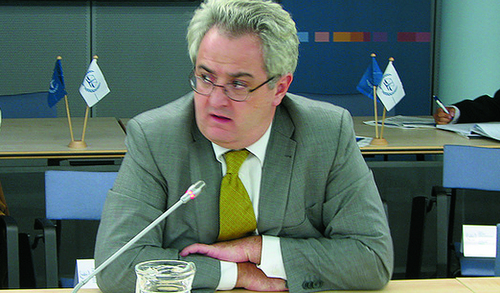
Esteban Peralta, one of the ICC staff who has remained in Libya since Melinda Taylor was arrested in order to provide her moral support.
3. Only Melinda Taylor is being held in detention for threatening Libya’s national security.
Fact. Originally, it appeared that both Helene Assaf and Melinda Taylor would be charged in Libya. In a show of remarkable solidarity and integrity, after being told the were free to leave Libya, Alexander Khodakov and Esteban Peralta Losilla chose to stay with Assaf and Taylor for “moral support”. While the circumstances are unclear, it recently became clear that Assaf was also free to leave. All three remain with their colleague but it seems clear that only Taylor is being held in detention. Continue reading









 Justice in Conflict