
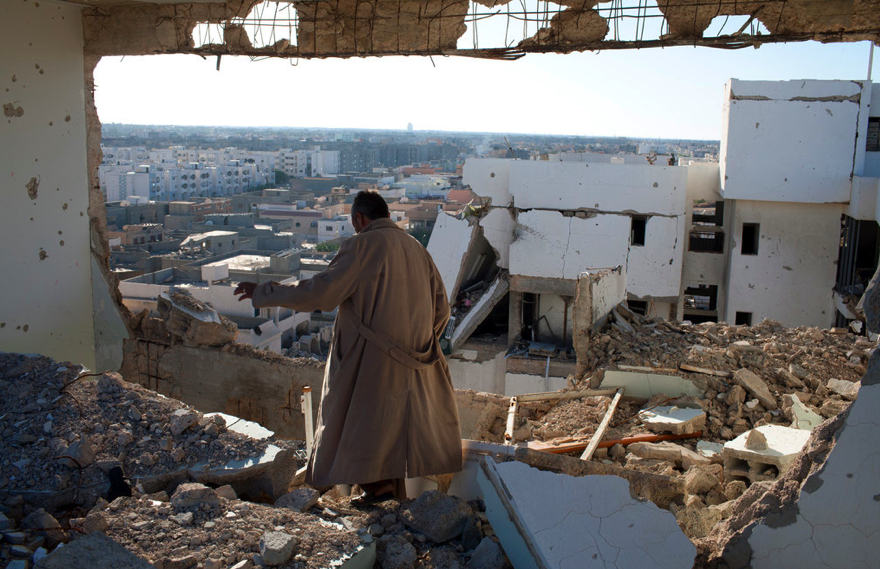
A Libyan man walks through an apartment damaged by NATO bombs in September 2011 (Photo: Tyler Hicks / The New York Times)
A recent report released by Human Rights Watch, entitled “Unacknowledged Deaths: Civilian Casualties in NATO’s Air Campaign in Libya”, has called upon NATO to thoroughly investigate any of its air strikes in Libya last year that killed civilians. NATO reacted sharply, exclaiming that it “deeply regret[s] any instance of civilian casualties for which NATO may have been responsible,” but that “the specific targets struck by NATO were legitimate military targets”and that the organization did everything possible to ensure that the loss of civilian life was minimal. The report and NATO’s response to it have recently triggered a timely debate: could, should and will the International Criminal Court investigate NATO’s role in the Libyan conflict?
Should They?
NATO was involved in a massive aerial campaign in Libya for eight months, there is no escaping that civilians were killed as a result, and any instances where this occurred should be investigated. If NATO or its member states are unwilling to thoroughly and transparently investigate incidences where their bombings resulted in a significant number of civilian casualties, it seems rather clear that the ICC should investigate NATO’s actions in Libya. This, of course, does not mean that NATO is guilty of committing war crimes or that NATO’s intervention should be vilified. There is an ever-present risk of demonizing NATO and the US, not for what they do, but simply for being Western. As David Rohde recently put it: “Some of the perceptions are exaggerated. The U.S. and NATO are not evil incarnate, nor are they perfect.”
There is a general acceptance that NATO’s intervention resulted in a remarkably low number of civilian casualties. Notably, while it was critical of NATO in some cases, the report of the UN Commission of Inquiry on Libya concurred that NATO had taken extensive precautions to prevent civilian deaths. HRW also accepts that civilian casualties were likely minimal. In this context, it is worthwhile highlighting that neither HRW nor the Commission of Inquiry have called on the ICC to investigate NATO, believing that NATO can and should investigate cases of civilian casualties themselves.
Of course, NATO’s success in minimizing civilians deaths does not excuse those instances where there were civilian deaths from being investigated. If there exists any right to truth for victims and survivors to know what happened to their family members, friends and communities, investigations into those aerial missions that resulted in civilian casualties are necessary.
Perhaps the most persuasive reason proffered as to why NATO shouldn’t be investigated is the argument that it would make future NATO interventions in response to atrocities less likely. But this argument presumes that NATO’s mandate cannot be enchanced from being investigated. On the contrary, an investigation by the Court that clears NATO of war crimes would boost the military organization’s credibility in combating atrocity crimes. It would also keep pressure on NATO to continue efforts to minimize the possibility of any civilian deaths in contexts where it intervenes.
Accepting that the ICC should investigate NATO crimes, the question becomes can they?
Can They?
There is no legal barrier to investigating citizens of those NATO states involved in Libya which are also signatories to the Rome Statute. A more controversial question, however, emerges with citizens of NATO members who are not members of the ICC, most obviously the United States. As I have argued elsewhere, the UN Security Council’s referral of Libya to the ICC, under Resolution 1970, was politically tailored by the Security Council (see also my recent academic analyses [here and here]). In this context, the US pushed through Operative Paragraph 6 of Resolution 1970 which excludes citizens of non-state parties from the Court’s jurisdiction, by stipulating that the Council: Continue reading











 Justice in Conflict