
This article was written as part of a broader campaign led by Canadian human rights and international justice advocates to encourage Canada to take a more pro-active and coherent approach to supporting the ICC. For more on that campaign as well as a declaration signed by 130+ Canadians and 30+ organizations, see here.
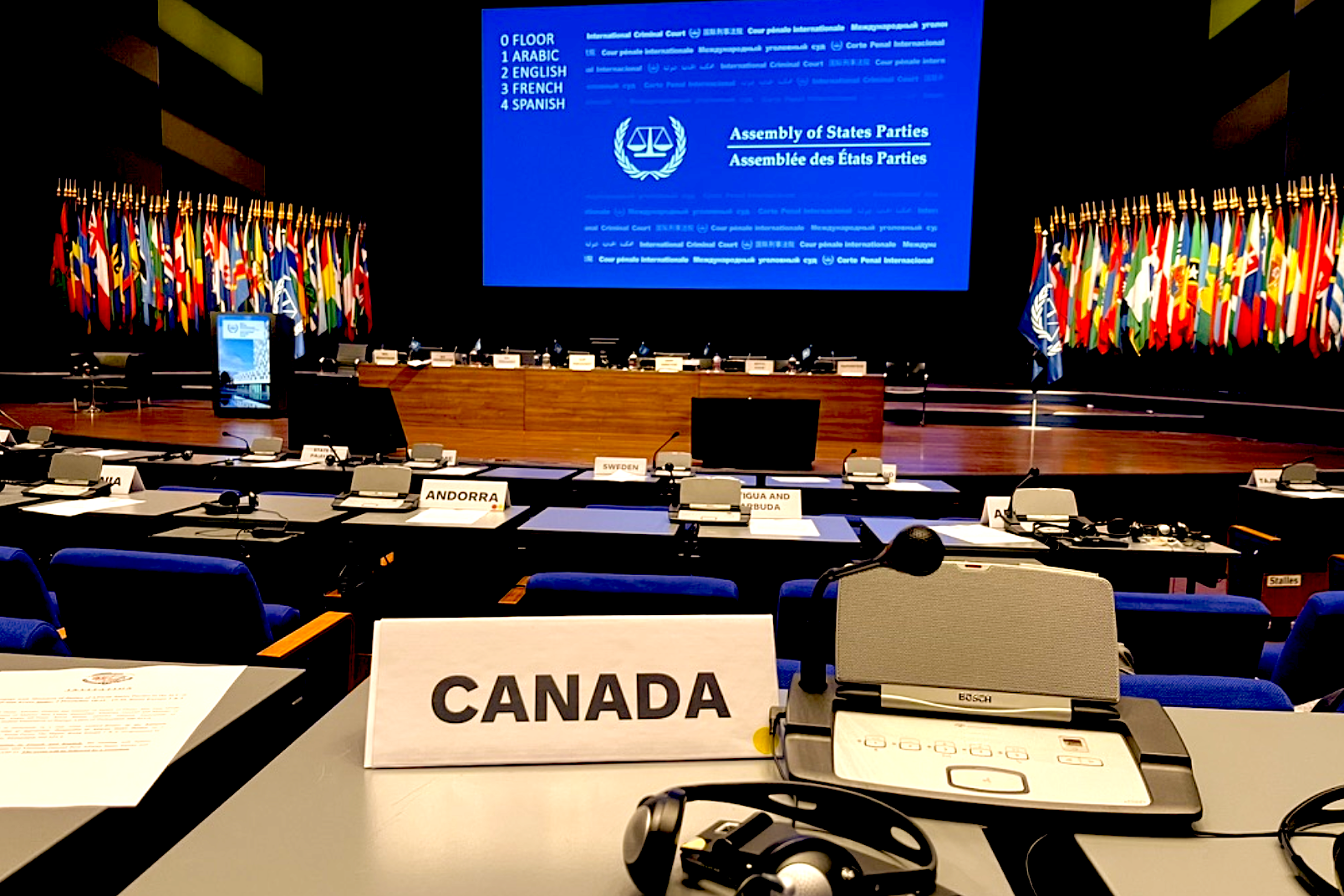
The International Criminal Court (ICC) is in its greatest hour of need. The goal of the Trump administration is clear: dismantle the ICC. At the very least, the U.S. wants to ensure that the ICC is rendered incapable of investigating or prosecuting citizens of non-member states like Russia’s Vladimir Putin, Israel’s Benjamin Netanyahu, or the regime in Myanmar, which Canada, the U.S. and now the International Court of Justice believe is genocidal. If Washington succeeds, the world’s only permanent international court with jurisdiction over war crimes, crimes against humanity, and genocide may not survive.
In August, Prime Minister Mark Carney called Canada’s support for the ICC “unequivocal”. It’s time to prove it, and to so in a consistent and coherent manner. Here’s what that could look like.
Washington’s campaign against the ICC is long-standing and unrelenting. In October, U.S. Secretary of State Marco Rubio announced that Washington would sanction the ICC as an institution. He also ‘offered’ a six-month ‘grace period’ for ICC member-states to address U.S. concerns. Chief among those was changing the ICC’s jurisdiction to ensure that it could not investigate or prosecute citizens of states that had not joined the Court, regardless of where they committed their atrocities. Some might think this about protecting U.S. citizens from ICC jurisdiction. But the Court has never targeted Americans and recent decisions indicate that it has no plans to do so.
If the U.S. campaign succeeds, the consequences would be devastating. Myanmar’s junta would be off the hook. The warrants for Putin and Netanyahu would disappear – regardless of suspected atrocities in ICC member-states like Ukraine and Palestine. Perhaps this is unsurprising. President Trump openly admires both men and has admitted that Washington’s mission against the ICC is about protecting Netanyahu and offered to work with Putin to protect him from the Court.
The first thing Canada should do is unequivocally state that it will not negotiate the future of the ICC while the Trump administration threatens the Court’s very existence. The ICC should retain the same parameters of jurisdiction as it currently has, which means that the Court can investigate and prosecute anyone who commits international crimes in states where the ICC has jurisdiction. The alternative risks encouraging dictators and terrorists to attack law-abiding states with impunity.
Second, and in line with Mr. Carney’s insistence on middle powers working together, Canada should offer to host an international diplomatic conference on the ICC in Canada, inviting all interested states to join. Such a conference could muster support for the ICC but also focus on much-needed measures to improve its performance in addressing international crimes. It could also be an opportunity for Canada to finally appoint an ambassador for international justice.
Third, Canada should invoke provisions in the Foreign Extraterritorial Measures Act (FEMA) to help insulate the ICC and Canadian employees from U.S. sanctions. When ICC Judge Kimberly Prost was sanctioned, Canada inexplicably failed to come to her defence, despite its European allies doing so for their staff. Moving forward, Canada should invoke provisions in FEMA designed to protect Canadian businesses from secondary sanctions when working with unfairly sanctioned people. Canada can do this in lockstep with its European Union and British partners who have similar provisions to block the impact of unjust sanctions and are preparing to use them.
Fourth, in both its forthcoming Foreign Policy Review and its campaign for a seat on the United Nations Human Rights Council for 2028-2030, Canada should include a clear-eyed position supporting the ICC and all of its investigations. This could be coupled with a call for additional funding to the Court. Canada has historically pushed for minimal growth in the ICC’s yearly budget. Changing tack would be a welcome act of endorsement, especially for a government that views much of international relations through the prism of investments. Canada could also follow Japan’s lead and pay its full 2027 contributions immediately – and before potential sanctions take place, and encourage other allies and major ICC funders to do the same.
Fifth, Ottawa should make it clear that anyone who faces an ICC arrest warrant is unwelcome in Canada or Canadian airspace. That includes embattled Israeli leader Netanyahu, who has entered Canadian airspace on multiple occasions without any evident opposition from the Canadian government. No one facing ICC charges should be accessing Canada’s sovereign territory, which – by law – covers our land, coastal waters and the airspace above them.
Finally, Canada should follow its allies and send a senior-level delegation on a visit to ICC’s premises in The Hague. Mr. Carney travels frequently, spending almost one-fifth of his time outside of Canada. It would take him less than an hour to get to The Hague from Brussels. Showing up at the ICC would be a powerful – and easy – act of support for the embattled court.
These proposals and others put forward in a Declaration by a group of 130+ Canadian advocates and 30 organization would bolster the ICC during a time of existential crisis but also reinforce Canadian sovereignty, middle power diplomacy, the international institutions we helped to establish, and the principles our government claims to stand for.
Mr. Rubio recently stated that the ICC and its allies should take the advice of Roman General Pompey, and “stop quoting laws to men with swords.” On the contrary, Canada must fight for a world governed by law, not war, and by accountability, not atrocity. Saving the ICC should be part of that effort.


