
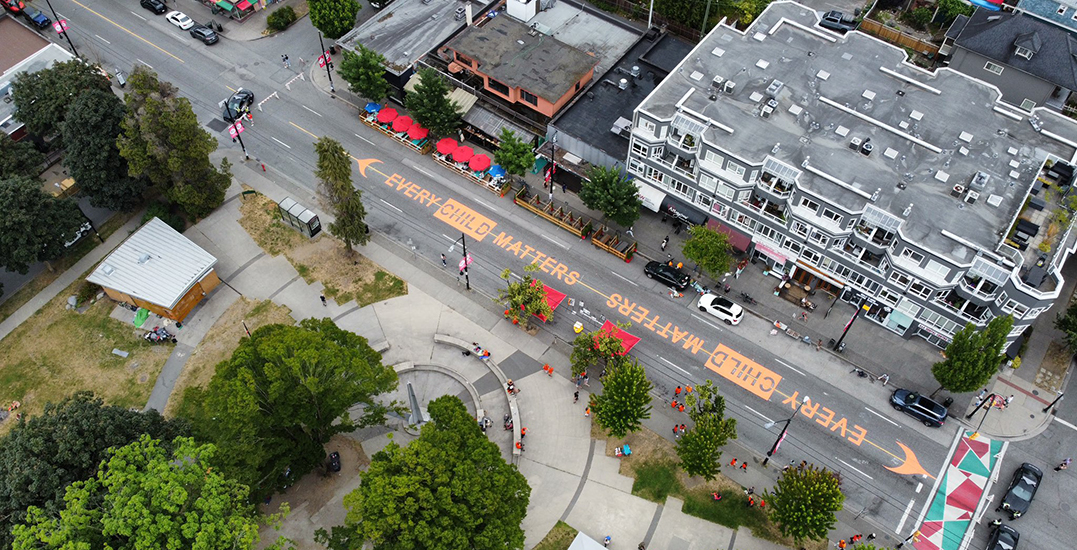
Alyssa Couchie and Randle DeFalco join JiC for this guest post on atrocity violence against Indigenous people and communities in Canada. Alyssa is a JD Candidate at the University of Hawai‘i at Mānoa William S. Richardson School of Law and proud member of the Nbisiing Anishnaabeg (Nipissing First Nation). Randle is Assistant Professor of Law, University of Hawai‘i at Mānoa William S. Richardson School of Law. He was born and raised on the traditional territories of the Mississauga and Haudenosaunee nations in Ontario, Canada. The authors would like to note that the term Indigenous is used throughout this post to encompass First Nations, Métis, and Inuit peoples that reside within the territory known as Canada. While we use this term for clarity and brevity, it is important to acknowledge the many complexities and power dynamics tied into such nomenclature. See here for more on this topic.
Sweetgrass or wiingaashk, the hair of Mother Earth, is a sacred medicine to many Indigenous peoples of North America. Sweetgrass is traditionally divided into three sections and woven into a braid creating strength. Indigenous peoples are much like the sweetgrass braid where individual, family, and community are the three strands. All three were once woven together, united and strong. Generations of violence perpetrated against Indigenous children through their forcible transfer to Indian Residential Schools (IRSs) and exposure to other oppressive systems, such as Canada’s child welfare system, has left this communal braid frayed and in danger of coming apart. While Canada’s setter-colonial government and peoples have begun to recognize this violence, in this post we share our concerns that this recognition continues to be too limited and too narrow in scope to foster the sustained, large-scale regenerative steps necessary to repair Indigenous communities.
The Horror of Mass Grave Exhumations
On 1 June 2021, the Tk’emlups te Secwepemc community confirmed that they had located the remains of 215 children on the grounds of the former Kamloops IRS in British Columbia by using ground penetrating radar. Many other Indigenous communities throughout Canada have since made similar announcements. Others are in the process of locating and exhuming numerous mass graves on or very close to former IRS sites across the country.
These exhumations have forced a greater acknowledgement of the harms committed against Indigenous communities perpetrated by the Canadian government and the various religious organizations, such as the Catholic Church, that ran the day-to-day operations of IRSs. The horrific nature of these mapping and exhumation efforts almost immediately led to discussions oriented around the idea that Canada faced (yet another) “reckoning” for its “long-hidden brutal history” in relation to the treatment of Indigenous peoples. To some extent, this forecasting of a new reckoning has proven true. A few days after the announcement of finding remains at the Kamloops IRS, Canadian Prime Minister Justin Trudeau publicly accepted the 2019 finding of the National Inquiry into Missing and Murdered Indigenous Women and Girls(National Inquiry) that “what happened amounts to genocide.” Then, in early 2022 the Canadian government announced that a forty billion dollar settlement had been reached–the largest in Canadian history–with various Indigenous organizations. The settlement stemmed from numerous anti-Indigenous abuses, including the discriminatory treatment of Indigenous children residing on reserve by government-affiliated child welfare programs for decades.
The Limitations of Horrific Spectacles in the Recognition of Atrocity Violence
The horrific aesthetic spectacle of these recent mappings and exhumations have both forced greater acknowledgement of atrocities committed against Indigenous peoples in Canada, and continued to limit the scope of such recognition to focus myopically on the IRS system. In some respects, the recent settlement and other forms of official acknowledgment of the harms suffered by Indigenous communities, such as Canada’s Truth and Reconciliation Commission (TRC) and the National Inquiry, represent a step forward in recognizing and addressing the harms caused to Indigenous peoples through the settler-colonial process. This recognition, however, remains focused on a narrow, highly visible subset of harms and forms of violence, especially those committed at residential schools. Other, less obvious forms of settler-colonial atrocity violence remain largely overlooked, even when intimately connected to the IRS experience. As discussed below, we believe the harms occasioned against Indigenous peoples through Canada’s child welfare system represents one such unspectacular and overlooked form of atrocity that in actuality, is inextricably intertwined with the worst abuses of the IRS system.
Continue reading



 Justice in Conflict