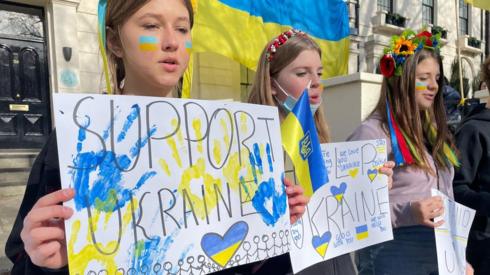
On February 24, during a United Nations Security Council meeting, Sergiy Kyslytsya, Ukraine’s Ambassador to the UN was informed that Russia’s invasion of his country had begun. Moments later, Kyslytsya turned to his Russian counterpart Vassily Nebenzia and told him: “There is no purgatory for war criminals. They go straight to hell.”
There is little doubt that Russia’s invasion into Ukraine is a violation of international law and the UN Charter. It is also a crime. It should be called as such, not only by human rights and justice advocates, but by states.
In recent days, many state representatives, media, and scholars have rightly gone to great lengths to stress the abhorrent behaviour of Russian President Vladimir Putin. But it is almost as if what Putin is doing now is particularly egregious. This invasion is the Russian president’s calling card and war crimes are his signature.
Everything transpiring now in Ukraine, including reports of rocket attacks on civilian buildings, is par for Putin’s course. Days ago, international law scholars Frédéric Mégret and Kevin Jon Heller predicted that Putin would commit the crime of aggression by invading Ukraine. No one should be surprised if the situation gets worse. Putin’s personal biography is littered with the embrace of atrocity crimes and human rights violations.
Putin came to fame and eventually to power on the back of Russia’s 1999-2000 war in Chechnya. In annihilating the breakaway region’s separatist movement, Russia deployed horrific levels of violence. Human Rights Watch has documented legions of atrocities, including allegations that Russian forces “indiscriminately and disproportionately bombed and shelled civilian objects” and “ignored their Geneva convention obligations to focus their attacks on combatants”. The West responded meekly to allegations of war crimes. Rather than being condemned, Putin was largely hailed as a leader that promised Russians a better life and the West – better relations, when he replaced Boris Yeltsin as Russian president. That was not to be the case.
In 2008, Putin turned his attention to Georgia and ordered Russian troops – whom he called “peacekeepers” – to invade the Georgian provinces of South Ossetia and Abkhazia. They were not there to keep the peace. While Moscow invoked humanitarian language in arguing that it had a “responsibility to protect” its citizens in both territories, Russian forces indiscriminately attacked civilian targets – a war crime. It is also alleged that Russian allies in South Ossetia forcibly transferred ethnic Georgians out of the region.
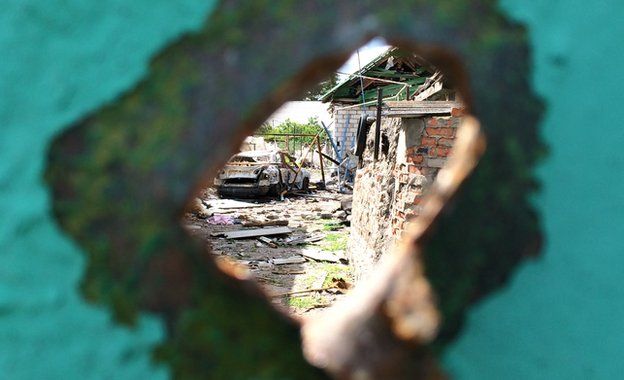
In 2014, Putin invaded Ukraine, leading to the illegal occupation and annexation of Crimea while also igniting a conflict in Lugansk and Donetsk that has cost an estimated 14,000 lives. During the violence, Russian-backed militants bombed Malaysia Airlines Flight 17 over Ukraine, killing all 298 people onboard. Attacks by Russian forces against civilians were commonplace and allegations of murder and torture were reported in detention facilities – referred to as “Europe’s last concentration camps” – run by pro-Russian separatists.
These are just a tiny cross-section of Putin’s crimes that have been documented by human rights and investigation bodies.
Continue reading