
Carsten Stahn joins us for this sixth contribution in our ongoing symposium, with EJIL:Talk!, on the ICC’s impacts on national justice. Carsten is a Professor of International Criminal Law and Global Justice at the Leiden Law School and the Programme Director of the Grotius Centre (The Hague).
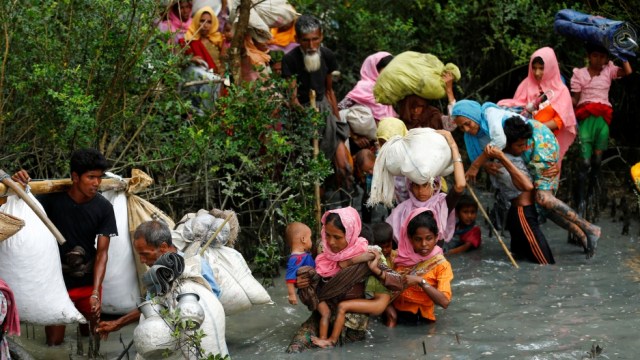
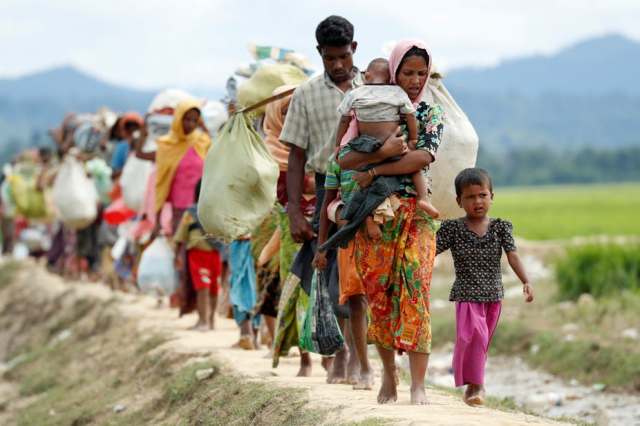
The ICC’s latest preliminary examination is into Bangladesh/Myanmar. Will the Office of the Prosecutor follow the same strategy as it has in other preliminary examinations? (Photo: Mohammad Ponir Hossain / Reuters)
It is a pleasure to contribute to this joint EJIL:Talk! and Justice in Conflict debate on ICC preliminary examinations (PEs). Elizabeth Evenson and Human Rights Watch (HRW) have done pioneering work in this field. I am grateful for the opportunity to offer a few reflections on the state-of-the art of PEs, certain points raised in the HRW reports, and some thoughts to re-visit ICC strategies, based on a joint research project with CILRAP/Morten Bergsmo.
“The line it is drawn, The curse it is cast”
Preliminary examinations operate at the intersection of law and politics. As Mark Kersten has illustrated, they constitute a form of productive power of the ICC. They frame narratives about conflict, shape the use of crime labels, entail classifications of armed violence or expressions of stigma or victimhood. The drafters of the Rome Statute of the International Criminal Court (ICC) have devoted relatively limited attention to the issue.
At other international criminal courts and tribunals, PEs had traditionally lesser importance, since the jurisdictional scope was pre-defined and complementarity had lesser space. At the ICC, policies and practices were largely developed through the managerial practices of the OTP. The goals of PEs were defined by prosecutorial strategy. The way in which they are conducted differ from national systems. PEs were not only treated as a gateway to investigations, but as a broader policy instrument to foster deterrence and incentivize domestic investigations and prosecutions. This approach is guided by noble intentions and the desire to make most of the ICC’s limited capacity. However, it poses difficult tensions and dilemmas.
PEs have essentially turned into a novel procedural stage of its own. The OTP has developed an elaborate system of assessment (i.e. a four-phase process) in its Regulations and Policy Papers, one which closely mirrors human rights monitoring. This process is designed to translate the complex reality of atrocity contexts into legal determinations, including the determination of jurisdiction, the determination of the crime-base, admissibility, or situational gravity.
Some the methodologies have come under critique. The ICC has accumulated a docket of highly delicate political situations, with limited analytical resources, restricted on-site access, lack of cooperation, or a clear exit strategy. The scope of situations varies from a single incident (e.g., North Korea, Comoros) to decade-long conflicts with long-standing historical roots (Afghanistan, Palestine). There is a bottleneck problem. Many situations have stayed under analysis for long periods of time, ranging from several years to over a decade. This may be helpful for expressive purposes, monitoring of violations, or complementarity objectives. But it can also have counterproductive effects. The OTP needs to navigate between political dialogue, strategic ambiguity, credibility of threat and vigilant monitoring. It can easily become an instrument of national politics. Skeptics have questioned to what extent the OTP should speculate on complementarity or deterrence outcomes, set benchmarks for domestic jurisdictions, or provide advice in transitional justice contexts. PEs should be approached with greater modesty.
“Come writers and critics …And keep your eyes wide”
Initially, the opening of a PE is a ‘quick-win’ for many sides. It is tempting for human rights institutions, civil society organizations and victims to call for an ever-growing list of ICC preliminary examinations. For them, the fact that a situation is under PE can be branded as a success. For states, PEs may be a convenient way to signal concern or moral outrage. For the ICC, PEs are a means to demonstrate political relevance in relation to atrocity or equality before the law. The OTP can use the unpredictability of the PE process to exercise influence over national justice processes, without having to ‘lock itself’ in or determine hard targets of investigations.
Over time, however, PEs may become a trap, due to prolonged silence, lack of decision-making or false or inflated expectations. The ICC’s leverage may be impeded by the relatively stable number of open PEs (i.e. around 10 at any given moment in time) and the phase-based approach to assessment, which makes OTP action predictable. The effects have remained mixed. The opening of PEs involving ‘Big Powers’ did not necessarily detract from African critiques of the geographical distribution of ICC scrutiny. In several contexts, the OTP has faced political deadlock during the PE or after its decision to move to investigations (e.g., Burundi, Philippines). Continue reading





 Justice in Conflict