Elizabeth Evenson, Balkees Jarrah, Elise Keppler, Juan Pappier, and Param-Preet Singh join JiC for this first instalment in our joint symposium with EJIL:Talk! on the ICC’s impacts on national justice. Elizabeth, Balkees, Elise, Juan, and Param-Preet are staff members of Human Rights Watch and the authors of the organization’s May 2018 report, Pressure Point: The ICC’s Impact on National Justice; Lessons from Colombia, Georgia, Guinea, and the United Kingdom.
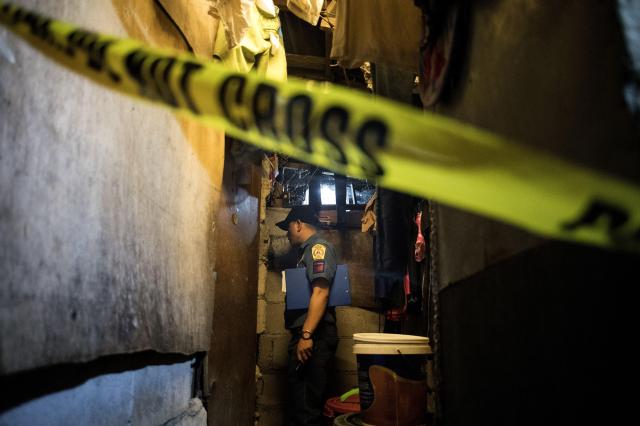
The situation in the Philippines is currently under preliminary examination by the ICC. Here, a policeman in Manila investigates the scene where the body of an alleged drug user lies after being killed by unidentified assailants on 8 December 2017. (Photo: Getty Images).
The International Criminal Court (ICC) is a court of last resort. Under the court’s treaty, the Rome Statute, which marks its 20th anniversary this year, the world’s worst crimes are admissible before the ICC only if national authorities do not genuinely investigate and prosecute cases. Far from simply a jurisdictional limitation, this principle of “complementarity” transforms the ICC from a single institution into a broader system for prosecuting international crimes, rooted in national courts.
Bolstering national proceedings is crucial to giving full effect to the Rome Statute system. It’s also necessary to broaden victims’ access to justice. The number of situations in which the ICC should act is probably far greater than the court’s founders envisioned. The ICC’s limited resources—provided all too sparingly by its member countries—mean it is struggling to keep up.
More attention should be paid to the ICC’s potential as an active player on national justice. Under the concept of “positive complementarity” it can serve as part of a wide array of efforts to press and support national authorities to carry out genuine investigations and prosecutions. The ICC is not a development agency, but it can lend expertise, broker assistance between other actors, and maintain focus on the need for accountability.
This is the case when the ICC opens its own investigations, as there will be a need for additional domestic investigations and prosecutions to bring comprehensive accountability. But the ICC’s Office of the Prosecutor has a particularly important role to play when it is still considering whether to open an investigation, during “preliminary examinations.”
This is because the prosecutor’s office has unique leverage in some of these preliminary examinations. If national authorities have an interest in avoiding ICC intervention, they can do that by conducting genuine national proceedings. By making the most of this leverage, the prosecutor’s office can be an effective catalyst for justice. The office recognizes that opportunity and has made it a policy goal to encourage national proceedings when it is feasible.
Human Rights Watch supports these efforts, given that they could help extend the reach of justice. But building on a set of 2011 recommendations, we wanted to take a fresh look at whether and how this policy is working, with a view toward strengthening its effect.
Our findings are set out in a May 2018 report, Pressure Point: The ICC’s Impact on National Justice; Lessons from Colombia, Georgia, Guinea, and the United Kingdom.We assessed the extent to which the prosecutor’s office had pushed forward the investigation and prosecution of ICC crimes relevant to its preliminary examinations in these countries. We interviewed government officials, investigating and prosecuting authorities, judges, members of civil society groups, journalists, and representatives of diplomatic missions and UN agencies, about 140 people in all, as well as staff in the ICC prosecutor’s office.
Our research makes clear that it is important not to overstate the prospects for success.
Of these four countries, trials of relevant crimes have, for the most part, only taken place in Colombia. And there- where we looked at one aspect of the ICC preliminary examination, the unlawful killings that military personnel officially reported as lawful killings in combat, known as “false positive” killings—proceedings against high-ranking military officials have been marked by prolonged delays, in spite of hundreds of cases against low- and mid-level soldiers.
There are persistent and stubborn obstacles to trying the most serious crimes before national courts. Objective factors—such as the peace process in Colombia or the cross-border nature of the Georgia-Russia conflict—also place significant constraints on what the preliminary examinations can achieve to spur national justice. And the prosecutor’s office, with only 13 staff members in its preliminary examinations unit, has limited resources for this work. Continue reading