
James P. Rudolph joins JiC for this guest-post on the International Criminal Court’s ongoing preliminary examination into war crimes and crimes against humanity committed in Nigeria. James is an Attorney in California and Washington, D.C. LLM, international law and a former Franklin Fellow in the U.S. Department of State, Bureau of African Affairs.
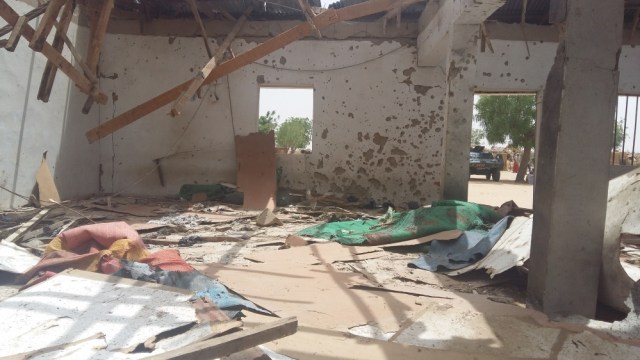
Damage to a mosque following a suicide attack in Maiduguri, Nigeria (Photo: AP)
Nigeria was an early member of the International Criminal Court (ICC), joining in September 2001. On paper at least, its commitment to international criminal justice has never been seriously questioned. It has, moreover, been one of the largest contributors of troops for African peace operations. The Economic Community of West African States, for example, has received most of its military resources from Nigeria. In other words, despite its declining military prowess, Nigeria has over the years been a bulwark of stability in a troubled region. This is why, in many ways, it was a foregone conclusion that Nigeria would join the ICC and throw its weight behind the burgeoning movement for increased accountability in Africa. But now that both the ICC and the world have placed alleged crimes committed in Nigeria under scrutiny, this rock-ribbed commitment has, lo and behold, shown signs of softening.
The ICC has jurisdiction over genocide, war crimes, and crimes against humanity. Pursuant to the principle of complementarity, the ICC’s ongoing preliminary examination into alleged war crimes and crimes against humanity in Nigeria is bifurcated. The first phase looks into whether the court has jurisdiction, meaning that one of the listed crimes in the Rome Statute allegedly has been committed. The second phase determines whether, despite having jurisdiction, the court’s case is admissible. If national authorities are responding adequately to the situation, then the ICC case is not admissible. The idea is that national authorities have the primary responsibility to investigate alleged crimes and, if warranted, prosecute them. The ICC steps in — i.e., complements — and can investigate only when a state is unable or unwilling to prosecute. The ICC, then, is seen as the court of last resort, to be activated only when it appears that national authorities are unresponsive to, or perpetuating (rather than ending) impunity.
Thus, vis-a-vis the conflict in the north with Boko Haram, the focus of the preliminary examination (initiated in 2010) has been twofold: first, whether Boko Haram has committed crimes; and second, whether Nigerian security forces have done the same. With respect to Boko Haram’s alleged crimes, the evidence overwhelmingly points to guilt. Indeed, Boko Haram has on several occasions admitted to committing war crimes and religiously targeted persecution. This is why this aspect of the examination is not terribly controversial. Boko Haram has been very explicit about wanting to target civilians; indeed, this has become part of its modus operandi. But with regard to atrocities committed by the Nigerian security forces themselves, the situation is much more challenging.
First and foremost, the Nigerian security forces are battling a brutal and nihilistic terrorist organization bent on creating a retrograde form of Islam and imposing it by force on the rest of the country. In other words, the Nigerian security forces have, on balance, had an easier time garnering sympathy. After all, the mission is to destroy a group that is almost universally loathed.
Yet this support for the mission has unfortunately led to some excesses by the armed forces. At Giwa barracks, for instance, Boko Haram detainees managed to escape, only to be rounded up by Nigerian forces that were hell-bent on exacting as much summary justice as possible — i.e., mass, undifferentiated arrests and on-the-spot executions. In the town of Baga, the U.S. State Department’s Human Rights Report notes that up to 228 people may have been killed following a security operation. Human Rights Watch, in its own report, notes that upwards of 2,200 homes were destroyed in Baga by Nigerian security forces. And it was determined by the Department of State (and reported to the White House) that Nigeria’s use of child soldiers in the fight against Boko Haram violated the Child Soldier Prevention Act.
Needless to say, this aspect of the ICC’s examination is politically and institutionally very sensitive. The Nigerian government rightly views Boko Haram as an existential threat. The Nigerian military, especially the army, sees its reputation on the line. Thus, the temptation to do whatever it takes to eliminate the threat is almost overwhelming. This is precisely why the notion of complementarity is so vitally important. The examination is not just about whether Nigeria’s institutions are unable to perform their duties; it’s also about whether Nigerian officials are unwilling to provide a fair and impartial forum in which to hear these issues. Continue reading




 Justice in Conflict