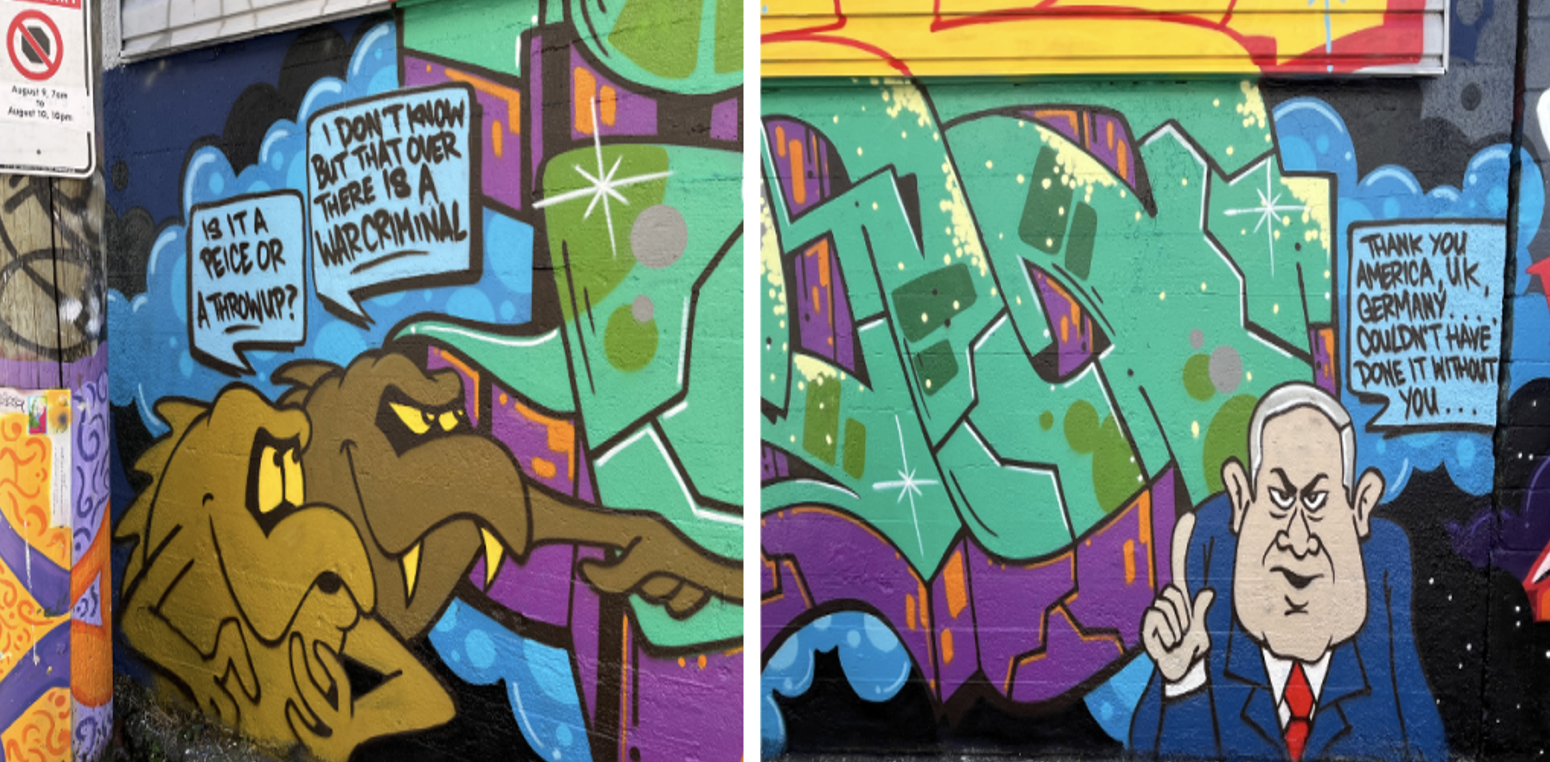
Graffiti in Vancouver, Canada (Artist: Tabs / Photo: Mark Kersten)
They thought they’d enjoy the festival, maybe a waffle and a Hoegaarden. Instead, the two Israeli soldiers were detained and questioned by Belgian police after facing allegations of war crimes stemming from the Hind Rajab Foundation, an organization set up to track soldiers allegedly implicated in atrocities committed during their service in Gaza.
While no allegations against the Israeli soldiers have been tested, let alone proven, in court, their detention is part of a pattern: at least twelve complaints over alleged war crimes have reportedly been issued in Brazil, Thailand, the Netherlands, Serbia, Ireland, Cyprus, and elsewhere. Is detaining suspects when they travel the future of international justice in Gaza and elsewhere? With bodies like the International Criminal Court (ICC) under siege and limited in their capacities, it is certainly a part of it.
It is troubling enough that perpetrators of war crimes, crimes against humanity, and genocide are rarely held accountable. It is made that much more offensive when those suspected of committing such atrocities enjoy the privilege of freely traveling abroad. In some instances, however, those moments also offer opportunities to hold perpetrators of atrocities to account.
The following is a guest post by Masoud Zamani is a lecturer in international law and international relations at the University of British Columbia. His research focuses on the intersection of emerging technologies and international legal accountability.
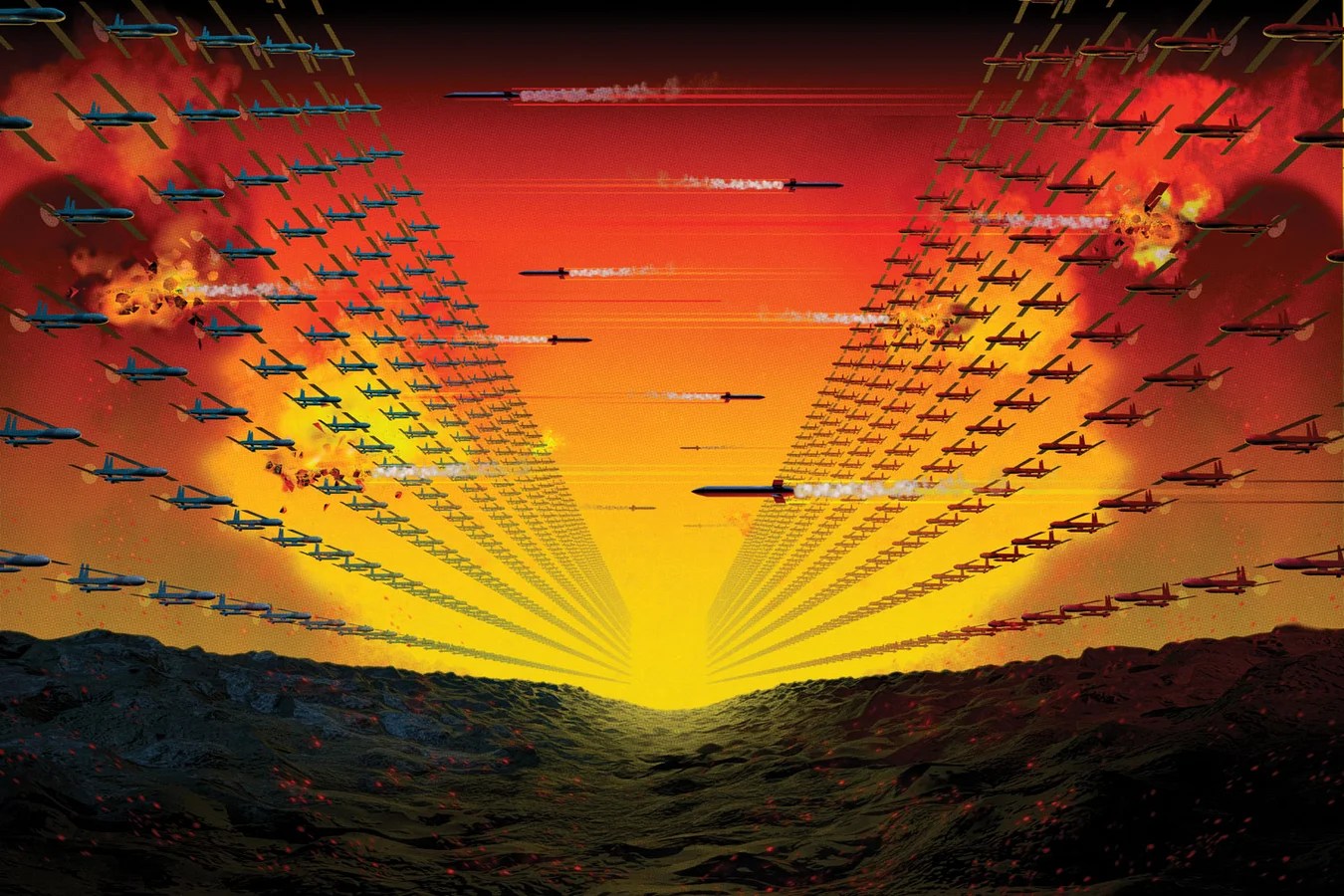
(Image by Tavis Coburn / Scientific American)
In recent years, the growing discourse on the regulation of lethal autonomous weapon systems (LAWS) has brought renewed attention to the question of individual criminal responsibility for acts committed by such systems. While theoretical debates have long grappled with whether individual criminal liability can arise in connection with the conduct of LAWS, more focused discussions on the specific modes of responsibility are now beginning to take shape— and at an accelerating pace.
International criminal law (ICL), shaped historically by a fundamentally anthropocentric orientation, has largely operated on the assumption that crimes are committed by human agents capable of intent, knowledge, and control. As such, traditional modes of individual responsibility, such as ordering, planning, instigating, aiding and abetting, and command responsibility, must now evolve to address the complexities introduced by autonomous warfare.
This post explores the current legal framework surrounding command responsibility under international criminal law and examines emerging conceptual pathways for adapting or extending existing modes of liability to account for the unique challenges posed by LAWS.
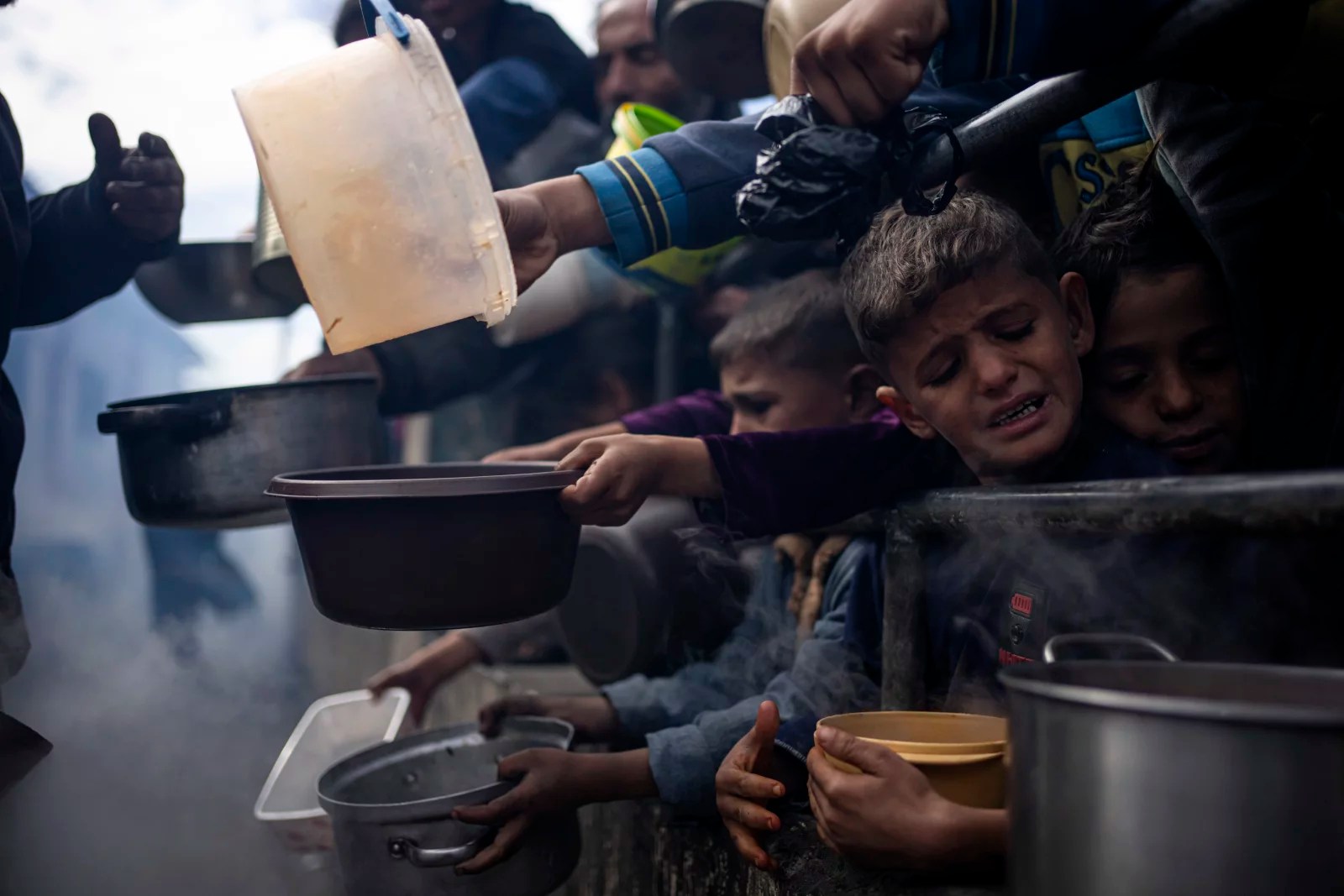
Palestinians, including children, seeking food in Rafah, Gaza, February 2024 (Photo: Fatima Shbair/AP)
A growing consensus of international and Israelihuman rights organizations, editorial boards, Israeli Holocaust historians and former Attorney Generals, as well as figures like Romeo Dallaire, have all come to the same conclusion: What is happening in Gaza is a genocide. But it is clear there remains confusion about what genocide is and how it is perpetrated, which breeds misinformation and polarization. Given the atrocities being perpetrated in Ukraine, Sudan, Myanmar and Palestine, it has never been more important to understand the nature of genocide precisely.
If I could impart one piece of knowledge from my decade-plus of researching and teaching about the topic, it would be this: Genocide is a process, not an event. That insight is critical to understand if we hope to prevent genocides and hold their perpetrators to account.
Genocide is not perpetrated instantaneously. It does not ‘just happen’. Rather, those who seek to commit genocide must prepare their population to either support violence or to turn a blind eye to it. They do so through a process of dehumanizing their target group, often through apartheid-type discrimination. They foster a narrative that the well-being of one group cannot bear the continued existence of the other, whose killing is justified by collectively reducing them to “cockroaches”, “savages”, or “terrorists”.
No genocide has ever been committed – whether it be the Holocaust, Rwanda, Srebrenica, or Gaza – without powerful actors investing tremendous political, economic and social resources into dehumanizing the people targeted by genocidal violence. The 1948 Genocide Convention’s answer to this is to explicitly oblige states to prevent genocide, not merely react to it, a fact too often overlooked.
The following article by Alette Smeulers is a response to the contributions to JiC’s recent symposium on Alette’s book, Perpetrators of Mass Atrocities Terribly and Terrifyingly Normal?. Alette is a professor at the University of Groningen in the Netherlands. Her research takes an inter- and multidisciplinary approach, focuses on on the causes and perpetrators of international crimes and terrorism, as well as the international criminal justice systems dealing with these crimes. Other contributions to the symposium can be found here.
(‘Past.Present.Future’ Artwork by Milana Rozovskaja)
I’d like to start by thanking all the contributors for reading the book, Perpetrators of Mass Atrocities – Terribly and Terrifyingly Normal? and for their blogposts, which were enriching and thought provoking. Also, many thanks to Mark Kersten and Aleja Espinosa for providing room and space for the book symposium.
The comments were overwhelmingly positive. Several contributors stressed or added important insights: Mirza Buljubasic emphasized the role of society in normalizing crimes; Mina Rauschenbach’s contribution centered around the moral agency of perpetrators; Bart Nauta discussed the traumatized perpetrator; and Nandor Knust suggested some potential benefits for transitional justice, with which I agree and for which I am very grateful. Two contributors, Iva Vukusic and Carola Lingaas were also, in many ways, positive but clearly more skeptical about my approach. In this response I will focus on their points of critique.
Studying perpetrators of mass atrocities is done by scholars from a wide variety of disciplines, including psychology, sociology, criminology, political science, anthropology, history, genocide studies, terrorism studies, and law. It has become a very inter- and multidisciplinary endeavor. This has significant advantages, leading to a rich and thriving field with many cross fertilizations between the subdisciplines. It also has a few disadvantages, among them that what one scholar is doing does not always sit easily with how another scholar views things.
A Palestinian boy and Israeli soldier in front of the Israeli West Bank Barrier, in 2004 (Photo: Justin McIntosh CC)
In the wake of the recent revelation that the Royal Canadian Mounted Police (RCMP) had opened a structural investigation into international crimes committed during the Israeli-Hamas conflict in early 2024, many have projected their gravest fears, and greatest hopes, on what an investigation could mean. The RCMP has provided so few details about its probe that speculation could only follow: Who is the RCMP targeting? What crimes are they focusing on? Why did they come public with the investigation now?
In this article, I endeavour to sift through recent speculation and statements in order to clarify what is and isn’t known about the RCMP’s investigation.
What is a structural investigation?
Rather than focusing on specific individuals or events, a structural investigation seeks to cast a wide net and collect evidence on a range of unlawful and criminal activities. In Canada, a structural investigation can be opened into international crimes under the Crimes Against Humanity and War Crimes Act, which allows Canadian authorities to investigate such atrocities even when they are committed abroad, by and against non-citizens of Canada.
The evidence collected can come in the form of witness testimony, documentation, as well as open-source or digital materials, like photographs or videos. Investigators then capture, store and preserve that evidence for potential use in Canadian courts, courts of other states, or international tribunals.
A common feature of structural investigations is engaging with individuals who have fled to Canada. In this context, it should be noted that it is unclear whether any victims, alleged perpetrators, or witnesses entering the country from Israel or Palestine have been contacted to provide testimony to the RCMP. Moreover, according to the RCMP’s own admission, the “online portal for submissions of information by the public and potential witnesses” is not yet available because of “technical challenges”. The portal will apparently be ready this summer, and the RCMP has said it will publicize it when it comes online.
The following essay examines the relationship between the ICJ and the ICC, at a time when both courts have increasingly found themselves seized of the same situations of mass atrocity crimes, including in Gaza, Myanmar, Ukraine and Afghanistan. It was published as part of PKI Global Justice Journal’s Special Issue on Human Rights and the International Court of Justice — Challenges and Opportunities, which also features insights from human rights and global justice scholars, including Michael Lynk, Ardi Imseis, Heidi Matthews, Bill Schabas, Faisal Bhabha, Payam Akkavan, Sara Seck and Penelope Simons, Christopher Campbell-Duruflé, as well as the organizers of the Special Issue, Alex Neve and Sharry Aiken. The volume is open access, and focuses on, inter alia, the following questions: Is the International Court of Justice becoming, in some fashion, a human rights court? If so, what does that mean? What are the strengths and weaknesses of viewing the ICJ as a human rights court? What are the challenges it faces in playing such a role? Are there opportunities to take that further? What of the relationship between the ICJ and the ICC? As Neve and Aiken write: “The time for examining these questions is both opportune and pressing.”
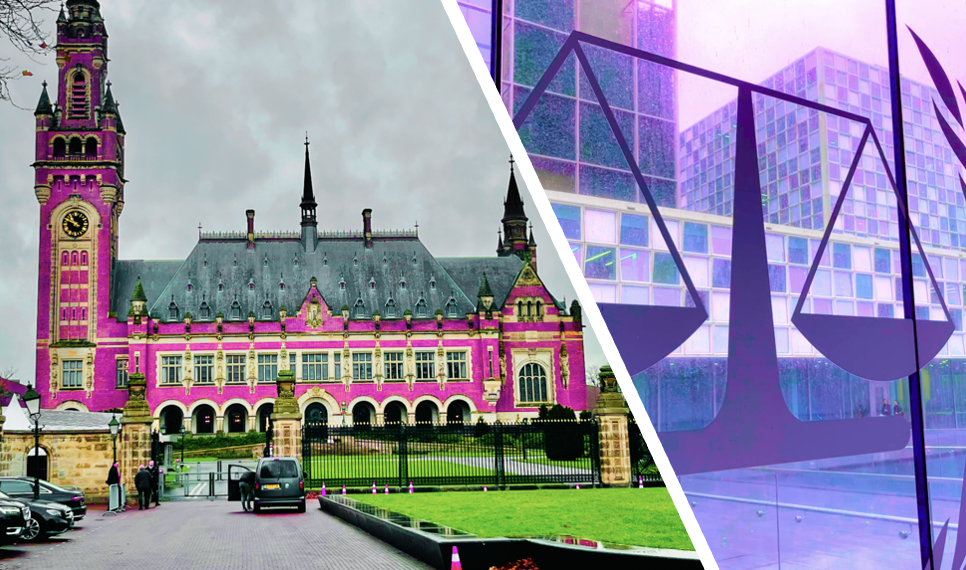
(Photo and image: Mark Kersten)
Introduction
In recent years, several wars and mass atrocity events have come under the scrutiny of not just one international court, but two. Situations like Russia’s war in Ukraine, Israel’s ongoing war in Gaza and occupation of Palestinian territories, atrocities against the Rohingya people of Myanmar, as well as the Taliban’s persecution of women and girls, have fallen under the purview of both the International Criminal Court (ICC) and International Court of Justice (ICJ). Observers of international law are accustomed to these Hague-based institutions being confused for each other in media portrayals. This confusion is unlikely to abate given the increasing overlaps between the atrocity events that have come under each court’s jurisdiction.
Few have attempted to articulate the consequences of this new dynamic or the relative strengths and weaknesses of each institution as venues to address the perpetration of international crimes, let alone their potential to work constructively and together to deliver a proverbial one-two punch of accountability for mass atrocities. With both institutions coming under increasing strain and with each susceptible to wider attacks on whatever remains of a rules-based order, such an assessment seems timely and is therefore the focus of this essay.
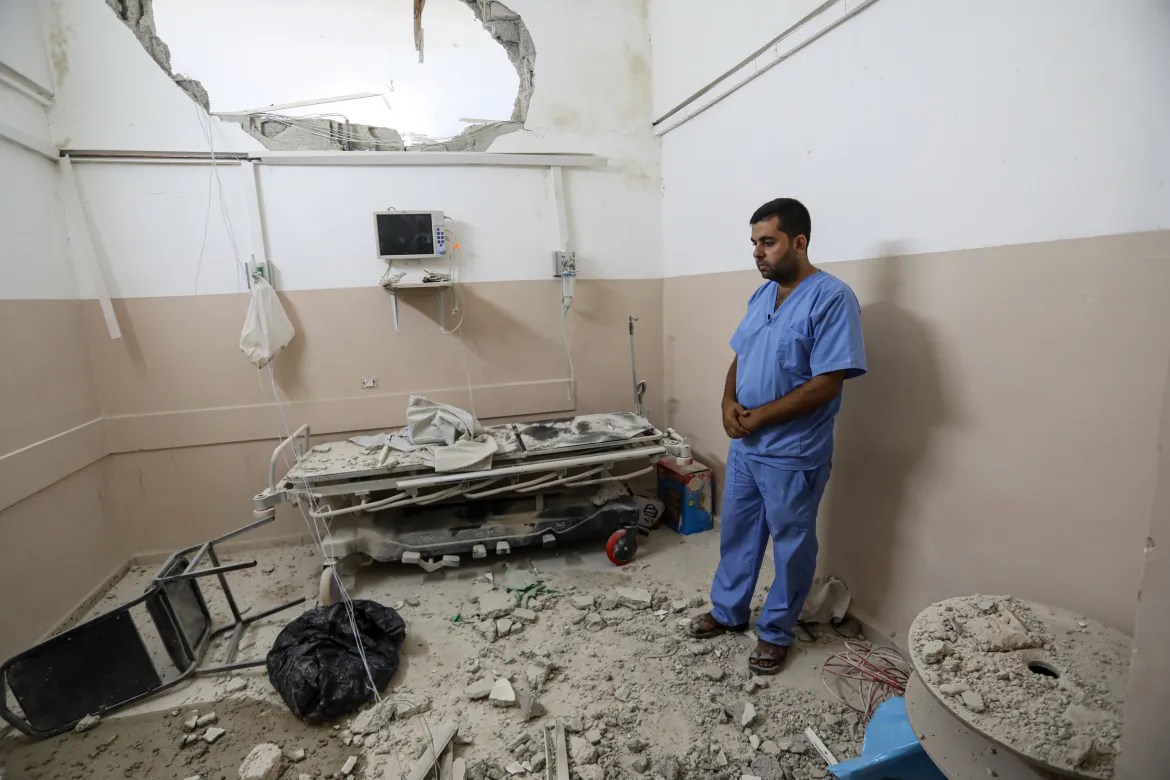
Dr Suleiman Qaoud at the Rantisi Specialist Hospital after Israeli attacks on the facility on 6 November 2023 (Photo: Abdelhakim Abu Riash/Al Jazeera)
The doctors assumed that a well-marked hospital would be safe, especially since the warring parties in the region were informed of its existence and its life-saving operations. But they were wrong, and the attacks came in waves. When it was over, the hospital walls were charred, the windows were shattered, and its roof had collapsed. Two dozen patients were killed, and many more were injured. The facility, its staff and the patients inside of the hospital were supposed to be protected from attack. At least that’s what international humanitarian law – the rules that govern conduct in war – says. But on that day, law offered no protection and those responsible for its violation escaped accountability.
The above is not a summary of recent attacks on hospitals in Gaza, Ukraine, Sudan, Iran, or Israel – though readers could be excused for assuming otherwise. It’s what happened in the early hours of 3 October 2015, when an American gunship attacked Kunduz hospital, in Afghanistan, run by Médecins Sans Frontières. The official U.S. military response to its bombing of the hospital was that the attack was a “mistake”. No justice followed. Instead, the events led to the “Not A Target” campaign, aimed at ending attacks on hospitals. As important as it is, that campaign has not worked. In recent years, attacks on medical facilities – by Russia, Israel, Sudanese armed forces, and Iran – have become an almost daily occurrence. That the wounded, sick, and disabled, as well as newborn babies, are increasingly the targets of deadly, indiscriminate attacks demands more than rhetorical condemnation. It demands accountability.
The list of hospitals and medical facilities attacked by in Sudan, Ukraine, Gaza, Israel, and Iran is disturbingly long. An accounting of each attack is beyond the scope of this article, but the numbers are staggering. In Gaza alone, it is estimated that 94% of hospitals have been damaged or destroyed by the almost 1,900 attacks waged by Israeli forces on health-care facilities.
Each attack has been met with similar shock and anger victims from victims, humanitarians, and human rights activists. Recently, the residents of Beersheeba, Israel, where Iranian missiles struck the Soroka hospital, were dismayed – and rightfully so. One doctor at the hospital said: “I never thought something like this could happen. Never.” Following military strikes on the al-Mujlad Hospital, which straddles the front lines between the Rapid Support Forces and Sudanese Armed Forces, World Health Organization chief Tedros Adhanom Ghebreyesus exclaimed: “We cannot say this louder: attacks on health must stop everywhere!”
The following article, by Dr. Mina Rauschenbach, is part of JiC’s ongoing symposium on Alette Smeulers’ new book “Perpetrators of Mass Atrocities Terribly and Terrifyingly Normal?”. Mina is Research Fellow at the Leuven Institute of Criminology (KU Leuven), an independent consultant, and a certified mediator.
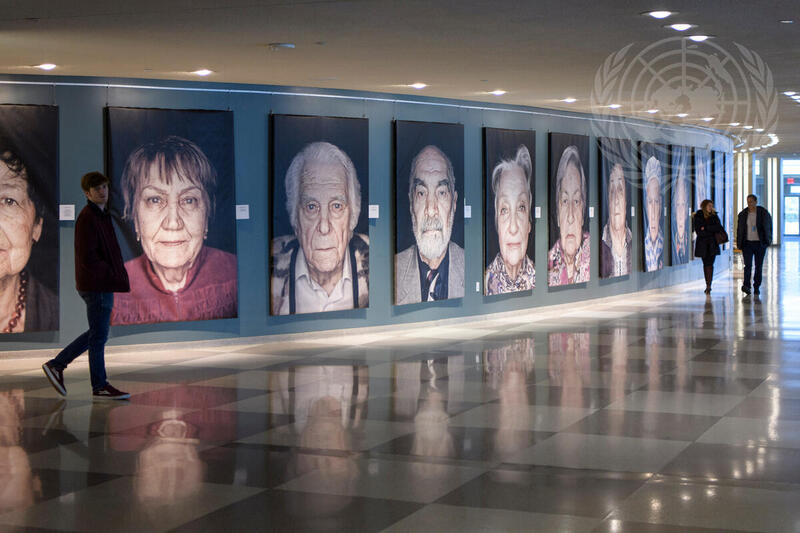
A Survivors, Victims and Perpetrators Exhibit at the United Nations headquarters in New York (Photo: UN)
Since the publication of Alette Smeuler’s book, the debates surrounding what constitutes criminal, immoral actions or moral ones within an entrenched conflict leading to mass atrocities are taking on a new salience in an increasingly complex and rapidly changing global context. In today’s significantly fragmented geopolitical landscape, the normative legitimacy of international human rights law and principles is increasingly undermined. Impunity for atrocity crimes continues unabated around the world, with the number of conflicts at a post-World War II high.
Even internationally recognised actors within the multilateral and NGO system are delegitimised in their moral authority to promote respect for international norms and to urge states to act in this regard. International norms also face unprecedented challenges amidst the global spread of political and social polarisation, which has reduced the space for traditional human rights advocacy and encouraged human rights violations.
In this troubled and volatile context, the main questions at the heart of this book – how can ordinary law-abiding citizens be involved as perpetrators in collective violence and can anyone become a perpetrator – take on full meaning. This publication offers a broad view of perpetration across a detailed typology of 14 categories which can be used as an analytical lens to better understand collective violence and its dynamics, its nuances and complexities. These typologies comprehensively demonstrate how different trajectories of perpetration result from the interplay of dispositional characteristics, individual life experiences, contextual factors related to an individual’s socio-political and structural environment, and perceived choices. Each type of perpetrator is characterised by a unique, or most salient, feature, driving force, motive and circumstance which contributed to their particular path and role in the commission of mass atrocities.
The following article by Carola Lingaas is the latest in JiC’s ongoing symposium on Alette Smeulers’ new book “Perpetrators of Mass Atrocities Terribly and Terrifyingly Normal?”. Carola is a full professor of law at VID Specialized University in Oslo (Norway). For all other submissions to the symposium, please see here.
Alette Smeulers and Nicola Quaedvlieg’s podcast ‘Terribly and Terrifyingly Normal?’ has utterly revolutionised my dog walks. From being rather uninspiring and duty-obligated routines, Mira is suddenly dragged onto hour-long walks that inspire and enrich her owner. Mira follows me reluctantly, signalling that she is ready to go home, while I stall until the respective podcast episode with fascinating conversations is finished. By now, Mira dreads the weekly release of a new episode. As an avid listener of the podcast, my expectations of Smeulers’ book, ‘Perpetrators of Mass Atrocities – Terribly and Terrifyingly Normal?’ were understandably high.
The book is like a written version of the podcast. The chapters and their sections read almost like a podcast manuscript. You can nearly hear Smeulers enthusiastically discussing her decades-long research on perpetrators. Her passion and fascination for the topic are palpable throughout the book, which is probably her magnum opus. She has set a new standard on perpetrator research with an aim to “makes us better understand the causes of mass atrocities” (p. 427).
The book provides insights into all the different aspects of perpetrators, ranging from the obvious criminological and legal sides of committing the most heinous crimes imaginable, to important historical, sociological, and psychological research that helps explain why ‘terribly and terrifyingly normal’ individuals can become perpetrators of mass violence. She shows some parallels between perpetrators from different conflicts and some not equally apparent commonalities (see e.g. pp. 27-33 or p. 40: “it is hard to find common denominators”). Nearly every chapter paints the answer to the question why everyone can become a perpetrator. Smeulers is convinced that “this is an important insight which we need to acknowledge in order to make this world a safer place” (p. 4). Given the current geopolitical earthquakes, nobody would deny that peace and safety are crucial values.
Nandor Knust joins JiC for this article, a part of JiC’s ongoing symposium on Alette Smeulers’ new book “Perpetrators of Mass Atrocities Terribly and Terrifyingly Normal?”. Nandor is an Associate Professor of Law at the Arctic University of Norway, in Tromsø. He has a rich history of practical experience during his time at international, regional, and non-governmental organisations within the field of human rights, atrocity crimes and transitional justice. All other contributions to the symposium can be found here.
(Image: Civil War Paths)
This review examines the implications of Alette Smeulers’ comprehensive typology of perpetrators of mass atrocities, as presented in her impressive work, Perpetrators of Mass Atrocities: Terribly and Terrifyingly Normal?for possible future designs and applications of transitional justice (TJ). By analysing the fourteen distinct perpetrator categories identified by Smeulers, my following little ‘thought experiment’ tries to explore how her typology can inform and enhance transitional justice mechanisms, particularly in the realms of justice, truth-seeking, and reconciliation.
Smeulers’ work is rooted in the notion that mass atrocity crimes are inherently collective in nature, manifesting within organisational frameworks and frequently involving significant numbers of otherwise law-abiding citizens. The central question driving her theoretical framework is how so many ordinary people can come to commit or enable extraordinary evil. In answering this question, Smeulers adopts an interdisciplinary approach, drawing on criminology and social psychology to complement her legal analysis. She surveys classic explanations, including obedience to authority, conformity to peer pressure, ideological indoctrination, hatred and dehumanisation of victims, greed or opportunism, fear and duress, etc. It is evident that all these factors can play a role, albeit in different ways and to a different extent, depending on the perpetrator. To summarise, there is no single cause-and-effect relationship leading to atrocities. Rather, personal dispositions (individual traits, beliefs, pathologies) interact with situational forces (group dynamics, coercive environments, war conditions) to produce varying outcomes. This theoretical stance explicitly rejects a one-size-fits-all portrayal of the atrocity perpetrator, emphasising nuance and diversity.
The foundation of Smeulers’ framework is a typology of fourteen perpetrator types. She developed this by studying individuals involved in mass violence from World War II to contemporary conflicts. By examining biographies, diaries, interviews, trial records and prior scholarship, she groups perpetrators according to common motivators and roles.




 Justice in Conflict