
JiC’s symposium on the trial of Dominic Ongwen and the prosecution of child soldiers continues with this contribution by Alex Whiting. Alex is a Professor of Practice at Harvard Law School where he focuses on international and domestic prosecution issues. He previously worked as a prosecutor at the International Criminal Court and International Criminal Tribunal for the Former Yugoslavia. For a list of the other contributions to the symposium, see here.
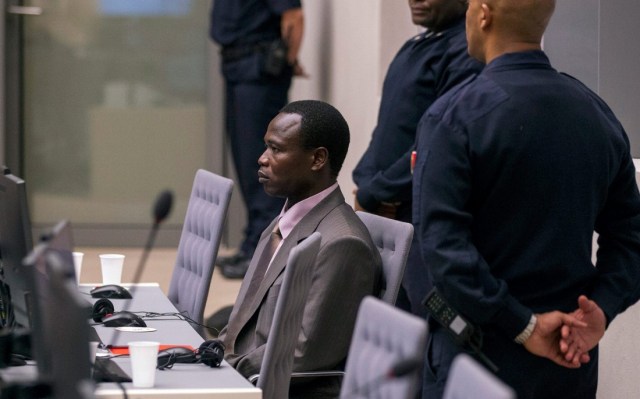
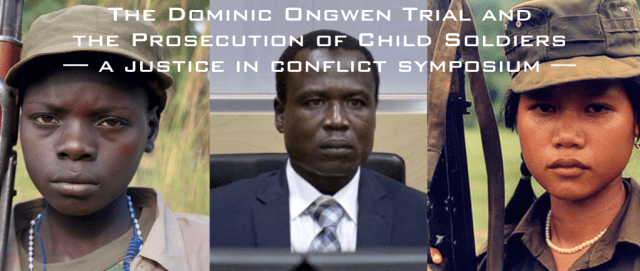
Dominic Ongwen during pre-trial proceedings at the International Criminal Court (Photo: ICC)
The title of this post is admittedly a little misleading. In one way, of course, the prosecution of anyone by an international court for war crimes and crimes against humanity is an extraordinary, not to mention challenging, event. But in all other respects, the case against Ongwen is straightforward. In particular, the fact that Ongwen was himself abducted into the Lord’s Resistance Army at the age of 12 (the defense alleges it was at age 9.5), and made into a child soldier, before allegedly committing crimes himself against others between the ages of 27 and 30, changes nothing about whether he is legally responsible for those crimes. That Ongwen was a victim before becoming a perpetrator may be ironic and sad. It may be an interesting story. And it may be paradoxical and/or depressing. But it is not a legal defense to the crimes charged against him. At most, it may be a consideration at sentencing if Ongwen is convicted, but even here I have my doubts.
Ongwen is charged with 70 counts of war crimes and crimes against humanity, including murder, attempted murder, torture, rape, forced marriage, sexual slavery, forced pregnancy, persecution, cruel treatment, other inhumane acts, outrages upon personal dignity, enslavement, attacks against the civilian population as such, conscription of children under the age of 15, use of children under the age of 15 in hostilities, pillaging and destruction of property.
Some of these crimes are charged as war crimes, some as crimes against humanity, and some as both. Ongwen is accused of committing certain crimes himself as a direct perpetrator – specifically some of the charges of rape, torture, forced marriage, sexual slavery, enslavement and forced pregnancy – while it is alleged he committed other crimes with or through others.
At the confirmation hearing, Ongwen’s defence argued that, because he was a victim of crimes as an abducted and coerced child soldier, he cannot be convicted of the grave crimes he is alleged to have committed almost a decade after he turned 18, the minimum age of responsibility under the Rome Statute (Article 26). The Pre-Trial Chamber correctly brushed aside these arguments.
First, Ongwen argued that because he did not leave the LRA until 2015, at age 30, he must be considered a “child soldier” until that time, and therefore cannot be prosecuted. In this regard, the defense argued that child soldiers are psychologically broken down, desensitized and dehumanized. That is certainly true as a general matter, and may even be true in Ongwen’s case, but it is simply not a defense to committing crimes oneself.
To the extent that there exist protections for child soldiers in international law and the Rome Statute, they are tied to age and disappear when the individual legally becomes an adult. Further, the Rome Statute does not recognize as a defense that the accused developed a criminal state of mind because of his or her past experiences. Nor should it. It is not uncommon that defendants at international criminal tribunals, or in domestic criminal courts, have themselves been the victims of crime, or have suffered traumatizing experiences in their past.
Ongwen’s story is simply a variation on this common reality because he was apparently the victim of one of the same crimes he is alleged to have committed: the conscription of child soldiers. But even this variation is not that unusual: it is well known that many who commit abuse or violence on others have themselves been the victim of abuse or violence. Unless one’s past experiences rise to the level of duress (addressed in the next paragraph) or result in a mental disease or defect that destroys the accused’s “capacity to appreciate the unlawfulness or nature of his or her conduct,” something Ongwen has not alleged, then the law imposes an undiluted obligation to refrain from committing crimes against others. There is simply no license for the victims of crime to victimize others. Continue reading



 Justice in Conflict
