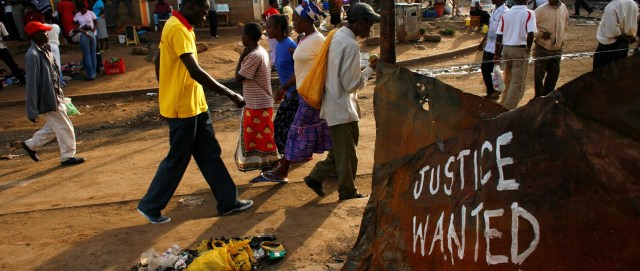

A 2011 scene from Tripoli street in the Libyan city of Misrata (Photo: Zohra Bensemra / Reuters)
It has been a decade since the international community endorsed the principle of “Responsibility to Protect.” But with hundreds of thousands dead in civil conflicts around the globe, it is clear that the expectations set by this doctrine are not even close to being met.
Adopted by the United Nations in 2005, Responsibility to Protect (R2P) encompasses a deceivingly simple, two-part proposition: First, states have a primary responsibility to protect their citizens from war crimes, crimes against humanity, genocide and ethnic cleansing; and second, if states are unable or unwilling to protect their citizens from such crimes, the responsibility is transmitted to the international community.
When the United Nations Security Council evoked R2P language in response to the 2011 Libyan civil war, many academics and diplomats found cause to celebrate. R2P had finally arrived. Five years later, however, states have refused to apply R2P to the crisis in Syria while a spiral of political violence ravages Libya. What does this mean for the fledgling doctrine?
The international community’s disregard for R2P in Syria certainly does harm to the doctrine. So too does Libya’s languishing in a violent political crisis and the allegations that R2P acted as a veneer for regime change. But what has also wounded R2P is the hubris of some of its proponents — those who over-confidently insisted that R2P had been invoked when it hadn’t and that it existed where it didn’t. By raising expectations bound to be frustrated, these advocates have hurt the R2P doctrine they hoped to elevate.
R2P’s architects and supporters saw the doctrine as a means to fundamentally transform how we conceptualized state sovereignty and responsibility, overlapping the two concepts to entrench and propagate respect for universal human rights and the sovereign integrity of states. But the principle experienced a rather rocky birth. Despite a multitude of candidate situations, in its first years R2P was never successfully invoked as a means to effectively protect civilians. While the doctrine had achieved what international human rights expert David Scheffer called “rhetorical presence” in international relations and law, little substantive advances have been made. In 2008, Gareth Evans, one of R2P’s chief proponents, asked whether it was “an idea whose time has come … and gone,” and observed that states seemed to exhibit “buyers remorse” towards the idea. Making matters worse, when R2P-type language was eventually evoked by states, it was done to advance nefarious political interests. Russia, for example, employed R2P-style rhetoric to justify its invasion of Georgia in 2008 and, later, its annexation of Crimea. In short, R2P’s future looked bleak.
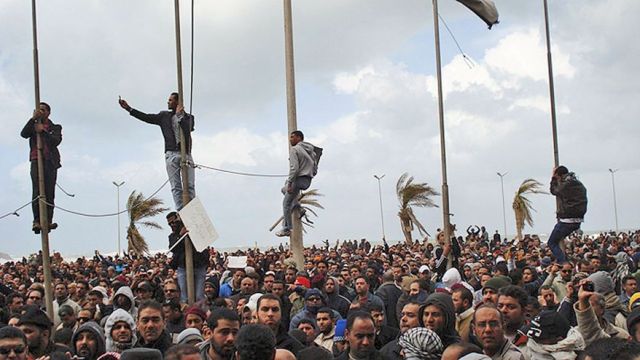
But as the regime of Moammar Gaddafi threatened to indiscriminately slaughter citizens protesting the dictator’s forty-year rule in early 2011, Libyan diplomats joined states across the region and world to call for an intervention to protect civilians. The U.N. Security Council responded by passing two resolutions. On Feb. 26, 2011, Resolution 1970 was passed unanimously. In referring the situation in Libya to the International Criminal Court, the council recalled “the Libyan authorities’ responsibility to protect its population.” A few weeks later, the council passed Resolution 1973, which evoked the language of R2P even more substantively by “[r]eiterating the responsibility of the Libyan authorities to protect the Libyan population and reaffirming that parties to armed conflicts bear the primary responsibility to take all feasible steps to ensure the protection of civilians.” Resolution 1973 subsequently authorized U.N. member states to take “to take all necessary measures … to protect civilians and civilian populated areas under threat of attack in the Libyan Arab Jamahiriya.”
Proponents of R2P immediately heralded the language of Resolutions 1970 and 1973. For Ramesh Thakur, one of R2P’s architects, the apparent invocation of the doctrine was a “game-changer” that “breathed life” into R2P. Academics Alex Bellamy and Paul Williams went so far as to assert that, “Libya reflects a new politics of protection.” U.N. Secretary-General Ban Ki-moon emphatically declared that “Resolution 1973 affirms, clearly and unequivocally, the international community’s determination to fulfill its responsibility to protect civilians from violence perpetrated upon them by their own government.” International relations and U.N. expert Thomas G. Weiss similarly stated that Libya signaled that R2P was “alive and well.”
The problem with such proclamations was that, in their overzealous drive to read R2P into Resolutions 1970 and 1973, many scholars and diplomats alike failed to realize that neither resolution actually operationalized the R2P doctrine. Continue reading