
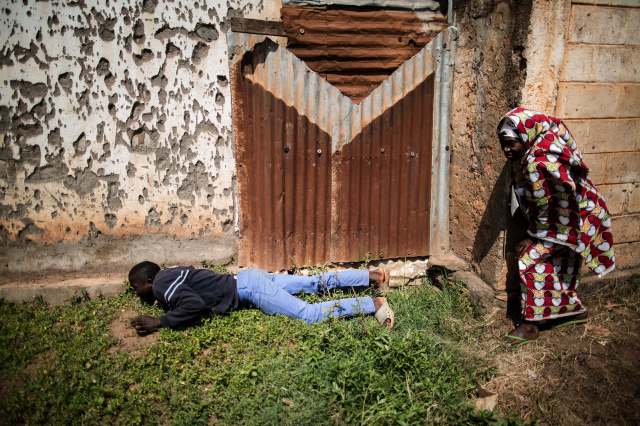
Muslim civilians in Bangui take cover to avoid heavy gunfire directed towards the Baya Dombia school where voters were gathering for the Constitutional Referendum on December 13, 2015.
(Photo: Marco Longari / AFP)
There is no point denying it. The current global production of mass atrocities far outweighs the tools and institutions that exist to respond to them. There is a far greater demand for, than supply of, international justice. We often hear about the development, growth, and entrenchment of a “system” of international justice. But Stephen Rapp, the former U.S. Ambassador-at-Large for War Crimes Issues, recently remarked: “there isn’t a global system of justice, just some cases in The Hague and a few other places”.
Despite lofty rhetoric, the International Criminal Court (ICC) was never going to be a silver-bullet solution to creating a system of international justice. That’s not the institution’s fault, but it is high time the international community look beyond the ICC towards establishing a network of institutions and organisations that can, together, cohere into such a system of global accountability. As just one part of that, serious consideration should be given to the establishment of a permanent hybrid tribunal to prosecute mass atrocities.
In 1998, when states gathered to negotiate the Rome Statute of the International Criminal Court, the preponderant idea was to move away from an ad hoc approach of international criminal justice to a permanent system that would, eventually, become universal in reach. And who knows, it might yet achieve that aim. But it won’t do so any time soon. While most states are members of the ICC, the most powerful countries — including Russia, China and the U.S., as well as the vast majority of the world’s population — lie outside of the Court’s jurisdiction. Moreover, if the lack of adequate funding of the ICC as well as the UN Security Council’s apathy and inaction on matters of international criminal justice are any indication, state interest in an effective and independent ICC is lukewarm — at best.
Making matters worse, states that were once staunch supporters of the Court are, at the very least, re-thinking their allegiances. The ICC’s Office of the Prosecutor itself understands its limitations, publicly admitting that the institution has a “basic size”, meaning that it can only afford to open a small number of investigations and have a small number of ongoing trials in any given year moving forward. Some, like Elizabeth Evenson of Human Rights Watch and Jonathan O’Donahue of Amnesty International, have described this situation as “the ICC’s capacity crisis”. But even if the ICC wasn’t facing such difficult times, the Court is inherently limited in what justice it can mete out. Even in an ideal world, the Court is structured in such a way that it would never be able prosecute all actors responsible for international crimes. And neither can states, particularly those emerging from violent political conflict. Some ‘outside the box’ thinking is needed.
The limits of what the ICC can achieve with regards to delivering justice and accountability point to the need to think beyond The Hague as the sole capital of international criminal justice. In the world of international criminal law, the ICC should not be, does not need to be and cannot be, the only game in town. Today, the widespread view that the Court should displace all ad hoc and hybrid tribunals seems as trite as it is misplaced. No tribunal type should be discarded entirely, certainly not in the name of the ICC, an institution that structurally and politically can only prosecute a tiny sliver of perpetrators.
As a result of the ICC’s limited reach, the incapacity of states to prosecute international crimes themselves, and the increasing expectation that justice be pursued in the wake of mass atrocities, we are witnessing the rehabilitation of other forms for tribunals, including the hybrid model. Last year, the Central African Republic (CAR) passed legislation establishing the Special Criminal Court. Early signs suggest that if any criminal tribunal is set up in South Sudan to deal with recent unrest, it also will take the form of a hybrid tribunal. While the push for a Security Council referral of Syria to the ICC has absorbed the lion’s share of global attention, there has also been persistent talk of the potential to create an ad hoc, possibly hybrid, court to deal with crimes perpetrated during the Syrian civil war. All of these tribunals, like their predecessors for Cambodia, Sierra Leone, Lebanon, etc., would be temporary. But what if there was a single institution which could host all of these hybrid courts? Continue reading








 Justice in Conflict