In the ICC’s Interest: Between ‘Pragmatism’ and ‘Idealism’?

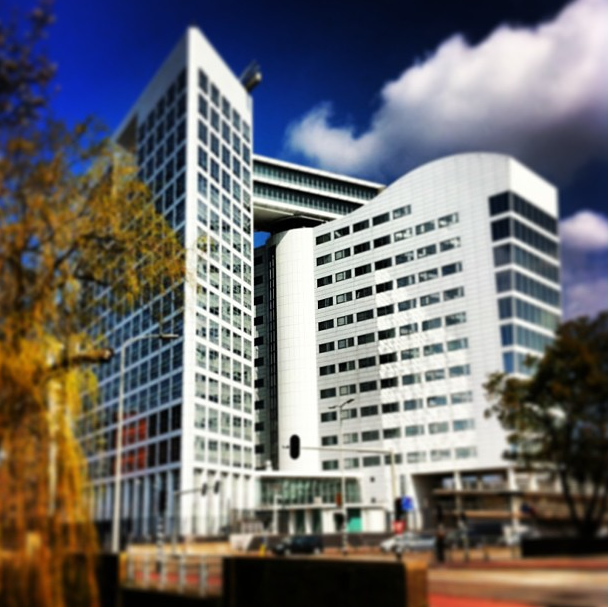
(The International Criminal Court. Photo: Mark Kersten)

(The International Criminal Court. Photo: Mark Kersten)

It is a regular occurrence to hear how the International Criminal Court (ICC) serves the interests of of particular actors, be it warring governments, rebel groups, or members of the international community more broadly. Rarely, however, have scholars and observers considered how the ICC’s decision-making is shaped by the ICC’s own ‘institutional self-interest’.

At the heart of criticisms that the ICC is ‘political’ is the view that the Court is inherently and inevitably selective. This critique is deployed both within and between situations. In cases such as Uganda, Cote d’Ivoire and Libya, it is argued that the ICC has erred in targeting only one side of the conflict. Alternatively, it is argued that the Court focuses myopically on the weakest states in the international community (see the ICC-Africa debate), leaving situations where major power interests collide (e.g. Iraq, Syria and Afghanistan) beyond the reach of international justice.

At the same time, the ICC has a well-rehearsed and institutionalized answer to these critiques: the Court can only investigate where in those states where it has jurisdiction; it can only investigate the ‘gravest’ crimes; and it will only seek to bring to account those individuals ‘most responsible’ for war crimes, crimes against humanity and genocide.

These arguments are familiar to observers of international criminal justice. Each has merit and undoubtedly guides the decision-making and reasoning of the Office of the Prosecutor (OTP). But there is something else going on. It isn’t nefarious but it isn’t particularly transparent either.

At an event held by the Coalition for the International Criminal Court (CICC), newly appointed ICC Deputy Prosecutor James Stewart made the following observation:

“The Prosecutor, for example in the case of Cote D’Ivoire, has always made it clear that she intends to look at all sides of the conflict. Sometimes you just can’t do everything at once. You have to make a choice between action and paralysis and between pragmatism and ideals. And I think if you choose pragmatic action, you really shouldn’t be criticized. But in the end, I suppose history will tell us whether or not the OTP has acted appropriately.”

While it is important to note that Stewart’s comments pertain specifically to the case of Cote d’Ivoire, there are grounds to suggest that such an approach is applicable to the OTP’s approach to (at least some) other situations.

There are at least three important points to take away from Stewart’s comments:

1) In at least some of its cases, the OTP believes that the ‘ideal’ is to prosecute all sides of a conflict.

2) The OTP believes that actually targeting both sides at the same time would harm its interests and the interests of justice, resulting in paralysis.

3) When faced with the dilemma of targeting one side of a conflict and not others, the OTP views being selective as a ‘pragmatic’ choice.
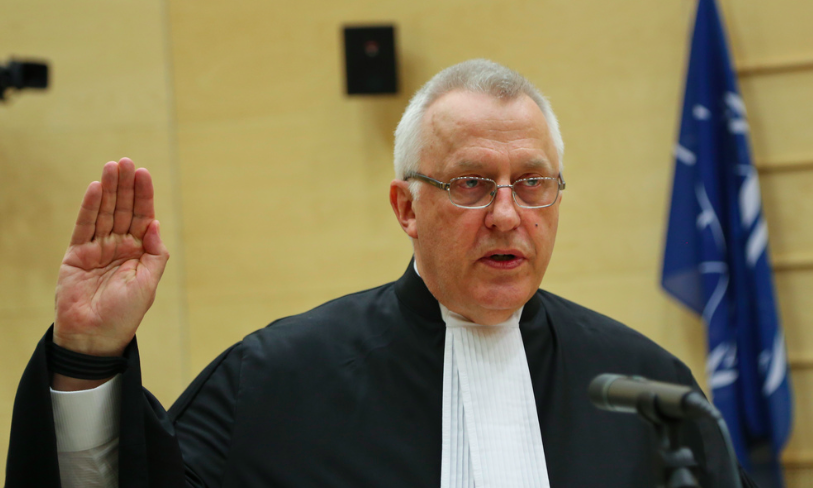
Deputy Prosecution James Stewart. (Photo: ICC)

Deputy Prosecution James Stewart. (Photo: ICC)

This adds a new layer to our understanding of how OTP decisions are made. It suggests that the OTP’s political calculus takes into account not only what is good for international justice but also what is good for the Court. Ultimately, then, at least four groups of political actors and their positions will potentially influence ICC decisions:

1) The position of the referring actor, especially when it is a state (e.g. Government of Uganda) or the Security Council (e.g. in the case of Darfur and Libya). These actors will try to encourage or coerce the ICC into investigating individuals and groups they view as ‘enemies’ (e.g. the Lord’s Resistance Army in northern Uganda and the Gaddafi regime in Libya). Notably, in no case of a self-referral has any individual from the referring party been indicted by the Court.

2) The position of ‘global civil society’ and the international ‘human rights community’. These actors, by and large, advocate the normative and moral principles underpinning the ICC and the impartial investigation of all sides responsible for international crimes. Inevitably there will be some exceptions (e.g. Invisible Children in Uganda propelling cases against the LRA and not the Government of Uganda). Importantly, these actors have effects not only on the Court but on other members of the international community, although their ‘normative reach’ across cases is up for debate.

3) The position of interested states in the international community, especially major powers. The ICC is likely to be prodded or encouraged to focus its work in specific ways and to investigate or not investigate certain cases where the interests of powerful actors are at play (see US position on ICC investigations in Palestine and Iraq; China, Russia and US position on ICC investigations in Syria).

4) The position of the ICC itself. This has changed dramatically as the Court has progressed from a nascent institution that was once unsure how long it would survive to one with 120 member-states and eight situations in its docket. Numerous forces, including those above, affect the ICC’s position and conception of self-interest. Broadly, the Court is expected to pursue decisions that can foreseeably add to its legitimacy and political credibility.

So what does this ‘pragmatism’ look like in practice? Let’s briefly consider two examples: Uganda and Libya. Continue reading
Posted in Deputy Prosecutor, ICC Prosecutor, International Criminal Court (ICC), Justice | Tagged | 6 Comments

Could the International Criminal Court be a Development Agency?

Teddy Nicholson joins JiC with this unique and insightful guest-post on the relationship between development and international criminal justice. A version of this piece was originally posted on the new site, The Development Blog. Check it out!

(Photo: Think-UNAS.org)

(Photo: Think-UNAS.org)

When we talk about the growing field of international criminal law, and especially the International Criminal Court (ICC), our first image is generally of warlords and political leaders sitting in the dock. It’s not an image of a development agency. There are good reasons for this and to begin this post by answering the question ‘Is the ICC a development agency?’, the answer is no – the ICC is definitely not a development agency. However, that answer obscures an important and increasingly rich debate within international justice circles about how to pull the fields of international criminal law and development closer.

There is a tendency in international affairs to separate issues into defined silos. Security people deal with military issues,diplomats and ‘IR-types’ with foreign policy, international justice people with courts and tribunals, and development people with development. It is of real note and interest therefore, when these sectors begin to intersect, in particular when they do so in unexpected and unforeseen ways. We start to see the possibility for a more holistic view of international affairs through a degree of joined-up thinking.

Over the past few years, the discourse surrounding the International Criminal Court has slowly but steadily begun to incorporate issues not just of law, but also of development. This was neither intended nor desired by many of the architects of the ICC, and yet it has been a logical consequence of the way in which the Rome Statute has been drafted.

Some context is necessary. The purpose of the ICC is to investigate and prosecute individuals who are alleged to have committed war crimes, crimes against humanity, or genocide. This it has done with varying degrees of success in eight countries since its inception in 2002 – two trials have been completed and a number of others are ongoing. Throughout this time, the Court is frequently accused of having an anti-Africa bias given that all eight situations under investigation are relating to African states.

The criticism is somewhat legitimate, and there are plenty of reasons for this. One of them is to do with the way the ICC’s jurisdiction works.

The ICC’s doctrine of “complementarity” distinguishes the ICC from previous international courts (see Yugoslavia and Rwanda) which had primary jurisdiction – if they wanted to try a case they could do it, even against the objections of the state in question. The ICC by contrast is forced to defer to States and only proceed if the state cannot or will not do so itself.

This idea has been under discussion by the States that are parties to the Rome Statute for a number of years now, since it implies far more than the simple idea that the Court must back off if the State in question investigates and prosecute international crimes. It means that States Parties to the Rome Statute have something in between an incentive and an obligation to develop their justice systems to the point where they are capable of handling cases against the perpetrators of these crimes.

ICC Judges: Development Workers? (Photo: CICC)

ICC Judges: Development Workers? (Photo: CICC)

This suddenly places the ICC squarely in the field of development. We now have an image of what true “joined-up” thinking between international justice, the rule of law, and development might look like.

The idea, which remains poorly articulated and defined, is that the ICC is an institution that is to be seen as the tip of the iceberg of an enormous, global “Rome Statute system”. This means that when a State becomes a party to the Rome Statute, they have an international legal obligation to ensure that they do not allow a justice gap to emerge. They are obliged to prosecute alleged perpetrators of crimes domestically, but if they cannot or will not then the ICC can step in.

Politically speaking, it may be embarrassing for a state to allow the ICC to intervene. The image of the Court opening an investigation is a clear signal that that state’s judicial system is inadequate and that the state’s rule of law is not sufficiently developed. Therefore, in order to avoid this, states have a fairly clear incentive to develop their judicial systems to the point where they can do it themselves.

This is far from theoretical – the Office of the Prosecutor (OTP) opened a Preliminary Examination (the stage before a formal investigation) into the conflict in Colombia in June 2004, shortly after the ICC was established. Over the past decade, the OTP has repeatedly engaged with Colombia as a partner and used the possibility of opening an investigation as a way of spurring the government to improve their judicial record. This has been far from a smooth process, but progress has definitely been made with some improvements in the Colombian judicial system and an increasing focus by the government on ensuring that prosecutions do happen. Continue reading

Posted in Development, International Criminal Court (ICC), International Law, Justice | 2 Comments

Backing the ICC: Why Botswana Stands Alone Amongst AU States

In the midst of the recent rancour and controversy in the relationship between African Union (AU) member states and the International Criminal Court (ICC), it was all too easy to forget that one state decided to take a rather valiant stand. When the African Union recently passed a resolution calling into question the conduct of the ICC and claiming that it had unfairly targeted African leaders, the sub-Saharan nation of Botswana decided it wasn’t having any of it.

If you read the AU resolution, you’ll notice that it includes a single footnote which reads: “The Reservation of the Republic of Botswana on the entire decision was entered.” But for that small footnote marring the title of the Resolution, the AU’s anti-ICC pact is otherwise pristine. For those who follow baseball, the footnote is akin to the asterisk hanging over the names of players whose records are tainted by steroid use – except that, in this case, the asterisk denotes courage not cowardice.

Sadly, it was only Botswana that decided to take a stand against the AU Resolution. It came as a disappointment that other state which had previously engaged the ICC and supported its work, including Ivory Coast and South Africa, threw their weight behind the Resolution. Even The Gambia, which reportedly considered voting against the Resolution out of support for the ICC’s Gambian Chief Prosecutor Fatou Bensouda, sided with the AU.

So why did Botswana do it?

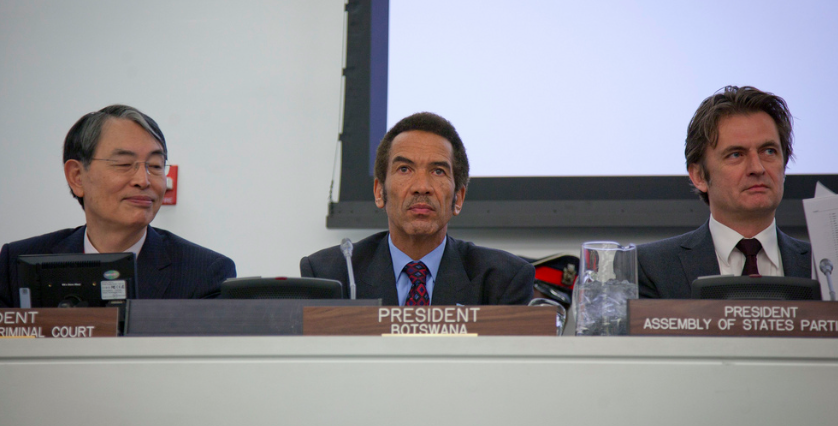
Seretse Khama Ian Khama of Botswana sitting with ICC President Judge Song and former President of the Assembly of States Parties, Christian Wenaweser. (Photo: CICC)

Seretse Khama Ian Khama of Botswana sitting with ICC President Judge Song and former President of the Assembly of States Parties, Christian Wenaweser. (Photo: CICC)

In the above video, Botswana’s ambassador to Kenya, John Moreti states clearly that his country’s decision had nothing to do with the Botswana’s position towards Kenyan President Uhuro Kenyatta or Vice President William Ruto, both of whom face charges at the ICC stemming from Kenya’s 2007/08 post-election violence. Instead, Moreti suggested that the AU’s Resolution was an unhelpful and deleterious political move that would only antagonize the Court and pull the African hinder improved relations with the international community. He added that he thought there was “no problem with the Court” and that any dislike of the Prosecutor did not amount to dislike for the Court itself. Continue reading

Posted in African Union (AU), Botswana, International Criminal Court (ICC), Kenya, Kenya and the ICC | 12 Comments

Plus Ça Change: Museveni and the ICC

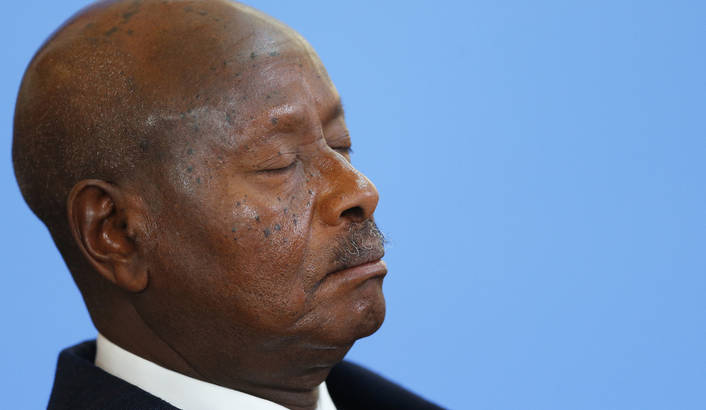
(Photo: Andrew Winning / Reuters)

(Photo: Andrew Winning / Reuters)

Judging by his recent statements, Yoweri Museveni has had it with the International Criminal Court (ICC). In the midst of ongoing acrimony between the African Union and the ICC, the Ugandan President has led the charge with a vocal and belligerent barrage of criticism.

Following the victory of Uhuru Kenyatta and William Ruto in Kenya’s recent Presidential elections, Museveni exclaimed:

“I want to salute the Kenyan voters on…the rejection of the blackmail by the International Criminal Court (ICC) and those who seek to abuse this institution for their own agenda… I was one of those that supported the ICC because I abhor impunity. However the usual opiniated and arrogant actors using their careless and shallow analysis have now distorted the purpose of that institution. They are now using it to install leaders of their choice in Africa and eliminate the ones they do not like.”

A few weeks later, Museveni asserted that there was a conspiracy afoot to kidnap Kenyatta if he travelled to The Hague:

“ICC should tell us if they plan to detain (Kenyan President Uhuru) Kenyatta. They should give us an explanation if he is going to come back to Kenya because the information we are receiving is different.

We will not agree to have him attend if the intention is to detain him. If we don’t have a clear picture of the plans by the International Court, then it means our relations with them will be soured. They should treat us with dignity.”

For proponents of the ICC, Museveni’s remarks might seem like a slap in the face. After all, it was only a few short years ago that Museveni lobbied hard – and successfully – to ensure that the the ICC’s Review Conference was held near Kampala. Of course, Uganda also issued the the first-ever self-referral to the Court in December 2003. At the time, Museveni and then-ICC Prosecutor Luis Moreno-Ocampo famously stood together in a London hotel to announce their cooperation in the hunt for Joseph Kony and the Lord’s Resistance Army (LRA).

In 2005, when the ICC intervened and issued arrest warrants against the LRA’s senior command, it helped legitimize Museveni’s government as well as its commitment to a military solution against Kony and the LRA. It painted Museveni the leader of a good government fighting against a satanic rebel group and its psychotic leader. Uganda reaped the rewards of military aid and international legitimacy. It was increasingly rare to hear criticisms of the government of Uganda. After all, they were crusading in the name of international criminal justice!

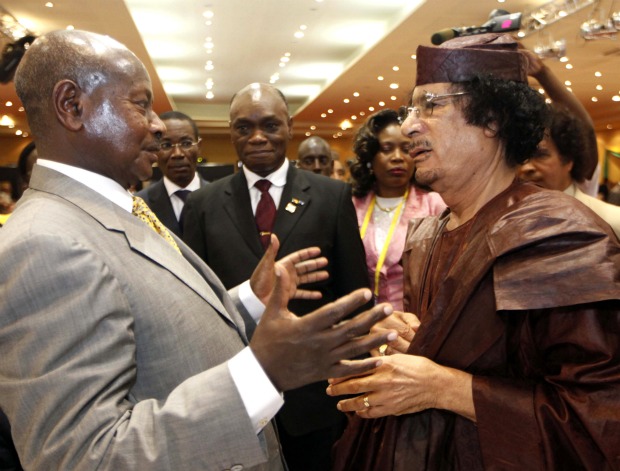
(Photo: Mahmud Turkia/AFP/Getty Images)

(Photo: Mahmud Turkia/AFP/Getty Images)

The ICC’s intervention also had the effect of vindicating Uganda’s military. By refusing to prosecute the atrocities the Ugandan People’s Defence Force (UPDF) committed (and they committed many), the Court sent the message that the UPDF was not complicit or responsible for crimes against civilians in northern Uganda or the Great Lakes region.

Thus, you would think that Museveni was thrilled with the ICC. Clearly he isn’t. So what happened? Continue reading

Posted in International Criminal Court (ICC), Lord's Resistance Army (LRA), Uganda | Tagged , , | 1 Comment

ICC Rules: Saif Gaddafi Should be Tried in The Hague, Not Libya

Saif al-Islam during a court appearance in Zintan earlier this year (Photo: BBC)

Saif al-Islam during a court appearance in Zintan earlier this year (Photo: BBC)

Judges at the International Criminal Court (ICC) have finally ruled on Libya’s admissibility challenge regarding Saif al-Islam Gadadfi. The ICC’s Pre-Trial Chamber has decided against Libya’s request to try Saif in Libya and have reiterated their demand that Saif be surrendered to The Hague.

It took 13 months – in sharp contrast to the 3 months it took the Court to move from accepting a UN Security Council referral to issuing arrest warrants against Gaddafi, his father and Abdullah al-Senussi – but the Judges were unequivocal in their ruling:

In this Admissibility Challenge, the Chamber has not been provided with enough evidence with a sufficient degree of specificity and probative value to demonstrate that the Libyan and the ICC investigations cover the same conduct and that Libya is able genuinely to carry out an investigation against Mr Gaddafi. The Chamber finds that the present case is admissible before the Court and recalls Libya’s obligation to surrender the suspect.

And from the Court’s press release on the subject:

Today, 31 May 2013, the Pre-Trial Chamber I of the International Criminal Court (ICC) rejected the challenge to the admissibility of the case against Saif Al Islam Gaddafi suspected of crimes against humanity of murder and persecution, allegedly committed in Libya from 15 February 2011 until at least 28 February 2011. The Chamber reminded Libya of its obligation to surrender the suspect to the Court. The Libyan authorities may appeal this decision or submit another challenge to the admissibility in accordance with article 19(4) of the Rome Statute. A challenge to the admissibility of the case is granted if the case is being investigated by a State which has jurisdiction over it, unless the State is unwilling or unable genuinely to carry out the investigation or prosecution. The challenge to the admissibility of the case against Mr. Gaddafi was submitted by Libya on 1 May 2012 and the Chamber conducted an assessment of the evidence presented by the parties and the participants.The Chamber concluded that it has not been sufficiently demonstrated that the domestic investigation cover the same case that is before the Court.

In addition, the Chamber recognized Libya’s significant efforts to rebuild institutions and to restore the rule of law. The Chamber, however, stressed that the Libyan State continues to face substantial difficulties in exercising fully its judicial powers across the entire territory. Namely, the Libyan authorities have not been able to secure the transfer of Mr Gaddafi into State custody and impediments remain to obtain the necessary evidence, and secure legal representation for Mr Gaddafi.

You can also listen to an MP3 explaining the Court’s decision here.

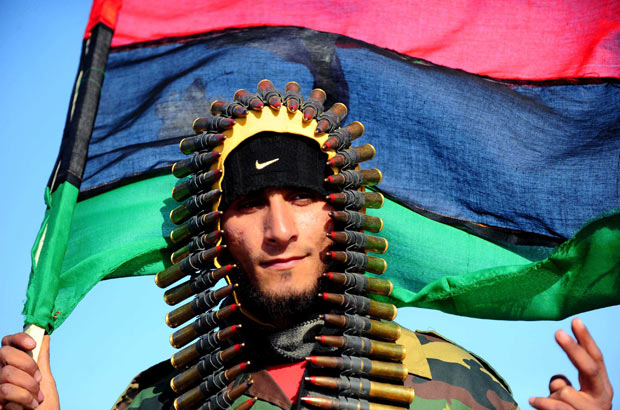
It remains to be seen how Libya will respond to the Judge's ruling (photo: Sipa Press / Rex Features)

It remains to be seen how Libya will respond to the Judge’s ruling (photo: Sipa Press / Rex Features)

There will undoubtedly be much to say and debate on the Court’s rulings in the coming days, including at JiC. But here are a few quick thoughts on the subject:

First, it is important to remember that this ruling pertains only to the case of Saif al-Islam Gaddafi. Libya’s admissibility challenge regarding Abdullah al-Senussi is still pending and, as I think many legal scholars would concur, stands a better chance of succeeding.

Second, the fact that Saif remains in the custody of a Zintani brigade and not the Libyan government played a major in the Judge’s decision:

the Chamber is of the view that its national system cannot yet be applied in full in areas or aspects relevant to the case, being thus “unavailable” within the terms of article 17(3) of the Statute. As a consequence, Libya is “unable to obtain the accused” and the necessary testimony and is also “otherwise unable to carry out [the] proceedings” in the case against Mr Gaddafi incompliance with its national laws, in accordance with the same provision…

…Libya is, in the view of the Chamber, unable to secure the transfer of Mr Gaddafi’s custody from his place of detention under the Zintan militia into State authority and there is no concrete evidence that this problem may be resolved in the near future. Continue reading

Posted in Admissibility, International Criminal Court (ICC), Libya, Libya and the ICC | Tagged | 2 Comments

Africa and the ICC: Some Unsolicited Advice

(Photo: VOA News)

(Photo: VOA News)

Allegations that the International Criminal Court (ICC) is biased against Africa aren’t going away. On the contrary, in the wake of the victory of Uhuru Kenyatta in Kenya’s recent Presidential elections, they seem to be increasingly common. Most recently, at the African Union summit in Addis Ababa this week, Ethiopia’s Prime Minister Hailemariam Desalegn declared that the ICC is “hunting” Africans because of their race.

I continue to maintain that the Court is not biased against Africa, neo-colonial nor racist. Africa is not monolithic and many states continue to support the ICC and its mandate. As has often been pointed out, many African citizens don’t share the views of their governments and, in fact, would like to see them held accountable. At the same time, even if some cases that aren’t before the Court should be, no case or situation currently before the Court shouldn’t be. As Abdul Tejan-Cole writes, “while it is true that the ICC can be lambasted for inconsistent case selection, there is not a single case before the Court that one could dismiss as being frivolous or vexatious.” Moreover, in cases where the Court has functioned to bolster the legitimacy and the political and military aims of African leaders (like Museveni in Uganda, Ouattara in Cote D’Ivoire, and Kabila in the Democratic Republic of Congo), governments have been more than happy to accept and manipulate the Court’s interventions for their own political purposes.

At the same time, it would be folly to deny the fact that the ICC works within an international structure that is far too unequal and within an international hierarchy that no longer reflects the distribution of power in the world. This structure reinforces the reality that powerful states are too often shielded from accountability. The Court’s promise was to transcend this by being an impartial institution independent of the realpolitik machinations of institutions like the United Nations Security Council and ‘great powers’ like the United States. It hasn’t been able to do so. That’s no secret. No honest advocate of international criminal justice can say that he or she is satisfied with the current reach of international criminal justice. The Court is selective and that is a problem.

So how did we get here? In my view, part of the problem comes down to the ‘perception game’ – how the ICC has communicated its work and decision-making.

Too often the ICC and its strongest proponents have responded to criticisms by being reactionary and defensive rather than reflective and measured. Far too often the Court has blamed its negative perception on external sources, refusing to take responsibility for how it is perceived by others. In an interview that touched on the question of the Court’s perceived bias against Africa, Bensouda suggested that it was the media’s fault. More recently, when recently asked about whether the Court has dealt poorly with the perception that it is biased against Africa, Bill Pace, the head of the Coalition for the International Criminal Court, responded by apportioning blame on the media and academia (update: see Pace’s response to this post in the comments below).

It is unwise and possibly even dangerous to refuse to understand how you are perceived by others, whether you are a state, an institution or an individual. It is a refusal that demonstrates, above all, immaturity. The ICC needs to – and can – avoid going down this path. But it can only do so if it is honest and accepts that it has an active role to play in the ‘perception game‘. It also has to realize that its current messaging strategies aren’t working.

(Photo caption from 'The Prosecutor')

(Photo caption from ‘The Prosecutor’)

Working against the Court is the fact that the playing field in the ‘perception game’ is highly uneven. In comparison to states like Kenya and institutions like the African Union, the ICC has very few resources for counter-messaging. Sadly, key states that ostensibly support the Court’s work haven’t picked up the slack.

But there’s also another problem. As I recently argued, the ICC has responded to allegations of being biased by consistently repeating the same set of responses: the vast majority of African states have signed and ratified the Rome Statute; there are numerous preliminary investigations in situations outside of Africa; the Court can only investigate situations under its jurisdiction; the argument that the ICC is biased is the work of a few autocrats and anti-ICC dictators afraid of justice, etc. All of these arguments are, to varying degrees, true. The problem is that they seem to be falling on deaf ears and have been for quite some time. They may be well-versed amongst proponents of the Court but, again, it is worth asking: has anyone who initially believed that the ICC was biased against African been convinced that it isn’t?

So what can the ICC do? Here are a few suggestions from an ICC supporter who wants to get beyond this ICC-Africa debate. Continue reading

Posted in African Union (AU), International Criminal Court (ICC), UN Security Council, United States | Tagged , , , , | 34 Comments

The ICC and North Korea: Let’s Talk Justice

Tortenschlacht_495x350_englisch.inddThe International Criminal Court and North Korea. It is remarkable how seldom these two have been used in the same sentence. This despite the fact that perhaps no regime since the end of WWII has benefitted from impunity more than North Korea. Indeed, it would seem that the reach of international justice simply doesn’t extend that far. Rather, a precarious silence has long loomed over questions of accountability for massive human rights violations on the Korean peninsula. In this context, the growing debate on the possibility of the ICC intervening in North Korea should be welcomed.

While speaking in South Korea recently, Song Sang-hyun, the President of the ICC, mulled the possibility of the Court getting intervening in North Korea. While the ICC is already investigating North Korea’s 2010 attack on a South Korean war ship, President Song rightly noted that for the ICC investigation to investigate crimes against humanity in North Korea a referral from the UN Security Council would be required.

But would the Security Council do so? A new article by Robert Marquand suggests that it might not be as far off as we think but that it remains unclear what the effects of an ICC intervention into North Korea would be:

“A UN panel report by three prominent judges and diplomats from Australia, Indonesia, and Serbia may indeed pressure the Security Council to refer North Korea to the International Criminal Court (ICC), and lead to an indictment of its leaders.

… Some analysts hope the inquiry will force a shutdown of the gulag. A mere UN inquiry may sound pallid. But for a North Korea that rules by fear, it may in time create great pressure for the country to do what for years it has avoided: change.

Yet some defectors and gulag survivors worry that the very act of trying to shine a bright public light into the dark corridors of the North could lead the Kim regime to kill the current denizens of the gulag, to “eliminate the evidence.”

… As the UN inquiry proceeds, the panel will employ a legal focus developed through the Rome Statutes of 1999. The statutes were used to inform the creation of the ICC and its standards of indictment.

In international legal terms, this is not good news for Pyongyang. The regime will be investigated for standard recognized crimes like execution, torture, and starvation. But under the Rome laws, the North will also be examined for practices peculiar to itself, and so heinous, as Cohen puts it, that “no terminology has been devised” to describe them.”

At the same time, respected human rights lawyer Geoffrey Robertson has also given his two cents on the subject, coming out forcefully in favour of the Council referring North Korea to the Court. According to him, the Council should “refer [North Korea’s] behaviour to the international criminal court prosecutor for investigation and potential indictment of Kim Jong-un and his generals.”

(Photo: AP / David Guttenfelder)

(Photo: AP / David Guttenfelder)

In the coming weeks, months and perhaps even years, we will undoubtedly hear a familiar chorus of arguments for and against the ICC’s involvement in North Korea. There will be those who argue that an ICC intervention will marginalize the regime of Kim Jong-un, pressuring it into better behaviour and reforming its ways. And there will be those who will argue that the Court will only force him to “dig in his heels” and lash out against his people and neighbouring states.  Continue reading

Posted in International Criminal Court (ICC), North Korea, UN Security Council | Tagged | 2 Comments

Indonesia and the False Promise of International Justice

Indonesia ICC ratificationIndonesia continues to have a contentious relationship with international justice. Now, “politics” is being blamed for Indonesia’s waning support for the ICC and ratification of the Rome Statute. According to this article out of the Jakarta Post, the ICC is perceived as a potential obstacle to the presidential bids of General Wiranto and General Subianto. The author further explains:

 “The two generals have been accused of ordering human rights abuses during the transition period in the late 1990s. An investigation by the National Commission on Human Rights (Komnas HAM) in 2003 deemed Prabowo and Wiranto responsible for the 1998 May riots owing to their capacities as former commander of the Special Forces Command (Kopassus) and chief of the Indonesian Military (TNI) respectively.”

As supporters and critics of the ICC are quick to point out, the Court would only be able to take on cases of atrocities by Indonesians or on Indonesian territory after the date of Indonesia’s ratification. So the fates of Wiranto and Subianto in Indonesia wouldn’t be those of Kenyatta and Ruto in Kenya. Yet, according to the author,

“several politicians warned the government against ratifying the Statute, over concerns that it could be used to thwart the presidential ambitions of Prabowo and Wiranto. ‘Are we willing to be humiliated by the international community by allowing our generals to be prosecuted?’ Rear Admiral Susanto of the National Resilience Institute (Lemhanas) said recently.”

The contentious issue of subjecting Indonesian military officials to international justice is not new. Widely considered responsible for atrocities in East Timor in 1999, Indonesian military elites have long leveraged concerns over regional and domestic stability and a global lack of political will to ensure their impunity.

Wiranto’s Impunity  Continue reading

Posted in Asia, International Criminal Court (ICC) | Tagged , , , , , | 3 Comments

Information is Beautiful, International Criminal Justice Style

Screen Shot 2013-05-20 at 12.16.46 PMKevin Jon Heller at Opinion Juris beat me to the punch, but this is most definitely worth sharing with JiC readers. Daniel McLaughlin, who has been a legal officer at the Extraordinary Chambers in the Courts of Cambodia (ECCC) and is currently at Fordham’s Leitner Center for International Law & Justice, has published a brilliant, beautiful (yes, beautiful) and unique report visualizing international criminal justice.

Every single day, we are bombarded with data. The increasing complexity of our world and of the challenges we face have made numbers somewhat silly. We throw them at problems: this many billion dollars for that project; this many million people forced to flee; this many thousand victims in that conflict. The relatively new and exciting field of data visualization has emerged in response to this proliferation of complexity, seeking to make sense of our data-rich world. But it’s not about graphs, charts or tables. It’s about merging design and function and appealing to our ability to visualize complex sets of data. According to one of its proponents,

The main goal of data visualization is its ability to visualize data, communicating information clearly and effectivelty. It doesn’t mean that data visualization needs to look boring to be functional or extremely sophisticated to look beautiful. To convey ideas effectively, both aesthetic form and functionality need to go hand in hand, providing insights into a rather sparse and complex data set by communicating its key-aspects in a more intuitive way.

Of course, data visualization isn’t entirely new to international criminal justice. Anyone who has seen former ICC Prosecutor Luis Moreno-Ocampo present can attest that he regularly used visualization software to map out alleged crimes in places like Darfur. Still, as I recently argued, very little has been done to communicate the work of the ICC in an effective and accessible manner. And despite being a dynamic and data-rich realm, international criminal justice has largely escaped the world of data visualization. That is, until now.

According to McLaughlin:

There is wide awareness, though little true understanding, of the work of the international criminal tribunals.

International prosecutions of high-ranking civilian and military leaders, including former heads of state, on charges of crimes against humanity, war crimes and genocide, represent for many the ultimate condemnation of these individuals’ past actions and a measure of their fall from power. Yet, despite the tribunals’ grasp on the popular imagination, they are the subject of significant misconceptions and confusion. Much of the media coverage dedicated to their work remains superficial, at best, and largely muddles over key distinctions between various tribunals, past and present. Conversely, the more informed scholarship is largely confined to specialty publications that remain inaccessible to most. In truth, many lawyers and non-lawyers alike lack a clear understanding of the role and functioning of these increasingly-pivotal international institutions.

This publication seeks to redress this knowledge gap by providing well-researched and accessible information for those wishing to more fully understand the international criminal tribunals and the conflicts over which they have jurisdiction. An informed public is an engaged public – and the issues that animate these tribunals, including delivering justice for victims of some of the world’s worst atrocities, are too significant to be discussed solely by a small cadre of international criminal law specialists. Continue reading

Posted in ICTY, International Criminal Court (ICC), International Criminal Tribunal for Rwanda (ICTR), International Law, Special Court for SIerra Leone (SCSL), Special Tribunal for Lebanon | Tagged | 1 Comment

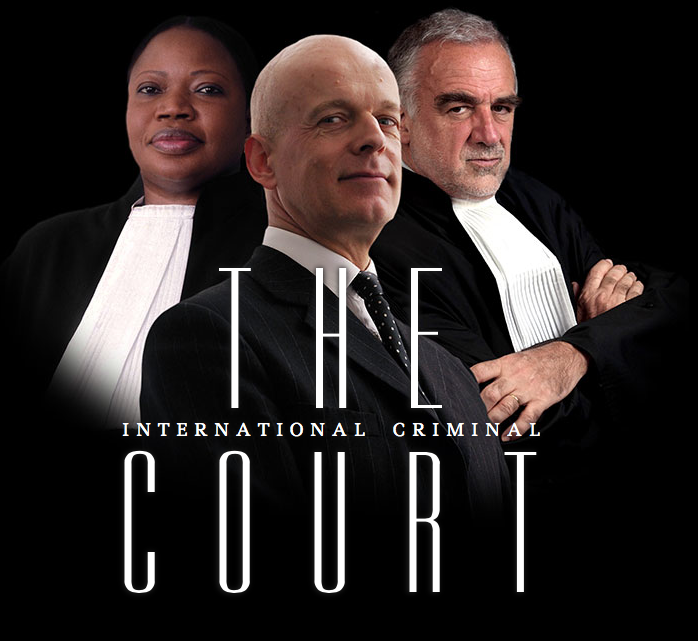
Backstage at the ICC: A Review of ‘The Court’

The Court.

The Court, a documentary by Michele Gentile and Marcus Vetter.

To many, if not most, the International Criminal Court (ICC) still looms like an impenetrable institution where the decisions made and actions taken in The Hague subsequently reverberate around the world. This isn’t to say that it’s a murky world but rather that it remains a rare and privileged opportunity to glimpse how decisions at the Court are made, what life in the halls of the world’s first permanent international criminal tribunal is truly like, and what really makes the Court’s staff – from the judges and prosecutors to the investigators and defence lawyers – tick.

Remarkably, over a decade after its creation, there have been very few efforts to shed light into the turbulent political and legal world of the ICC. There is no ethnography of the Court. There isn’t even a biography of the Court’s first Prosecutor, Luis Moreno-Ocampo. As a result, very few people understand how the International Criminal Court (ICC) truly functions. Three years after dedicating much of my time and energy to this subject, I still don’t.

Given this, my curiosity was piqued when I was told by a friend about a new documentary entitled ‘The Court’ which she had seen screened in The Hague. To be honest, though, despite being intrigued, I was also quite skeptical. After all, many of the films made about the ICC to date have tended to be triumphalist and advocacy-oriented. So asked my friend the inevitable question: “When you watched the documentary, did you feel it shed a positive or negative light on the ICC?” Her response could not have been more promising: “I’m really not sure.”

‘The Court’ does many things effectively. Directors Michele Gentile and Marcus Vetter brilliantly and brutally juxtaposes the horrors of violent political conflict with the sterility of international criminal justice. In one frame we witness a woman being carried, a massive flesh wound on her thigh; the next, we watch Moreno-Ocampo preparing coffee and biting into a pastry. We witness a child being ripped apart from his family before shifting to scenes of banal Court proceedings. We hear the tortured cries of a Palestinian man who has just seen his daughters killed in an Israeli air raid before the film cuts to Moreno-Ocampo leaning back in his chair and pondering out loud whether or not he can investigate alleged crimes committed in Palestine.

One might criticize the film for how it decontextualizes the violence and brutality portrayed throughout the film. It is rarely clear against whom the violence portrayed is being waged, who the perpetrators are and where the violence is being done. Yet these scenes are also a subtle reflection of the way in which international criminal law itself decontextualizes the causes and dynamics of violence and conflict.

But, above all, what the ‘The Court’ offers is a unique glimpse into the life and work of one man: Moreno-Ocampo himself.

During his tenure as ICC Prosecutor, Moreno-Ocampo was a lightning rod for controversy. He was dogged by allegations of being overtly selective in his cases, for playing fast-and-loose with the law and for often speaking off the cuff, saying the wrong thing at the wrong time. He was also vociferously defended as having ‘put the ICC on the map’ of international relations, of establishing a permanent interest in in the functioning of the Court, of making the ICC a relevant institution.

Continue reading

Posted in Fatou Bensouda, Film, ICC Prosecutor, International Criminal Court (ICC), International Law | Tagged , , | 1 Comment