
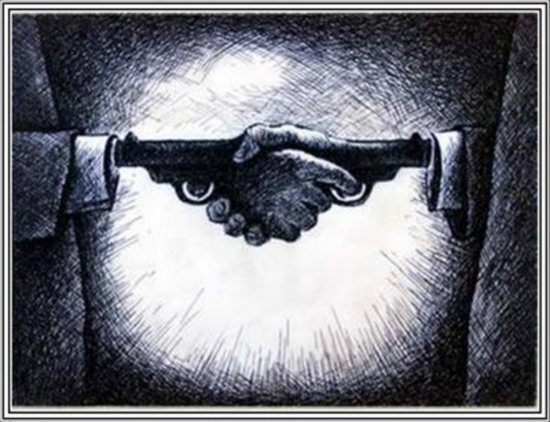
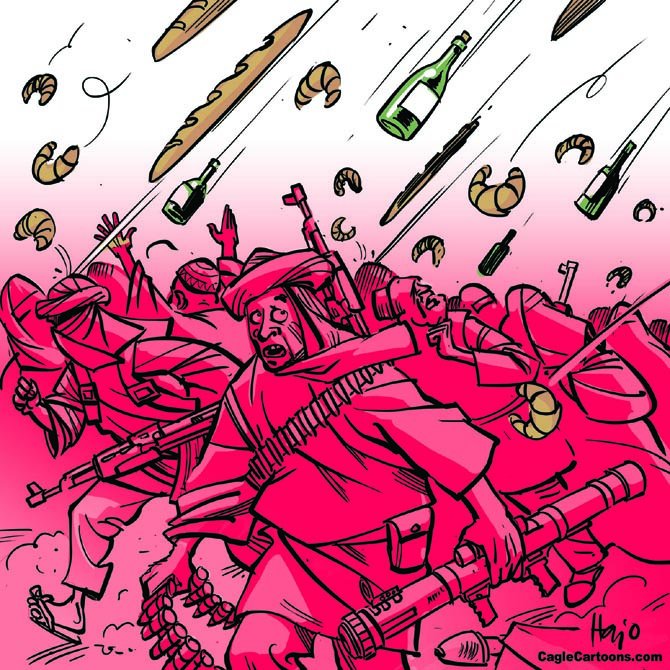
(Photo: dudelol.com)
Should we negotiate with individuals suspected of having committed the most egregious international crimes? This question goes to the very heart of the “peace versus justice” debate and has long been hotly contested. On the one hand, most in the international justice community fervently believe that individuals indicted for war crimes, crimes against humanity and genocide can never be legitimate negotiation partners. Negotiating with ‘evil’ can never be justified and risks legitimizing perpetrators of atrocities. On the other hand, diplomats, mediators and negotiators often argue for a more “pragmatic” approach to negotiations and that the inclusion of all key parties to a conflict is a necessary condition for successful peace negotiations. Leaving powerful spoilers out of a peace process, it is argued, could spell its demise.
Of course, this a messy and complex debate. Making matters worse, the key organizations, states and agencies which offer mediation to warring parties are often unclear where they stand. Enter the United Nations. A few weeks ago, I was sent a fascinating report from June 2012, entitled: United Nations Guidance for Effective Mediation. As far as I can tell, it marks the first time the UN has issued specific guidelines for mediators.
The UN report covers the International Criminal Court (ICC) in a handful of areas. First, it outlines the shifting normative and legal expectations being placed on mediators:
“Mediators also conduct their work within the framework constituted by the rules of international law that govern the given situation, most prominently global and regional conventions, international humanitarian law, human rights and refugee laws and international criminallaw, including, where applicable, the Rome Statute of the International Criminal Court. In addition to binding legal obligations, normative expectations impact on the mediation process, for example regarding justice, truth and reconciliation, the inclusion of civil society,and the empowerment and participation of women in the process.”
There’s nothing controversial here. The post-Cold War landscape has changed dramatically, in large part because of an explosion in conventions, institutions and practices covering, broadly, the fields of international law and human rights. This is a reality that mediators and negotiators simply have to acknowledge in order to be effective.
The Guidelines subsequently touch on the dilemma having ICC indictees participate in a peace process:
In designing an inclusive process, mediators face a number of challenges…Arrest warrants issued by the International Criminal Court, sanctions regimes, and national and international counter-terrorism policies also affect the manner in which some conflict parties may be engaged in a mediation process. Mediators need to protect the space for mediation and their ability to engage with all actors while making sure that the process respects therelevant legal limitations.
This passage is undoubtedly, and perhaps purposefully, vague. It doesn’t suggest whether or not mediators should engage with ICC indictees or not. In fact, it doesn’t suggest anything about how mediators should approach the question of including ICC indictees in peace processes. Instead, the statement seems to simply note the rather obvious fact that ICC arrest warrants will affect whether and how indictees themselves will be willing to participate in a peace process.
 Finally, the report issues some recommendations to potential mediators. With regards to the ICC, five are pertinent:
Building on a comprehensive mapping of all conflict parties and stakeholders, mediators should:
- Limit contacts with actors that have been indicted by the International Criminal Court to what is necessary for the mediation process. Continue reading




 Justice in Conflict