Lustration in Libya: Ruling Congress to Pass “Political Isolation Law”

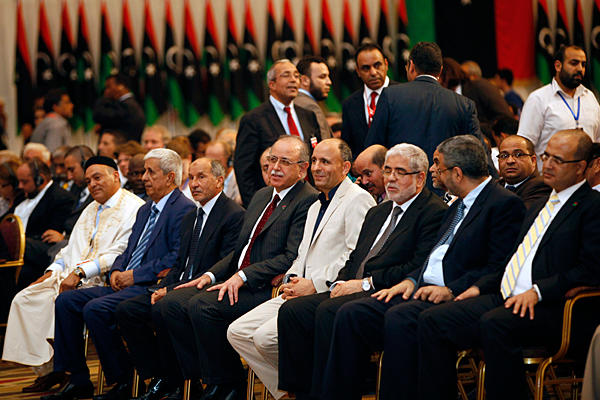
Members of Libya's General National Council (Photo: Ismail Zitouny/Reuters)

Members of Libya’s General National Council (Photo: Ismail Zitouny/Reuters)

Libya has made yet another significant and controversial decision as it continues down the bumpy path of its post-conflict and post-Gaddafi transition. According to the Libya Herald, the country’s General National Congress (GNC) is preparing to institute a “Political Isolation Law” which will prohibit politicians who were close to the Gaddafi regime from taking political office. The wisdom of such a policy is surely to be hotly contested.

Just days before the new law was announced, a group of GNC members issued a statement declaring that they would “work through the GNC to speed up the passing of a law to block the way for any leftovers from the former regime to infiltrate the organs of the state and its institutions.” They added that “anyone who participated in the destruction can not in any way be a tool for rebuild the state, and it is unimaginable that anyone who took part in the corruption of the social, political and economic life of Libya could ever be a cause for reform.”

The decision by the GNC to introduce the law appears to have come in response to widespread frustration amongst Libyans at the possibility of former Gaddafi officials re-branding themselves to remain in power.

At first glance, this demand would appear unproblematic. Proponents of lustration argue that it is a necessary measure for consolidating the trust of citizens in democratic reforms and institutions. Moreover, there is precedence for such a law. Similar legislation (with the same name) was passed in Egypt. In Iraq, former members of Sadaam Hussein’s Ba’ath Party were barred from office, albeit with disastrous consequences. The official practice of lustration, as a transitional justice mechanism, dates back to the experience of post-communist states in Eastern Europe. After finally escaping from the clutches of communist rule, states such as Poland and Czechoslovakia instituted lustration policies to exclude former communists from political office.

Still, lustration is inevitably a controversial mechanism for achieving post-conflict justice. It typically relies on the release of secret state documents which often cannot have their accuracy verified. It can ensnare innocent government officials who played minimal and often technocratic roles in a process that resembles more of a witch hunt than political vetting. Lustration can also inspire political backlashes as excluded officials with significant material and political resources reorganize to challenge or undermine their country’s political transition. Of course, such policies are also inevitably an action taken by ‘victors’ against their former ‘oppressors’ and can thus entrench social and political divisions and make reconciliation more difficult to achieve. In this context, some political figures may attempt to use lustration not as a means to achieve justice but to exclude competitors from favourable positions. Moreover, in states where virtually the entire political class was associated with a past regime, lustration may disqualify or irrevocably taint political actors whose skills could positively contribute to the country’s transition.
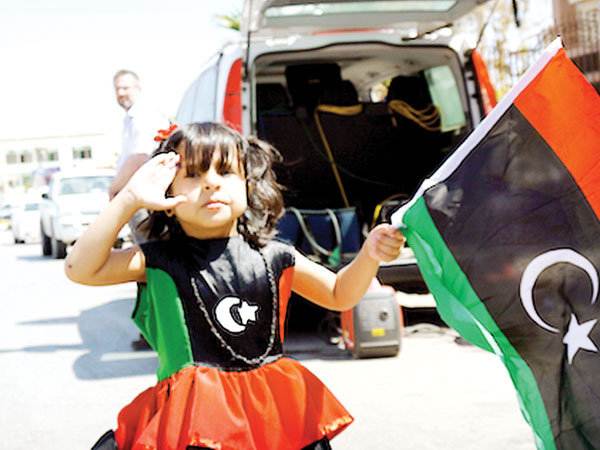
(Photo: Lorianne Updike Toler)

(Photo: Lorianne Updike Toler)

Given the above, it will be critically important that Libya – like any other state considering the use of lustration policies – be very careful in deciding precisely who is to be excluded and on what grounds. Many of the failures of past lustration policies have been the direct result of poor planning and confused policies. Continue reading
Posted in Libya, Lustration, Transitional Justice | Tagged , | 8 Comments

International Crimes, Local Justice: National Systems to End Impunity

Aminta Ossom joins JiC with this guest-post on the need for national accountability systems for international crimes in Sierra Leone and Ghana. Aminta is the 2012-2013 Crowley Fellow in International Human Rights at Fordham Law School’s Leitner Center for International Law and Justice. She has conducted research on behalf of Amnesty International’s Campaign for International Justice as a Harvard Satter Human Rights Fellow and American Society of International Law Arthur C. Helton Fellow in West Africa. 

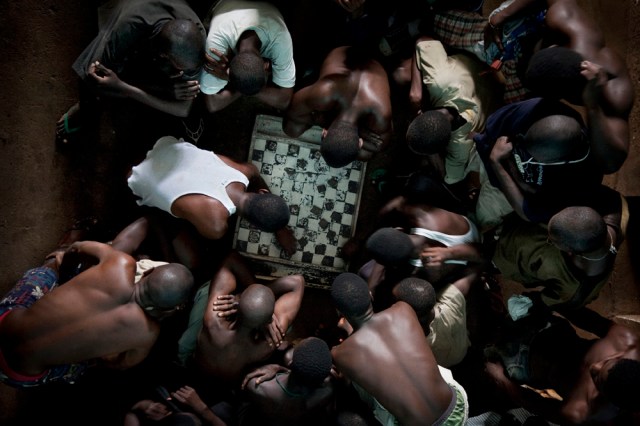
Prisoners in Freetown, Sierra Leone (Photo: Fernando Moleres / Panos / laif)

Prisoners in Freetown, Sierra Leone (Photo: Fernando Moleres / Panos / laif)

This week Amnesty International releases Sierra Leone: End Impunity through Universal Jurisdiction, Ghana: End Impunity through Universal Jurisdiction, and Vanuatu: End Impunity through Universal Jurisdiction, the latest country papers in its No Safe Haven series. This blog post will focus on the Ghana and Sierra Leone reports, which outline the West African states’ ability to address crimes under international law through their national justice systems.

Currently, only a handful of African countries have a legal framework in place guaranteeing the arrest and prosecution or extradition of suspected perpetrators of crimes under international law who seek ‘safe haven’ within their territory. An infamous accountability gap persists where – despite some national prosecutions, two international criminal tribunals, and the work of the ICC – only a small fraction of perpetrators of crimes under international law have been brought to justice on the continent and worldwide. Others suspected of committing these crimes have traveled freely. To end this impunity and to advance complementarity, the No Safe Haven series outlines individual states’ relevant legal frameworks, obstacles to prosecution and the exercise of universal jurisdiction and procedures for extradition and mutual legal assistance. (Eight of these papers are available online, examining Germany, Spain, Sweden, Bulgaria, Venezuela, Solomon Islands, Burkina Faso and, also released this week, Vanuatu.) Designed to assist countries reforming their legislation in accordance with international law and victims and prosecutors seeking to initiate legal action, the series updates and expands Amnesty International’s 2001 Memorandum Universal Jurisdiction: The duty of states to enact and enforce legislation and its 2011 supplement, which survey the global landscape of universal jurisdiction legislation.

Supported by a fellowship through the Harvard Human Rights Program, I conducted research and drafted Sierra Leone and Ghana papers for the No Safe Haven series over the course of a year. A significant fieldwork component, including residence in each focus country, facilitated the process of identifying legislation, conducting consultations with local lawyers and civil society, and obtaining background materials often available in hard copy, which cumulatively served as the basis of the reports.

Sierra Leone: Lacking Legal Framework

A routine of interviewing legal experts and referencing in-country resources produced remarkable revelations: despite its transition out of a period of widespread human rights abuses, and despite its hosting an international criminal tribunal for nearly a decade, Sierra Leone is still a safe haven for perpetrators of crimes under international law. The country has enacted minimal legislation defining crimes under international law as crimes within Sierra Leonean law, which would allow for national prosecutions of suspected perpetrators. Sierra Leone does not legally guarantee reparation for victims of war crimes and crimes against humanity, and it does not have a significant legal framework in place to extradite fugitives to a country willing and able to prosecute them on behalf of the international community. Further, significant obstacles to prosecution – from recognition of amnesties to limited guarantees for victims’ rights – would likely hinder the realization of justice should its courts gain jurisdiction over these crimes in the future. Continue reading

Posted in Ghana, Guest Posts, Justice, Sierra Leone, Special Court for SIerra Leone (SCSL) | Tagged , | 2 Comments

The ICC and Justice in the Wake of the Ngudjolo Acquittal

hi-congo-ngudjolo-cp-037424For many at the International Criminal Court, it was a rough day at the office. For many in the DRC, it was bewildering and upsetting. On 18 December, ICC judges acquitted Mathieu Ngudjolo, the former Congolese rebel leader who had been on trial for his alleged role in orchestrating the 2003 Bogoro Massacre in which at least 200 civilians were killed. The bombshell acquittal is likely to have significant implications not only on the development of international criminal law but also on the capacity of the ICC to achieve and serve justice.

Many insightful observers have already weighed in on the Ngudjolo acquittal. William Schabas and Jens David Ohlin have assessed its implications on international criminal law. David Bosco weighed in on the shortcomings of the ICC Prosecutor’s strategy of targeting the leadership of governments and rebel groups. Numerous commentators have also argued that the acquittal actually indicated that international criminal law was working – and working well. Over at Wronging Rights, Kate Cronin-Furman, for example, argued  that the Ngudjolo there was a silver lining to the verdict: the “acquittal shows that, although the ICC faces tremendous pressure to deliver convictions, it will not operate merely as a stamp on public consensus about a defendant’s guilt.” In a similar vein, Joshua Keating discussed the appropriateness of expecting that everyone who faces justice at the ICC should be convicted:

I understand the frustration here, but I do think there’s a danger in human rights groups decrying trial as a failure because a suspect was not convicted…In any fair court, defendants — includings ones who are almost certainly guilty — are going to sometimes be acquitted for reasons ranging from lack of evidence to prosecutorial incompetence…[W]e’re going to have to accept that sometimes the bad guys will get away with it.

There is a lot of merit in these comments. It seems clear that the Ngudjolo verdict is a demonstration that international criminal law and fair trial standards at the ICC are functioning properly. However, the fact that the ICC’s trial standards were met should not be conflated with a belief that ‘justice’ was served. Rather, the Ngudjolo acquittal sits awkwardly amongst competing conceptions of justice. More specifically, the acquittal exposes the tension between international criminal justice as achieved through tribunals like the ICC and broader expectations that perpetrators are brought to account. This tension has, of course, always been somewhat problematic because it treats ICC justice as superior and sophisticated and local expectations as simplistic and emotional. Continue reading

Posted in Democratic Republic of Congo, ICC Prosecutor, International Criminal Court (ICC), Outreach, War crimes | Tagged , , | 1 Comment

If the ICC Intervenes in Syria, Where Will Assad Go?

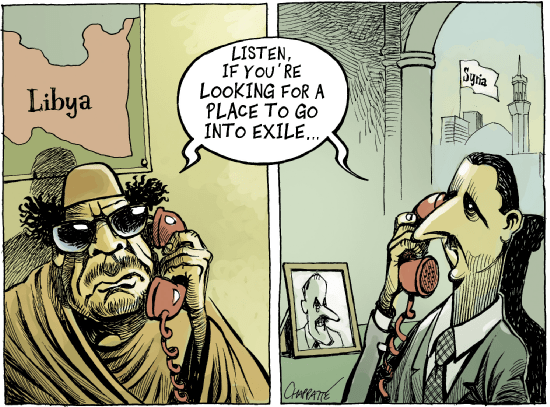
assad-gaddafi-exile-step-down-caricature-lebanon-spring-blog-libya-syriaIf the International Criminal Court (ICC) ever opens an investigation into Syria, it will almost assuredly become an irresistible trope to claim that the Court’s involvement caused President Bashar al-Assad to “dig his heals in” and “fight to the death”. It is an intuitive and persuasive claim to make. But there seems to be little support it.

It has long been argued, in the so-called “peace versus justice” debate that ICC investigations and prosecutions, when targeted against government or rebel leaders, remove the incentive of such leaders to negotiate a peaceful settlement and complicate their plans to go into exile or seek asylum. We witnessed this line of reasoning, most recently, in the case of Libya. Muammar Gaddafi was given numerous offers of exile as an incentive to end the conflict through a political, rather than military, solution. Initially, some offers were from ICC states parties, such as Uganda. As the conflict progressed, however, the intervening states exploring exile for Gaddafi made it clear they were looking for non-ICC member states could accept him. Of course, such offers ignored a rather simple but critical fact: Gaddafi had no intention to leave Libya. He said he would stay and fight until his death and he held his word. Little to no evidence suggests that he intended to do otherwise.

More broadly, there is little reason to believe that a leader like Gaddafi or Assad could trust an offer of exile. Offers of asylum or exile for leaders with blood on their hands are increasingly temporary gestures. For proof, look no farther than the case of Charles Taylor as evidence of this fact.

As many readers will already know, Taylor, a Liberian, was a key perpetrator in the notoriously brutal conflict in Sierra Leone. Taylor, however, was also the President of Liberia. During peace negotiations in Ghana to end the civil war in Liberia, the Special Court for Sierra Leone (SCSL) issued an indictment for Taylor. He immediately returned to Liberia, agreed to resign his presidency and fled to Nigeria, which granted him asylum and immunity from prosecution and extradition. After about two years, following requests by the new President of Liberia, Ellen Johnson Sirleaf, and under pressure from the United States and others, Nigeria finally agreed to send Taylor back to Liberia. In response, Taylor tried to flee to Cameroon but was arrested at the border, sent to Liberia and was eventually flown to The Hague to be tried and convicted by the SCSL. Gaddafi, as an important supporter of Taylor, knew this story well.

So what will happen to Assad if the ICC intervenes?

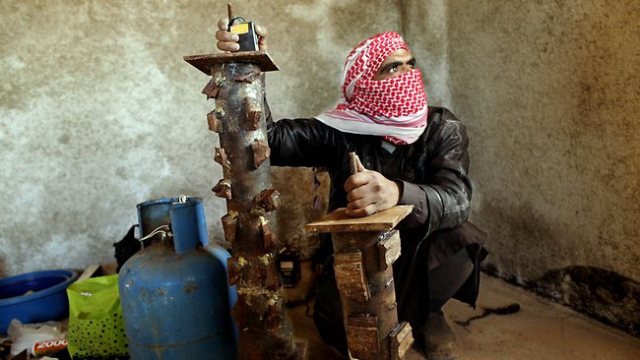
A Syrian rebel prepares pipe bombs (Photo: AFP)

A Syrian rebel prepares pipe bombs (Photo: AFP)

Here’s a snippet from a recent and insightful piece on the subject by Carol Williams and her interview with Andrew Tabler and his take on whether Assad could seek exile: Continue reading

Posted in Exile, International Criminal Court (ICC), Syria | Tagged | 1 Comment

Something Good that Might Have Come from KONY2012

Invisible Children_0I recently had the opportunity to give a talk (for slides see here), hosted by Aidan Hehir, at Westminster University on a ‘pet project’ of mine – the role of social media in affecting political change and waging social activism. Over the past few months I have been particularly fascinated with the effects of Invisible Children’s KONY2012 campaign. Many readers will likely know that this blog has provided a rather critical space for the campaign and its implications on the ‘hunt for Joseph Kony’ and the Lord’s Resistance Army (see here, here and here). But there is a question that I have always struggled to answer and, perhaps inevitably, it came up in the Q&A following my presentation. The questions is simple: could I name anything good that arose from Invisible Children’s campaign.

I remain convinced that KONY2012 and its message is – and will be – overwhelmingly damaging to efforts to resolve the LRA crisis. Still, the above question sits uncomfortably with me because I simply don’t believe that anything as ‘significant’, ‘effective’ and ‘widespread’ as KONY2012 can only have negative effects. As a campaign that garnered so much attention, it was bound to have a complex series of implications on political decision-making, especially in the United States. Moreover, it’s unlikely that we will know the full extent of KONY2012’s effects for some time to come.

Inevitably, some will claim that this isn’t a difficult question at all. The awareness KONY2012 raised for victims of the LRA was good in and of itself. After all, more people now know about Joseph Kony and his crimes than ever before. And more people knowing surely must be a good thing.

The problem, as I’ve argued previously, is that Invisible Children blew past a threshold of simplification and decontextualization to the point where any understanding of the LRA situation one might glean from KONY2012 is not just wrong but potentially dangerous. The video reinforces regional militarism (which has never helped in resolving the conflict), obfuscated the government’s role and alleged crimes, and glossed over key dilemmas, including that any military action against the LRA will inevitably kill children.

Despite this, there is evidence of a more subtle, but positive, development in Washington which appears to be at least somewhat linked to KONY2012: the softening of anti-ICC resentment on America’s political right.

In the wake of KONY2012, Republican Senator Lindsey Graham declared:

“This is about someone who, without the Internet and YouTube, their dastardly deeds would not resonate with politicians. When you get 100 million Americans looking at something, you will get our attention.”

Republicans should be paying attention. Some of the most active youths involved in the KONY2012 campaign were evangelical Christians who (I don’t think it is a stretch to claim) are inclined to vote for the Republicans. This was by design. Continue reading

Posted in Activism, Central African Republic (CAR), Democratic Republic of Congo, Lord's Resistance Army (LRA), Social Media, Uganda | Tagged , , | 5 Comments

Frustrations over the ICC and Justice in Palestine

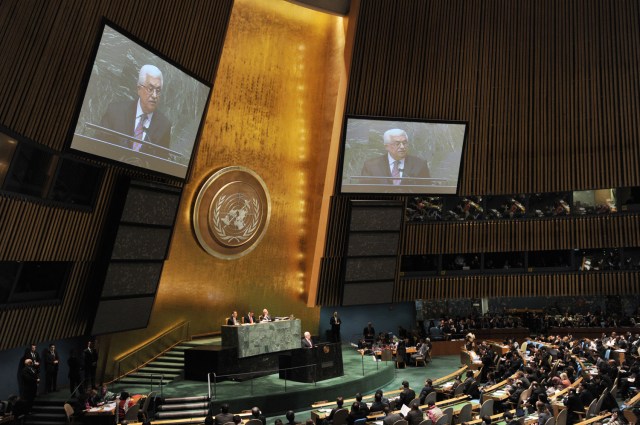
Mahmoud Abbas at the UNGA.

Mahmoud Abbas at the UNGA.

It came as no big surprise that the United Nations General Assembly voted to upgrade Palestine to non-member observer status. But, reflecting the reality that international criminal justice now goes to the very heart of Middle East politics, many are left wondering whether Palestine will join the International Criminal Court and request (once again) that the ICC investigate its conflict with Israel. Pondering this issue has left me deeply frustrated.

While it may not be wise to box oneself into a particular moral outlook, I consider myself to be a liberal cosmopolitan. Very briefly, that means that I believe in a politics where all human beings share fundamental individual rights and that when those rights are blatantly violated we, as a global community, have some obligations to respond. This political ethos, I believe, is also what guides most proponents of the ICC, not to mention other liberal cosmopolitan projects such as the Responsibility to Protect.

It is through this liberal cosmopolitan conviction that I view the ICC as inherently political but embodying the potential for fundamentally good politics. I criticize the decision-making of the ICC as well other actors in international relations, such as the UN Security Council, when they move the Court away from its liberal cosmopolitan premise and promise. Of course, this does not mean that I believe that the ICC should be deployed as a blunt instrument, forced down the throats of populations who legitimately seek alternative paths towards accountability and justice. That is far too hegemonic for my taste. But it seems to me, in the case of Palestine at least, that the citizens themselves want to see justice done and see the ICC as an institution through which they can achieve at least some degree of it.

Yet there is a rather convincing political argument to be made that the ICC should not investigate Palestine. In a recent post Kevin Jon Heller deftly covers this argument. Heller writes (in the comments):

I have no doubt that both Israel and the Palestinians have committed serious international crimes.  But I also believe it would be suicidal for the ICC to wade into the most politicized conflict in history — virtually guaranteeing that the US would revert to its previous hostility and that all of the Court’s other work would be ignored by the media and the international community. The Court’s long-term legitimacy is more important than any individual investigation, no matter how deserving of investigation a situation might be.

In my view, Heller is absolutely correct in noting that an ICC investigation of Palestine would seriously complicate the Court’s standing in international politics, likely undermine its legitimacy, and consequently hamper its ability investigate other situations in the future. And this exposes a serious and rather frustrating dilemma: it may be necessary to protect the institution that furthers liberal cosmopolitan aims (ie. international criminal justice) by undercutting its ability to achieve those liberal cosmopolitan aims in some cases.

Continue reading

Posted in Palestine, Palestine and the ICC | 6 Comments

If Simone Gbagbo ends up in The Hague, She won’t be the First

As readers will know, the ICC has unsealed an arrest warrant for Simone Gbagbo, becoming the first woman indicted by the Court. Today, Janet Anderson joins JiC for this timely background post on women who have been tried at international criminal tribunals. Janet is a consultant supporting local journalists covering international justice based in The Hague. 

Simone Gbagbo shortly after being arrested, along with her husband Laurent, in Abidjan, Ivory Coast (Photo: EPA)

Simone Gbagbo, whose arrest warrant by the ICC was made public on Thursday, is charged with the crimes against humanity of murder, rape and other forms of sexual violence, other inhumane acts and persecution. The warrant against her describes how she was part of the inner circle who organized post election violence in the Ivory Coast, in 2010 and 2011, targeting civilians who were seen as supporters of her husband – Laurent Gbagbo’s – political rival Alassane Ouattara or from specific ethnic or religious communities. The warrant notes that while she was “not elected, Ms Gbagbo acted as an alter ego for her husband, exercising the power to make State decisions.”

But Simone Gbagbo is not the first woman to be charged by an international court for crimes against humanity. Both the International Criminal Tribunal for the former Yugoslavia (ICTY) and for Rwanda (ICTR) have also tried and sentenced a woman.

Pauline Nyiramasuhuko at the ICTR

Pauline Nyiramasuhuko was sentenced to life imprisonment when she became the first woman to be convicted of genocide and crimes against humanity by an international court. She was the former Rwandan Minister of Women’s Development and was tried alongside her son Arsène Shalom Ntahobali, who had been a student prior to the genocide, as well as four others, in what was known as the ‘Butare trial’.

The judgment describes what happened in 1994 in the area of Butare as refugees took shelter from the violence engulfing the country. It details how local leaders including Nyiramasuhuko armed and directed the activities of the militia group the Interahamwe. The judgement declares that

“The evidence presented by these survivors, and accepted by the Chamber, is among the worst encountered by this Chamber; it paints a clear picture of unfathomable depravity and sadism.”

Pauline Nyiramasuhuko at the ICTR (Photo: All Voices)

The court, in a trial which lasted for 10 years, involving 189 witnesses, heard how Nyiramasuhuko asked her son to organise militias to take part in the kidnap and rape of women and girls in Butare. In the end, Pauline Nyiramasuhuko was convicted of genocide and of conspiracy to commit genocide as well as rape as a crime against humanity. Ntahobali, who was in his early 20s at the time of the genocide, was also found guilty and sentenced to life.

“Nyiramasuhuko, Ntahobali, Interahamwe, and soldiers went to the Butare préfecture office to abduct hundreds of Tutsis. Many were physically assaulted, raped, abducted, and taken away to various places in Butare, where they were killed. During the course of these repeated attacks on vulnerable civilians, both Nyiramasuhuko and Ntahobali ordered killings… Nyiramasuhuko aided and abetted rapes and is responsible as a superior for rapes committed by members of the Interahamwe.”

Upon her conviction, the BBC ran a profile of Nyiramasuhuko. It describes how she would also force people to undress before loading them on to trucks, taking them to their death. Continue reading

Posted in Crimes against humanity, Genocide, ICTY, International Criminal Court (ICC), International Criminal Tribunal for Rwanda (ICTR), Ivory Coast / Côte d'Ivoire, Ivory Coast and the ICC, Serbia | Tagged , , | 1 Comment

The ICC to Investigate Libyan Rebel Crimes? We’ll See.

Fatou Bensouda (Photo: Reuters)

Over the past few days, a number of individuals have contacted me to ask about a statement in which ICC Chief Prosecutor Fatou Bensouda told the United Nations Security Council that her office was investigating rebel crimes committed during the Libyan civil war.

Here’s what Bensouda had to say:

“My Office continues to collect evidence in relation to a possible second case in Libya. No decision has yet been taken as to the focus of that second case. We continue to collect information on allegations of rape and sexual violence, which targeted both men and women; allegations against other members of the Al-Qadhafi Government for crimes committed during the events of 2011; and allegations of crimes committed by rebels or revolutionary forces, including against the residents of Tawergha, individuals hors de combat and detainees. I will take a decision on the direction of a possible second case in the near future.”

So should we take Bensouda’s statement as a sign of things to come? Are more arrest warrants on the horizon? Will the ICC target alleged crimes committed by Libyan rebel forces?

First, is important to remember that such statement have been made since the very first days of the ICC’s intervention into Libya. Indeed, in the very first press conference on the ICC’s investigation into alleged crimes in Libya, former Prosecutor Luis Moreno-Ocampo warned rebel factions that if opposition groups commit crimes, their leaders will also be investigated.” Moreno-Ocampo also subsequently claimed NATO would be investigated “impartially and independently by the prosecution.” But despite periodic statements, there remains no evidence that any indictments for rebels – or NATO for that matter – are forthcoming. 

Second, it has to be said that there is nothing particularly controversial about Bensouda’s statement. The Prosecutor declared that her office continues to “collect information” on various alleged crimes. This is something that the Office of the Prosecutor (OTP) does constantly and it gives no indication of whether that information will be transformed into a request for arrest warrants or even the official opening of a second case. Moreover, Bensouda was quite clear in stating that “[n]o decision has yet been taken as to the focus of that second case.”

Tawergha (Photo: BBC)

Still, there is a case to make for continuing to investigate Libya and, in particular, investigate alleged crimes perpetrated by the rebels, or thuwar. In her statement, Bensouda specifically mentioned Tawergha, a town outside of Misrata. She was right to do so. The citizens of Tawergha were forcibly expelled from their town in what almost certainly amounts to a war crime or crime against humanity. Kevin Jon Heller has recently argued that “[i]t is at least arguable that the Misratan thuwar committed genocide against the Tawerghans.” This is bolstered by claims, cited in the International Commission of Inquiry on Libya, that rebels declared that Tawergha deserved “to be wiped off the face of the planet.” The Commission added that “The Misrata thuwar have killed, arbitrarily arrested and tortured Tawerghans across Libya. The destruction of Tawergha has been done to render it uninhabitable.” This sad chapter and stain on Libya’s transition continues as internally displaced Tawerghans remain the target of periodic violence. Moreover, as numerous human rights groups have made clear, absolutely nothing has been done to bring rebel perpetrators to justice. This is at least in part due to ‘Law 38’ which grants a blanket amnesty to any crimes committed by rebels in the name of the revolution.  Continue reading

Posted in Crimes against humanity, Genocide, Justice, Libya, Libya and the ICC, UN Security Council, War crimes | Tagged , | 2 Comments

The aftermath of the ICTY’s Gotovina Trial: Due process and Historical truth

The following is a guest-post by Rhodri C. Williams, a human rights consultant and commentator who recently began working on rule of law issues in Libya with the International Legal Assistance Consortium. Rhodri also writes at his fantastic  TerraNullius blog. In this post, Rhodri examines the uneasy relationship between international criminal law and post-conflict reconciliation.

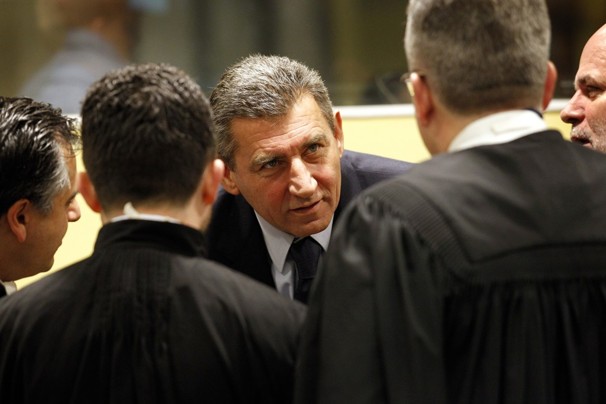
Ante Gotovina shortly after being told he and  Mladen Markac had been acquitted (Photo: AP / Washington Post)

In April 2011, Trial Chamber I of the International Criminal Tribunal for the former Yugoslavia (ICTY) convicted two Croatian Generals, Ante Gotovina and Mladen Markač to lengthy jail terms for their role in planning and carrying out ‘Operation Storm’, a 1995 offensive that resulted in the flight of up to 250,000 Croatian Serbs from their homes in the Krajina region of Croatia. At the time, the conviction hardly came as a shock given that the Storm campaign was widely seen as one of the most large-scale episodes of ethnic cleansing among the many that the 1990s wars in the former Yugoslavia had to offer.

But last Friday, in what has been described as “one of the most comprehensive reversals of the tribunal’s 19-year history”, the Appeals Chamber eviscerated the Trial Chamber’s findings and ordered the immediate release of both defendants. The summary read out in court reflected the Appeals Chamber’s acceptance of both the defense’s key arguments: first that the shelling of four Serb-held towns at the outset of the offensive had not been unlawful, and second, that absent unlawful shelling, the Trial Chamber’s finding of a ‘joint criminal enterprise’ (JCE) to permanently remove the Serb population of the region could not stand in regard to the defendants.

As I’ve described at TerraNullius, at the time of the Trial Chamber decision, the finding of the existence of a JCE by the Trial Chamber tied the defendants to a range of discriminatory actions and policies that accompanied the offensive. Perhaps most notably in relation to the current situation of Krajina Serbs, thousands of whom remain displaced, such acts included both the destruction of private property and the ex lege cancellation of Croatian Serb refugees’ rights to ‘socially owned’ apartments they had often occupied for generations.

As set out in the summary of the decision, the rejection of a JCE removed this link, leaving insufficient evidence to tie the defendants to the policy of expelling Serbs found by the Trial Chamber:

…the Appeals Chamber, Judge Agius and Judge Pocar dissenting, considers that the Trial Chamber’s findings on the JCE’s core common purpose of forcibly removing Serb civilians from the Krajina rested primarily on the existence of unlawful artillery attacks against civilians and civilian objects in the Four Towns. While the Trial Chamber also considered evidence concerning the planning and aftermath of the artillery attacks to support its finding that a JCE existed, it explicitly considered this evidence in light of its conclusion that the attacks on the Four Towns were unlawful. Furthermore, the Trial Chamber did not find that either of the Appellants was directly implicated in Croatia’s adoption of discriminatory policies.

Gotovina and Markac upon their return to Croatia (Photo: Goran Mehkek / CROPIX)

This shock reversal has already begun to generate intense legal and political debate. The Prime Minister of Serbia, where most of the Krajina refugees found shelter, was quick to claim that that the ICTY does not function as a court but rather fulfills “pre-determined political tasks.” However, supporters of Generals Gotovina and Markač began to read the acquittal as a blanket vindication of Croatia’s conduct and aims during its 1991-95 war. As reported in the Guardian, for instance, Gotovina’s defence lawyer, Greg Kehoe, said the appeal verdict demonstrated that Operation Storm had been entirely legitimate under international law, “as a proper and just attempt to bring back that land into Croatia.”

By Friday evening, Gotovina and Markač had already returned from the Hague in the official Croatian government airplane and were met by the Prime Minister and a cheering crowd of 100,000 in the main square of the capital, Zagreb. Both Generals were quick to draw a line under the past, with Gotovina stating that the war “belongs in history” and Markač “happy that in the future every Croat in the world can say ‘we have our homeland and we freed it in a clean way.’” Croatian President Ivo Josipovic went further, arguing that the ruling was evidence that the “Croatian army wasn’t involved in any criminal activities.”

When the dust settles, the legal issues may turn out to be deceptively straightforward. It is certainly credible that the Trial Chamber went too far with its JCE finding and that the Appeals Chamber was right to tighten the focus to what criminal acts could be directly and unambiguously attributed to the defendants. On the other hand, this decision is demonstrative of the legal certainty-defying manner in which international law expands. After all, the same Appeals Chamber that last week swatted away an expansive JCE theory previously presided over an unprecedented – and not uncontroversial – expansion of the genocide definition in the 2004 Krstic judgment (involving the Srebrenica massacre in Bosnia; see the case-sheet here and a synthesis of the criticism here). Continue reading

Posted in Balkans, Croatia, ICTY, Serbia | Tagged , , | 4 Comments

Whither Victim Participation?

The following is a guest-post by Chris Tenove, a doctoral candidate in Political Science at the University of British Columbia where his research explores the political and ethical dilemmas of global governance for international criminal justice and humanitarianism. Chris also runs an excellent blog (see here). In this post, Chris examines critical questions pertaining to, and ways to strengthen and improve victim participation at the International Criminal Court. Enjoy!

(Photo: ICC)

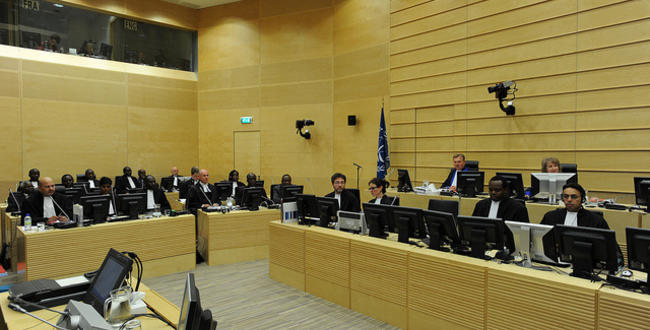
In the next two weeks, the Assembly of States Parties will undoubtedly address one of the most innovative and troubled aspects of the International Criminal Court: victim participation. Such discussions must take heed of recent decisions by Trial Chamber V on the upcoming trials in the Kenya situation, which introduced a dramatically different scheme for victim participation compared to previous Court practice. Will that decision lead to a shrinking role for victims at the ICC, or make it more efficient and inclusive? Much will depend on how the new scheme is operationalized, including the resources and direction the ASP offers.

The ICC’s approach to victim participation is without precedent. The only role for victims at previous courts was limited to witnesses, a role that was criticized by civil society actors and some states during the drafting of the Rome Statute. The Rome Statute ultimately included Article 68(3), which stated that: Where the personal interests of the victims are affected, the Court shall permit their views and concerns to be presented and considered at stages of the proceedings determined to be appropriate by the Court…

Judges and court staff spent considerable energy in the Court’s early years interpreting and re-interpreting how victims would participate. Fundamental questions have been grappled with: Who is a victim eligible to participate? What modalities of participation are possible, and at what stages of proceedings? ? How can common legal representatives (CLR) for large numbers of victims be selected?

While rules for victim participation have become more concrete, they continue to leave many unsatisfied. This summer, several legal advisers for State Parties told me that it was a top issue for reform, primarily for budgetary reasons. While some civil society groups were pushing for more resources for victims’ legal teams, key State Parties continue to push for tightening legal aid and Registry budgets. These areas of the budget will continue to be squeezed so long as the Court takes on more situations (some referred to it by the UNSC) while State Parties hold to zero-growth in funding.

Kenya I and II: A New Direction for Victim Participation? 

Judge Christine van den Wyngaert weighed into the debate with a published paper that called for a dramatic rethinking in approach. Wyngaert argued that victim participation has been resource-intensive and has slowed down proceedings, while providing little real benefits to victims. She notes that the expected costs for victim participation in 2012 (including ICC staff, external lawyers, and in-country field staff) is estimated at over € 7 million. She also notes that Chambers spend considerable time assessing each individual victim’s application to participate. In her paper, Judge van den Wyngaert sees little role for victims other than to provide evidence, and assumes that their main interest is proving the guilt of the accused and receiving reparations. She pointedly questions whether “the participation system set in place is ‘meaningful’ enough to justify the amount of resources and time invested in it or whether it would be better to spend those resources and time directly on reparations” (p. 495). In contrast, Judge Adrian Fulford, presiding judge in the trial of Thomas Lubanga Dyilo, claimed that victim participation did not significantly extend the trial and that victims’ representatives made succinct and relevant contributions.

The new scheme proposed in the Kenya I and II decisions bears traces of Judge van den Wyngaert’s reasoning. It creates two categories of victims. First, those who want to appear directly before the court (in person or video-link). They must prove their status as victims through a submission to be reviewed by Chambers, which is similar to the current process. Second, those who may communicate with the CLR and inform his or her general thinking, but who do not need to submit an application to Chambers. The CLR will be based in Kenya and will only appear in court in The Hague for key moments such as opening and closing statements. Otherwise, the ICC’s Office of Public Counsel for Victims (OPCV) will handle legal proceedings.

This two-tier approach is apparently designed to enable participation that is both deep and broad. A few victims can participate directly in judicial processes. A much larger group will be ‘represented’ by the CLR in a diffuse way and make little demand on Chambers’ resources. This scheme clearly responds to the fact that several thousand Kenyans have expressed an interest in participation—often, as a number of Kenyan civil society members told me, out of the mistaken belief that participants are more likely to receive reparations. While the legal framework is in place, the Kenya I and II decisions leave much to be worked out. How will the CLRs consult with and inform large numbers of participants? How will they choose a small number of active participants? How will the CLRs and the OPCV jointly determine a legal strategy?

Victims and survivors of Kenya’s post-election violence airing their views on the ongoing ICC case. (Photo: Nandemu Barasa / West Fm)

What’s the Point of Victim Participation?

Whether this new approach will improve or harm victim participation depends on what participation should achieve—and there is little clear thought, and even less consensus, on that question. I would propose that there are three general concepts of victim participation:

Victims as legal clients: As much as possible, victim representation should mirror the relationship between lawyers and clients in domestic judicial proceedings. This approach – a favourite among lawyers who work with victims – emphasizes the determination of individual interests of victims, the need for ongoing consultation between lawyer and client, and a substantial role in trial proceedings. It opposes the idea that victims should be treated as an undifferentiated mass whose main interest aligns with the prosecutor. Continue reading

Posted in Assembly of States Parties, ICC Prosecutor, International Criminal Court (ICC), Victim Participation | Tagged | 7 Comments