Thank you and Farewell from Patrick Wegner

Dear readers,

It is with great regret that I have to stop contributing to JiC regularly due to time constraints. I recently became a diplomat at the German Foreign Office and am trying to finish my thesis at the same time, which is very time consuming. I am therefore no longer able to contribute to JiC regularly. You will probably find a post by me every once in a while as a guest author. With Alana Tiemessen, Mark and Elke around I have no doubt that my absence will be barely felt and that JiC will be contributing meaningful commentary to international criminal law in conflicts for the months and years to come.

I would like to thank all our readers for their interest and their comments and I would like to thank the JiC team for an amazing year of blogging together.

All the best,

Patrick

Posted in JiC News | 5 Comments

Has Social Media Successfully Reinvented Social Activism?

This week I had the honour to participate in a debate at the historic Oxford Union on whether “social media has successfully reinvented social activism”. The relationship between social media and social activism has become a critically important subject in the wake of the so-called “twitter revolutions” in Iran and Moldova, the use of blogs, Facebook and Twitter in the Arab Spring as well as Invisible Children’s KONY2012 viral campaign. Nevertheless, we are only just beginning to understand how social media in fact produces real-life results in the context of conflict, revolutions, and social upheaval.

It was a fascinating debate and a wonderful event with an impressive cast of debaters. Speaking in proposition of the motion were David Vitter, US Senator for Louisiana, Mark Pfeifle, former Deputy National Security Advisor to President George W. Bush, Benjamin Cohen, Tech Correspondent at Channel 4 News, and Ella Roberston, a student at Oxford. In opposition were Dr. Christopher Carpenter, professor of Communications at University of Western Illinois, Matt Warman, the Consumer Technology Editor at The Telegraph, Robert Sharp, Head of Campaign & Communications at English PEN, and myself. I am very happy, proud and even a bit surprised to say that the opposition was victorious.

While not directly related, in the wake of KONY2012, the question of how social media and social activism relate has been on the minds of all of us interested in international criminal justice. I therefore wanted to share with you a draft of the speech I gave on this increasingly pertinent subject. At the bottom of this post, you’ll also find a small bibliography with a few online sources which I found particularly useful in my preparation for the debate, especially for deciphering fact from fiction. As noted above, this is just the beginning of the debate. In that vein, I would love to hear what you think!

Madam President, honourable members, ladies and gentlemen,

There is no point in standing before you and denying that social media has changed how political and social activism is done. It clearly and obviously has. Despite this, social media has not, I will argue, “reinvented” the fundamental rules of social activism. To suggest so is to misunderstand what it means to do social activism and to be a social activist.

We are told a very simple story about the relationship between social media and social activism. You have all heard it. Social media topples Arab tyrants. Social media leads to democratic elections. Social media can bring rebel leaders in the heart of Africa to justice. At the core of this apparently irresistible narrative is the belief that social and political campaigns are a success when they achieve massive online traffic and “go viral”. The problem here is simple. None of the above is true.

An absolutely necessary condition for the effectiveness and success of a social campaign is building a political community of real-life, off-line physical human beings committed to a common cause.

Take for example, Invisible Children’s KONY2012 campaign. It did not go viral randomly or because of celebrity endorsements on Twitter and Facebook. Beneath this popular veneer, is the reality that Invisible Children worked for almost a decade to build a network of like-minded individuals willing to drive across Canada and the United States in order to show the group’s latest films in schools and churches. It should thus come as no surprise that KONY2012 began trending on Twitter before the campaign video itself was released – as the carefully cultivated community of Christian youths in mid-sized American cities began tweeting.

Consider too, the role of social media in the Arab Spring. It would be wrong to attribute the effectiveness and success of human rights and democracy campaigners in Egypt, Tunisia, Libya, Bahrain, and so on, entirely to social media. The opposition to these regimes had learned from decades of experience, training in human rights and civil disobedience.

The people who bravely marched on Tahrir Square in Cairo and Green Square in Tripoli did so not because they heard about it on Twitter but because of real grievances; because of years of outrage and humiliation; because, to them, enough was enough.

Part of the popular narrative also tells us that re-tweeters and sharers on Facebook themselves are a new breed social activists, ready at the whim to tackle tyranny and oppression, their iPads and iPhones proof of their commitment to liberal democratic values. Of course, they’re not the same type of activists. Instead, the popular and rather disparaging argument is that they are “slactivists”. Again, this is fundamentally misleading. Sharing and re-tweeting KONY2012 was a symbolic action, the merits of which we can debate. But it was symbolic action taken almost exclusively by people who were never activists in the first place. This helps to explain why Invisible Children’s campaign to “Cover the Night” – which required real activists – was such an epic flop. Continue reading →

Posted in Activism, Advocacy, Iran | Tagged , , , , | 13 Comments

ICC Prosecutor Moreno-Ocampo headed to FIFA

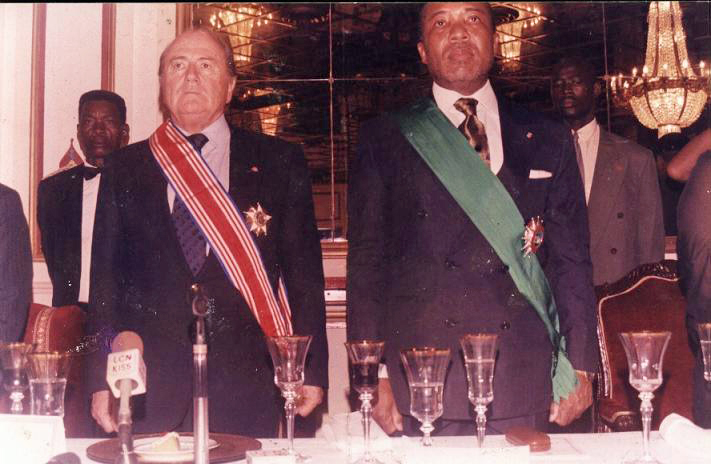
FIFA President, Sepp Blatter, with former Liberian President, Charles Taylor, recently the convicted for aiding and abetting war crimes in Sierra Leone.

So that came out of left field. ICC Chief Prosecutor Luis Moreno-Ocampo will become FIFA’s ethics and corruption czar. As most readers will likely know, Moreno-Ocampo’s tenure at the ICC is coming to a close. In mid-June he is due to leave the Court after nine years as Prosecutor. His position at FIFA brings to an end speculations of where Moreno-Ocampo would go after a controversial but in many ways remarkable tenure at the ICC. Interestingly, Moreno-Ocampo does have a historical link to soccer/football, having been former superstar Diego Maradona’s lawyer.

Here’s from the BBC:

The Argentine is expected to be confirmed next month, and will investigate allegations of corruption or ethics rules breaches.

Ocampo’s chamber will bring charges, while a separate arm will judge cases.

In March, football’s governing body announced a wide-ranging overhaul of its governance, in light of a series of corruption allegations that have rocked the organisation over the last 18 months, concerning bothWorld Cup bidding and the presidential election.

Fifa’s single-chamber ethics committee failed to gather enough evidence to prosecute allegations of vote-rigging during the 2018 and 2022 World Cup bidding contests.

A report by Fifa’s anti-corruption adviser, Swiss professor Mark Pieth, called Fifa’s past investigation of corruption allegations “unsatisfactory”, with sanctions imposed both “insufficient and clearly unconvincing.”

A double ethics chamber, with one arm overseen by Ocampo, is an attempt to improve the efficiency and reputation of Fifa in this area.

David Bond adds that “[c]rucially, this body would have the powers to delve into the past – reopening the prospect of another more thorough examination of claims of wrongdoing during the 2018 and 2022 World Cup bidding contests.” Continue reading →

Posted in ICC Prosecutor, International Criminal Court (ICC), Sport | Tagged , , | 3 Comments

Does the ICC Need to Reconcile with Africa? Bensouda Comes Out Swinging

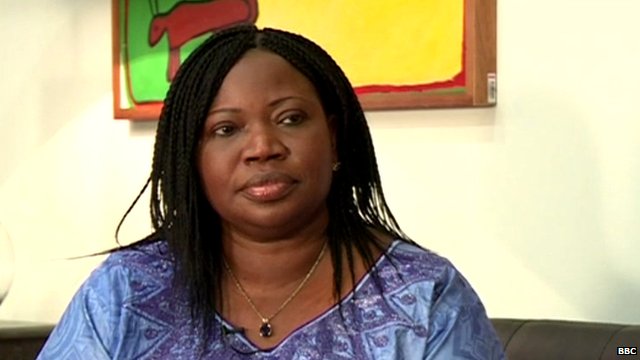
Photo: BBC

Fatou Bensouda, incoming Chief Prosecutor for the International Criminal Court, has put threatening war criminals and defiant states on notice. In several recent public statements she has directly addressed two of the Court’s most significant challenges: the accusation that the Court’s credibility suffers from a “pro-Western, anti-African” bias and the related issue of ensuring state cooperation and support, particularly in executing arrest warrants.

The argument that the ICC has (so far) unjustly targeted only African states and individuals is mostly based on misperception and has become a rhetorical tool of political elites to undermine the Court. Yes, all of the situations presently under the Court’s jurisdiction are from Africa. But as Bensouda and many others have pointed out, the Africa bias criticism is baseless for the following reasons.

African states wanted the ICC: Much of the strongest support for a permanent international criminal court in the Rome Treaty negotiations came from the Africa group. That support continued after Rome and African States Parties have a high level of ratification of the treaty (although, notably, a weak level of corresponding implementation legislation).

African states need the ICC: The empirical reality is that many situations of atrocities, and those that meet the (vague) “sufficient gravity” criteria for the Court to intervene, are in Africa. Moreover, many African states have a weak rule of law that fails to deter and respond to such atrocities, and so these situations justify the ICC’s intervention as a “court of last resort.” As Bensouda defended,

“The office of the prosecutor will go where the victims need us….The world increasingly understands the role of the court and Africa understood it from the start. As Africans we know that impunity is not an academic, abstract notion.”

African states invited and welcomed the ICC: Three states self-referred their situations to the Court (Uganda, DRC, and the Central African Republic) and three states initially welcomed and have since exhibited a satisfactory pattern of cooperation with the Court (Cote d’Ivoire, Kenya, and Libya). Only Sudan remains resolutely defiant and given its head of state is among the accused this should prove, not disprove, the ICC’s credibility. Bensouda expressed frustration that cooperation from African states and civil society is

“not the story relayed in the media….(and) anti-ICC elements have been working very hard to discredit the Court and to lobby for non-support and they are doing this, unfortunately, with complete disregard for legal arguments.”

J’accuse! African war criminals don’t want the ICC: Accusing the ICC of a “pro-Western, anti-African” bias is a rhetorical political tool of the accused themselves. Accusing an international tribunal of pro-Western bias or victor’s justice is also not unique to the ICC – Goering, Milosevic, Taylor, etc. all rejected the tribunals they faced with this grandstanding challenge. The accused cannot defend their crimes, so they choose to undermine their accusers instead and invoke hyperbolic claims of racism and neo-colonialism. Continue reading →

Posted in African Union (AU), Fatou Bensouda, ICC Prosecutor | 8 Comments

Welcoming new JiC Co-Author, Alana Tiemessen!

Alana TiemessenDear Readers,

It is with great pleasure and excitement that I introduce to you, Alana Tiemessen, who has joined JiC as a new co-author. Many will already be familiar with Alana’s work on transitional justice, international criminal justice and lawfare at The Duck of Minerva and the Canadian International Council, amongst other publications. Alana already has a fantastic post up on Fatou Bensouda’s defense against allegations that the ICC has an African bias. We simply could not be happier that she’s agreed to join JiC!

Here’s a bit from her bio:

Alana will be joining the University of Chicago in fall 2012 as a Postdoctoral Fellow in the Department of Political Science and is presently a Visiting Assistant Professor in the Department of Political Science at UMass Amherst. Her current research focuses on judicial interventions and the International Criminal Court, transitional justice norms and practice, and the intersection of international security and human rights in failed states and post-conflict societies. She received her PhD in Political Science from the University of British Columbia in 2011. You can follow her on Twitter and on Academia.edu

Please join me in welcoming Alana!

Posted in Uncategorized | Leave a comment

Justice for Sexual Violence and Gender Crimes in Argentina

The following is a guest-post on gender and sexual violence as crimes against humanity and torture in the context of Argentina’s Dirty War by Mariana Rodriguez Pareja and Alia Al-Khatib, who is a human rights activist and Vassar Maguire Fellow in Buenos Aires, Argentina. Enjoy!

(Photo: Stephen Perry)

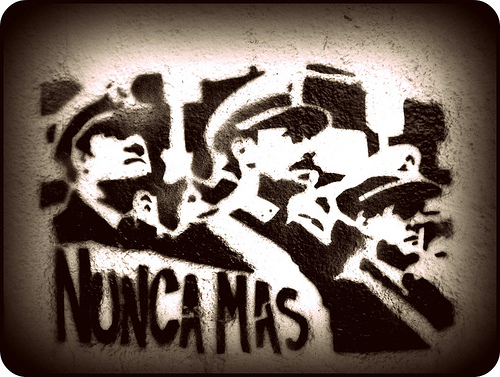
The military coup in 1976 began the worst phase of Argentina’s recent history, the so-called National Reorganization Process, which left 30,000 people killed or forcibly disappeared according to official estimates.  In contrast, the restoration of democracy in 1983, with the help of Raul Alfonsín, brought with it a pursuit of justice and truth, especially with the National Commission for Disappeared Persons (CONADEP) and its report, Never Again, as well the famous Trial of the Juntas in 1985.

This process of justice was quickly truncated in 1986 when the National Congress approved the laws of Full Stop and Due Obedience.  These laws prevented national courts from investigating mid and low-level military members for their actions during the dictatorship. Likewise, those who were not included within the standards outlined by these laws benefited from the presidential pardons of Carlos Menem in 1989 and 1990.

Following a strong agenda for justice and memory, former President Nestor Kirchner sent to Congress in 2003 a law which declared the amnesty laws null and provided constitutional status to the Convention on war crimes and crimes against humanity.  Another breakthrough occurred in 2006 when the Supreme Court declared unconstitutional the laws of Full Stop and Due Obedience.

The “mega-trial” ESMA    

The Navy Mechanics School or ESMA is located in the city of Buenos Aires. The largest clandestine detention center during Argentina’s military dictatorship functioned within its facilities.  About 5,000 people were arbitrarily detained, tortured and disappeared, and only about 200 have survived2.

Due to the magnitude of the cause and the number of defendants, the trial or “mega” trial, as it is called in the local media, was divided into three parts.  In 2011, the Federal Oral Court No. 5 in the city of Buenos Aires in a landmark judgment convicted former military officers for crimes against humanity committed in the ESMA. According to the ruling, 12 defendants were sentenced to life imprisonment, two to 25 years in prison, one to 20 years and another to 18 years in prison.  Two defendants were acquitted, however, and remain in custody for other pending cases.

The next trial for crimes committed in the ESMA begins in August of 2012.  It is set to be the largest in the country, with 61 accused and approximately 800 victims.  While charges of torture and murder have been brought, there has been no mention of charges for sex crimes committed in the detention center. Even as testimony revealed sexual abuses in clandestine detention centers, the focus has been on other crimes committed during this period.  To date, there is only a single case on sexual violence committed during the military regime, dated June 16, 2011 from the Federal Court of Mar del Plata, No. 2086, though crimes of a sexual nature have previously been treated as “torture.”

As international criminal jurisprudence evolves and incorporates crimes of sexual violence within the context of systematic crimes committed by the State, a strong push has emerged in Argentina to address these abuses.

Dirty War Argentina

(Photo: Nadim Ab)

Sexual violence as a crime against humanity  

Rape and sexual violence are acts which constitute genocide, according to the judgment in the Akayesu case from the International Criminal Tribunal for Rwanda. Such crimes have also been classified as forms of torture and war crimes.  For the first time in 2001, an international criminal tribunal framed sexual violence as a crime against humanity. During  the case Kunarac et al. at the International Criminal Tribunal of Yugoslavia (ICTY), three Bosnian Serbs were convicted of systematic sexual violence committed during the Bosnian War.  This was the first conviction in an international tribunal that recognized sexual violence as a crime against humanity.     Continue reading →

Posted in Argentina, Crimes against humanity, Sexual Violence, Torture | Tagged , | 1 Comment

Justice in Libya: Investigating NATO?

NATO bombing in Libya

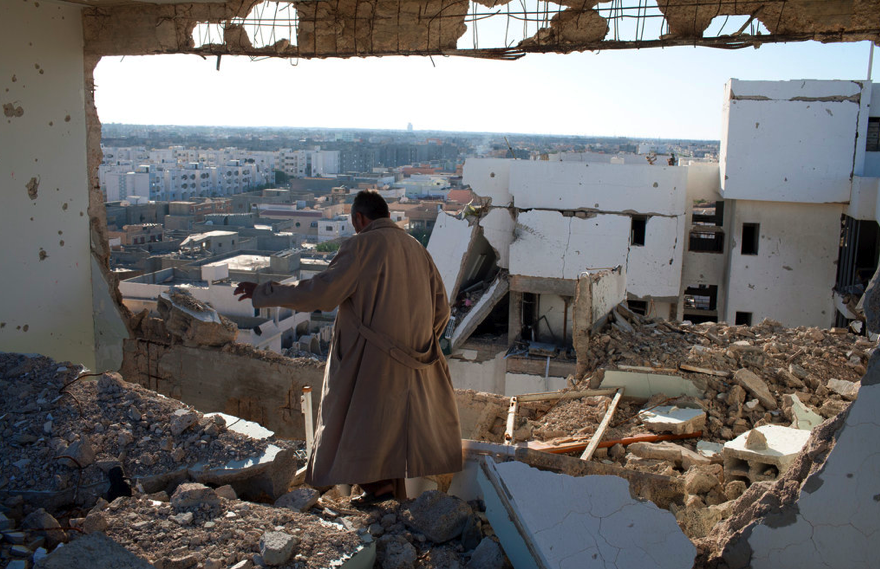
A Libyan man walks through an apartment damaged by NATO bombs in September 2011 (Photo: Tyler Hicks / The New York Times)

A recent report released by Human Rights Watch, entitled “Unacknowledged Deaths: Civilian Casualties in NATO’s Air Campaign in Libya”, has called upon NATO to thoroughly investigate any of its air strikes in Libya last year that killed civilians. NATO reacted sharply, exclaiming that it “deeply regret[s] any instance of civilian casualties for which NATO may have been responsible,” but that “the specific targets struck by NATO were legitimate military targets”and that the organization did everything possible to ensure that the loss of civilian life was minimal. The report and NATO’s response to it have recently triggered a timely debate: could, should and will the International Criminal Court investigate NATO’s role in the Libyan conflict?

Should They?

NATO was involved in a massive aerial campaign in Libya for eight months, there is no escaping that civilians were killed as a result, and any instances where this occurred should be investigated. If NATO or its member states are unwilling to thoroughly and transparently investigate incidences where their bombings resulted in a significant number of civilian casualties, it seems rather clear that the ICC should investigate NATO’s actions in Libya. This, of course, does not mean that NATO is guilty of committing war crimes or that NATO’s intervention should be vilified. There is an ever-present risk of demonizing NATO and the US, not for what they do, but simply for being Western. As David Rohde recently put it: “Some of the perceptions are exaggerated. The U.S. and NATO are not evil incarnate, nor are they perfect.”

There is a general acceptance that NATO’s intervention resulted in a remarkably low number of civilian casualties. Notably, while it was critical of NATO in some cases, the report of the UN Commission of Inquiry on Libya concurred that NATO had taken extensive precautions to prevent civilian deaths. HRW also accepts that civilian casualties were likely minimal. In this context, it is worthwhile highlighting that neither HRW nor the Commission of Inquiry have called on the ICC to investigate NATO, believing that NATO can and should investigate cases of civilian casualties themselves.

Of course, NATO’s success in minimizing civilians deaths does not excuse those instances where there were civilian deaths from being investigated. If there exists any right to truth for victims and survivors to know what happened to their family members, friends and communities, investigations into those aerial missions that resulted in civilian casualties are necessary.

Perhaps the most persuasive reason proffered as to why NATO shouldn’t be investigated is the argument that it would make future NATO interventions in response to atrocities less likely. But this argument presumes that NATO’s mandate cannot be enchanced from being investigated. On the contrary, an investigation by the Court that clears NATO of war crimes would boost the military organization’s credibility in combating atrocity crimes. It would also keep pressure on NATO to continue efforts to minimize the possibility of any civilian deaths in contexts where it intervenes.

Accepting that the ICC should investigate NATO crimes, the question becomes can they?

Can They?

There is no legal barrier to investigating citizens of those NATO states involved in Libya which are also signatories to the Rome Statute. A more controversial question, however, emerges with citizens of NATO members who are not members of the ICC, most obviously the United States. As I have argued elsewhere, the UN Security Council’s referral of Libya to the ICC, under Resolution 1970, was politically tailored by the Security Council (see also my recent academic analyses [here and here]). In this context, the US pushed through Operative Paragraph 6 of Resolution 1970 which excludes citizens of non-state parties from the Court’s jurisdiction, by stipulating that the Council: Continue reading →

Posted in Human Rights, ICC Prosecutor, International Criminal Court (ICC), Libya, Libya and the ICC, NATO | Tagged , , | 10 Comments

LRA Commander, Caesar Achellam, “Captured” – Some (Mostly Skeptical) Thoughts

Caesar Achellam following his capture on the DRC – CAR border. (Photo: James Akena / Reuters)

In what has generally been reported as a “major coup” for African Union forces – and by extension the KONY2012 faithful – a senior LRA commander, Caesar Achellam was detained over the weekend while crossing the border between the Democratic Republic of Congo and the Central African Republic.

While the Ugandan army (the UPDF) were quick to exclaim that they had captured a “big fish” and many reported that Achellam’s arrest marked a huge victory in the hunt for Kony, there are good reasons to be skeptical of these claims.

Who is Caesar Achellam?

Achellam is a senior commander in the LRA. He was, at least as of 2008, a Major General. It was reported that he was close to Vincent Otti, the LRA’s second in command who was executed in 2008, on orders from Kony, for having been too deeply involved in efforts to resolve the ongoing conflict. Many of those who were close to Otti feared for their lives and Achellam apparently sought to surrender himself. While it is unclear how, he clearly regained the trust of Kony, rising to a prominent position in the LRA. Some say that, at the time of his “capture”, he was the fourth most senior commander in the LRA, perhaps even the LRA’s most senior strategist. Despite his seniority, however, Achellam is not amongst those LRA combatants indicted by the ICC.

Something Smells Fishy

There is no doubt that this is a major PR victory for the UPDF and its attempts to “kill or capture” Kony. They are clearly treating it as such as well. In the immediate aftermath of Achellam’s “capture”, regional officials were barred from publicly admitting that Achellam was in UPDF custody. The UPDF wanted the media to gather in a South Sudanese town before Achellam arrived and was paraded before them.

Another rather odd aspect of Achellam’s “capture” was the friendliness with which he was met by UPDF soldiers. He emerged from a military helicopter smiling and seemed to be greeted warmly by UPDF personnel and Felix Kulayigye, the Ugandan army’s chief spokesperson. Further, Achellam was candid and open about supporting ways to end the rebellion and dismantle the LRA. In interviews he declared that “”My coming out will have a big impact for the people still in the bush to come out and end this war soon.”

This may, at least partly, be explained by the reasons why Achellam was detained. Despite media reports and statements to the contrary it is not clear whether Achellam was captured or whether he surrendered. Interestingly, in describing what had transpired, Achellam says: “For me, I knew, I was coming out.” (see video below) Continue reading →

Posted in Lord's Resistance Army (LRA), Uganda | Tagged , , | 8 Comments

The ICC in Libya: Beyond Peace vs. Justice

This post is my contribution to a timely symposium being held at the Canadian International Council on the “peace versus justice” debate. I encourage you to check out other contributions to the symposium from Leslie Vinjamuri, Alana Tiemessen and Stephen Brown, amongst others. Enjoy!

(Photo: Reuters)

Just weeks after Colonel Moammar Gadhafi initiated his crackdown on civilian protesters, the United Nations Security Council unanimously passed Resolution 1970, referring the situation in Libya to the International Criminal Court (ICC). Human-rights groups joined a chorus of international actors in exclaiming that the Security Council’s decision was a victory and milestone for justice. Almost as quickly, however, critics of the ICC began to blame the Court for impeding a peaceful resolution to the conflict in Libya. The controversy was unsurprising. As in the case of northern Uganda and Sudan, commentators and scholars alike have framed the ICC’s judicial interventions as a trade-off between peace and justice. But was either side in this dichotomous debate right in its assertions?

Readers are likely familiar with the arguments central to the “peace versus justice” debate. On the one hand, many claim that there is “no peace without justice” – that achieving accountability and fighting impunity is a moral imperative, and that no “true” peace can exist if justice isn’t achieved. Advocates of the ICC further argue that pursuing justice can marginalize the perpetrators of atrocities, halt the spiral of violence by preventing victims from seeking violent retribution, establish truths about the commission and experience of atrocities, and provide closure to victims and survivors.

On the other hand, critics of the ICC argue that there is “no justice without peace” – that seeking to bring warring parties to justice can hamper peace processes by making it impossible to offer amnesties or exile to belligerents. Faced with the prospect of trials and imprisonment, warring parties will not engage in peace negotiations. If justice is pursued at all, proponents of this perspective argue, it should wait until a certain degree of stability and order is firmly in place.

The arguments on both sides are intuitive and simple enough to seem sensible. The problem is that they often misrepresent reality.

Libya is a case in point. Observers didn’t shy away from deploying “peace versus justice” rhetoric in their descriptions of the crisis in Libya. In particular, critics of the ICC claimed that the Court’s involvement prevented Gadhafi from seeking exile and instead gave him every incentive to continue fighting. Military historian and foreign-policy analyst Max Boot claimed that the ICC ensured Gadhafi would “fight to the death and take a lot of people down with him.” Washington Post writer Jackson Diehl exclaimed that Libya was mired “in a civil war in large part because of Gaddafi’s international prosecution.” The Globe and Mail columnist Doug Saunders similarly suggested that the ICC backed Gadhafi into a corner. “[T]he ICC may have perpetuated, rather than ended, his crimes,” Saunders wrote. “Col. Gadhafi and his sons and generals do not dare end their campaign of violence if it means spending years in a Dutch cell.”

The light Gaddafi saw at the end of the tunnel he hid in shortly before being killed (Photo: Reuters)

Unfortunately for these commentators, there is little evidence that Gadhafi’s behaviour or decision-making was affected by either the ICC’s investigation or the arrest warrant issued against him, his son (Saif al-Islam Gadhafi), and his intelligence chief (Abdullah al-Senussi). Negotiations were initiated by the African Union in April 2011 and quickly failed – but not once because of the Court. Libya’s National Transitional Council (NTC), which was set up to represent the rebels, outright rejected negotiations that would result in Gadhafi retaining any power. Meanwhile, offers of exile were extended to the Libyan leader on a number of occasions. As late as July 2011, NATO states sought to break the apparent stalemate in the war by seeking a political solution to the crisis and offering Gadhafi exile into a non-ICC member state such as Belarus, Zimbabwe, or Sudan. Gadhafi, however, consistently vowed that he would not leave Libya, reiterating time and again that he would die a “martyr.” Gadhafi’s last will is telling of both efforts to provide him with a safe haven outside of Libya as well as his recalcitrance to such a fate:

Let the free people of the world know that we could have bargained over and sold out our cause in return for a personal secure and stable life. We received many offers to this effect but we chose to be at the vanguard of the confrontation as a badge of duty and honour. Continue reading →

Posted in International Criminal Court (ICC), Libya, Libya and the ICC, The Tripoli Three (Tripoli3) | 4 Comments

Impunity Rules: Libya Passes Controversial Amnesty Law

(Photo: UPI/Mohamaad Hosam)

While haggling between the ICC and Libya’s National Transitional Council (NTC) over the fate of Saif al-Islam Gaddafi and Abdullah al-Senussi continues, Libya quietly, but controversially, passed a blanket amnesty for pro-Revolution rebels.

According to Lawyers for Justice in Libya (LFJL), under ‘Law 38’, amnesty will be granted for any “acts made necessary by the 17 February revolution” and for the revolution’s “success or protection”. Earlier, reports suggested that the amnesty law was being drafted in order to appease Libya’s tribal leaders who presumably fear anti-Gaddafi rebels being held accountable for human rights violations committed during the uprising.

It is no secret that both sides of the conflict committed atrocities. In this context, it is notable that the need for amnesty is in itself an acknowledgement that crimes occurred – otherwise there would be no need for an amnesty in the first place.

Notably, the amnesty law was passed along with ‘Law 37’, which forbids “praising or glorifying Gaddafi, his regime, his ideas or his sons”. Rather precariously, the law claims that Libya is still in a state of war and allows for the imposition of a life sentence on anyone who “harms the state” in glorifying the Gaddafi regime. While, to my knowledge, Western states have remained entirely silent on the subject, LFJL and Amnesty International have harshly condemned the legislation, suggesting that they harken back to the brutal and draconian laws that restricted the freedoms of Libyans under Gaddafi.

But is Libya’s new amnesty law in any way justifiable?

As I have argued before, despite the protestation of some wishful thinking scholars, it isn’t clear that all amnesties are all bad. Louise Mallinder has shown that amnesties can vary along at least three dimensions: what crimes are covered, which groups and individuals the amnesty covers and whether amnesty has attached conditionality or not. In the case of conditional amnesties, the guarantee of immunity is tied to participation in other transitional justice mechanisms, such as testifying at a Truth Commission, as in the case of the South African Truth and Reconciliation Commission. This, in turn may contribute positively to peaceful transitions and to the establishment of the truth.

Nevertheless, granting amnesties for human rights violations aren’t the ideal and shouldn’t be seen as such. But, as Mark Freeman writes in his must-read book on the subject, amnesties may be “necessary evils”. People may be repulsed by impunity but their “repulsion for war and tyranny is greater.” Christine Bell has similarly argued that: “If the choice is between an imperfect peace and a perfect war, imperfect peace may be worth a gamble.” Continue reading →

Posted in Amnesty, International Criminal Court (ICC), Libya, Libya and the ICC | 15 Comments