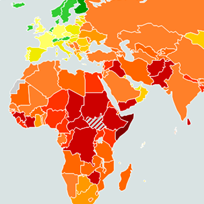
Image (c) Fund For Peace
The new Failed States Index, published yearly by Foreign Policy magazine and The Fund for Peace, is just out and it comes as no surprise that most states with cases at the International Criminal Court are highly ranked as “failed.” The degree to which a stated is failed is determined by a compilation of 12 indicator scores. Here, I will put aside my skepticism that “state failure” has become a conceptual garbage can to collectivize the world’s governance problems and speculate about the nature and relevance of a correlation between failed states and international judicial intervention.
First, in some ways, the correlation seems obvious. As a “court of last resort,” the intentions of those who designed and continue to support the ICC will argue that it is meant to fill impunity gaps in states that have weakened to the point where atrocities become possible and the rule of law is flawed or entirely absent. Therefore, the ICC will intervene within its legal jurisdiction and consider situations and cases admissible if a) there are grave and mass human rights violations and b) the relevant authorities prove incapable and unwilling to pursue genuine accountability. Three indicators in the failed states index are most relevant to these criteria and states with cases at the ICC have relatively to exceptionally high scores on them:
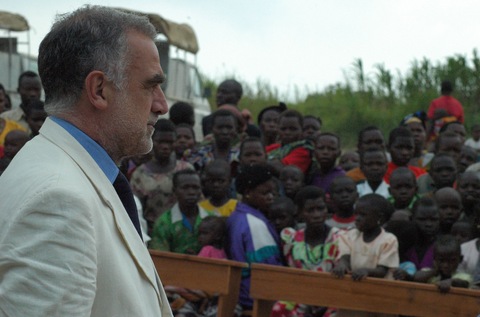
Former ICC Chief Prosecutor, Luis Moreno-Ocampo, visits a massacre site in the DRC.
Photo (c) Sheila Velez, White Pine Pictures
Vengeance Seeking Group Grievance. This indicator includes a “history of aggrieved communal groups citing injustices of the past” and a “pattern of atrocities committed with impunity against communal groups.”
These factors make atrocities more likely and aptly characterize most of the conflict situations among ICC states, particularly those with an ethnic dimension and where electoral contests spark violent protests. Many of the state failure indicators are consistent causes and consequences of atrocities but, of course, not all failed states are home to such mass human rights violations.
Legitimacy of the State. This indicator includes “resistance of ruling elites to transparency, accountability and political representation…”
The Court’s mandate puts pressure on ruling elites to mete out accountability domestically or find themselves in The Hague alongside their rivals. In practice, investigations and prosecutions are imbalanced in this regard. For example, ruling elites in DRC, Uganda, Cote d’Ivoire have successfully resisted the pressure for domestic trials but have not been called to account at the ICC for their own alleged crimes.
Violation of Human Rights and Rule of Law. This indicator includes the “emergence of authoritarian, dictatorial or military rule in which constitutional and democratic institutions and processes are suspended or manipulated” and the “outbreak of politically inspired (as opposed to criminal) violence against innocent civilians.”
As alluded to above, the ICC can and will only intervene selectively. Impunity gaps and the absence of rule of law make atrocities and human rights violations possible and necessitate international judicial intervention.
(The Fund for Peace provides more elements of each indicator here.) Continue reading