
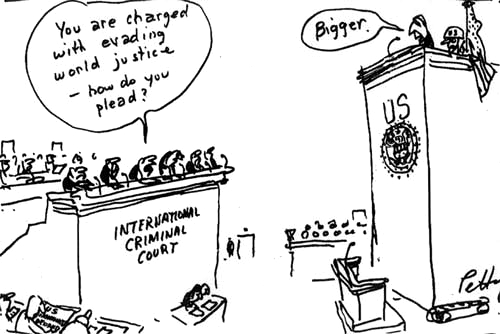
 Hilary Clinton recently suggested that Syrian President, Bashar Assad, fit the definition of a war criminal. Could the US be inching towards endorsing another UN Security Council referral to the International Criminal Court? Not so fast. Clinton added that, despite the likelihood that Assad was guilty of war crimes and crimes against humanity, any attempt to bring him before the ICC would “complicate a resolution of a difficult, complex situation because it limits options to persuade leaders perhaps to step down from power.” Clearly, the peace-versus-justice debate is alive and well.
A familiar pattern is emerging in Syria. The continuing humanitarian crisis and the lack of a coherent response from the ‘international community’ in Syria has inevitably left many to ponder what possible actions could now be appropriate. Once again, observers are seemingly divided between two camps: one, tired of a lack of action and driven by examples where inaction has led to devastating tolls on human life and which screams “act first, think later”. The other, more calibrated and wary of past experiences in Iraq, Afghanistan and elsewhere urging international actors to “think first, act later.”
There appears to be no coherent response on the horizon to address the acts of atrocity in Syria. While some response is desperately needed, this lull does provide an opportunity for sober reflection on the ever-evolving tools to effectively address and end atrocities.
This essay is based on research I am currently conducting and offers an attempt to grapple with the relationship between the ICC and the UN Security Council. As such, it delves into the ever-shifting sands at the nexus of international politics and international criminal justice in the wake of the Libyan intervention.
Negotiating the ICC’s Independence
The contemporary emergence of international criminal justice and the creation of the ICC can be seen within the context of a particular political ethos, namely liberal cosmopolitanism. Liberal cosmopolitanism seeks to displace the state – or any collective for that matter – as the primary moral and political unit in international relations. It is the individual human’s experience, security and rights that must be, above all, privileged. The end of the Cold War, characterized as it was by realpolitik and stagnation on many human rights questions, provided the elbow room necessary for liberal cosmopolitan projects – previously deemed idealistic or utopian – to institutionalize. Whatever necessary impetus was missing, guilt stemming from the inaction by the international community in the face of the Rwandan Genocide and the Srebrenica massacre fueled the liberal cosmopolitan cause.
Out of this unique historical and political moment emerged a set of concepts, practices and institutions which, students of international politics often argue, constitute the very contours of international politics: international criminal justice; human security; the responsibility to protect; and liberal peacebuilding. All, at their very core, share the view that it is the individual, above all else, who must be ‘protected’ and, when at risk, ‘saved’.
Given this context, it should be unsurprising that, during the Rome Statute negotiations, a key issue of contention was the relationship between the Court and the UN Security Council. Proponents of the ICC sought to guarantee a Court independent of international power politics, one which could transcend the orthodoxy of international relations wherein asymmetries of powers determine whose sovereignty is respected and whose is permeable. ICC advocates were deeply uncomfortable with, suspicious of, and perhaps even feared giving the UN Security Council too much influence over the functioning of the Court. The concern was that if the ICC worked at the behest of the Security Council, it would result in a Court that was an extension of state powers rather than ‘humanity’.
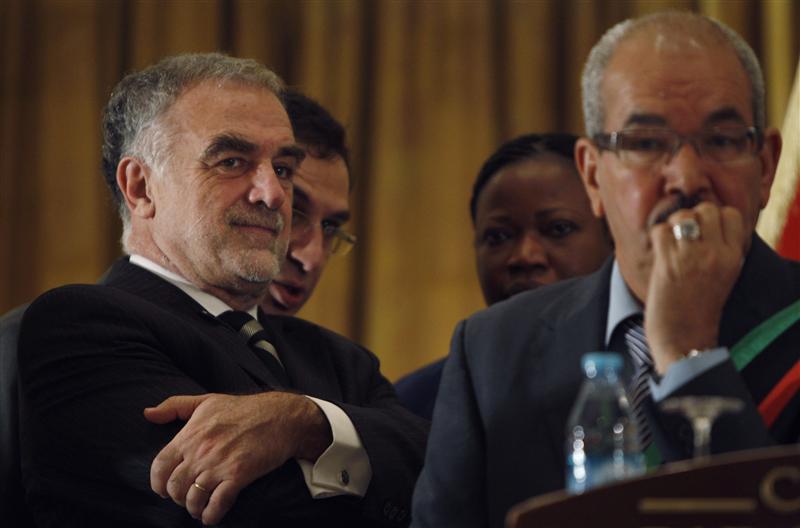
Moreno-Ocampo in Libya (Photo: Mohammed Salem/Reuters)
Cozying up to the Security Council
To a remarkable extent, fear of the Court being shaped and determined by the Security Council has dissipated.
If there was any discomfort with the ICC’s first UN Security Council referral – that of Darfur in 2005 – little to no concern was voiced when, in February 2011, Libya became the Court’s second Security Council referral. On the contrary, the Security Council’s action was welcomed by human rights groups without reservation. Richard Dicker, head of Human Rights Watch, heaped praise on the Security Council arguing that it had finally demonstrated that “[t]he United Nations is showing concerted international resolve to pressure Gaddafi and his henchmen to end their murderous attacks on the Libyan population.” Other groups suggested it was a “victory”, “milestone” and “triumph” for international justice.
The Office of the Prosecutor at the ICC was likewise eager and enthusiastic about the Security Council’s referrals. This is most powerfully evidenced by the unprecedented speed with which the Libya referral was accepted and translated into arrest warrants for the Libyan leader, Colonel Muammar Gaddafi, his son and former heir-apparent Saif al-Islam Gaddafi and Libya’s internal and external head of intelligence Abdullah al-Senussi.
For some, like legal scholar, Frédéric Mégret, this proximity is the result of an evolution in the relationship between the ICC and the UN Security Council. In a masterful piece on the subject, Mégret illustrates how “the irresistible attraction of power” leads the ICC to “gravitate towards the Security Council”:
The ICC has had “a tendency to gravitate towards the very power that [it is] supposed to constrain” and finds itself “obsessed with the need to enlist power for [its] cause not only in the sense of needing immediate patrons for the purposes of having certain ideas endorsed, but because [the ICC] depend on power to be implemented in the long term. The irony…,then, is a tremendous tendency to reinforce that which [the ICC claims] to transcend, sovereign states on the one hand, and the Security Council on the other…[T]he ICC’s aspiration to international criminal justice…[is] exposed as ultimately weak and dependent on the very sort of power whose limitations [it] condemn[s]….The Court thus ends up being highly subservient to the Security Council power logic that was supposed to be so lethal to the fundamental justice of international criminal justice…”
It can easily be claimed that this irresistible attraction led the Court to accept Security Council Resolution 1970, a referral which is as much a matter of politics as law or justice. Continue reading










 Justice in Conflict