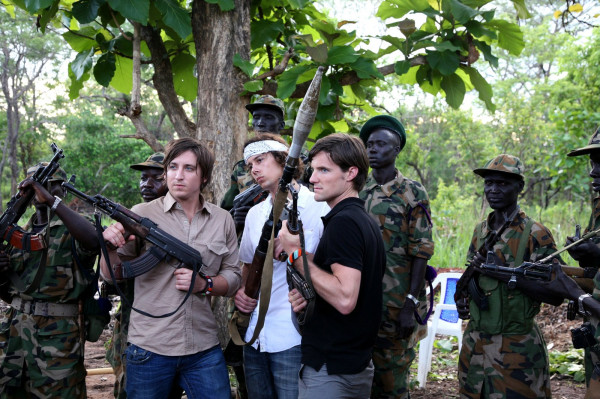
The makers of Kony 2012. (Photo: Glenna Gordon / Scarlett Lion)
As we speak, one of the most pervasive and successful human rights based viral campaigns in recent memory is underway. Invisible Children’s ‘Kony 2012‘ campaign has taken Twitter, Youtube, Facebook and every other mainstream social media refuge by storm. In many ways, it is quite impressive. But there’s one glaring problem: the campaign reflects neither the realities of northern Ugandan nor the attitudes of its people. In this context, this post examines the explicit and implicit claims made by the ‘Kony 2012’ campaign and tests them against the empirical record on the ground.
Before jumping into the fray, however, I should preface the post by noting that, in many ways, Invisible Children have done a fantastic job in advocating for the rights of northern Ugandans, highlighting the conflict and providing tangible benefits to victims and survivors of LRA brutality. Indeed, this post is not intended to take aim at Invisible Children as an organization but rather to debunk some of the myths its ‘Kony 2012’ campaign is propagating.
The Problem is Popularity?
Kony 2012 is about making Joseph Kony, the leader of the notorious LRA, famous because, the line of reasoning goes, if everyone knew him, no one would be able to stand idly by as he waged his brutal campaign of terror against the people of East Africa.
I am actually stupefied that any analysis of the ‘LRA question’ results in the identification of the problem being that “Kony isn’t popular enough”. The reality is that few don’t know who Joseph Kony is in East Africa and the Great Lakes Region, making it all-too-apparent that this isn’t about them, their views or their experiences. But even more puzzling is that Joseph Kony is one of the best known alleged war criminals in the world – including in the United States. This is the case in large part because of the advocacy of Western NGOs, including Invisible Children and the Enough Project as well as the ICC arrest warrants issued against Kony and his senior command.
I would understand if this were the 1990s or even the early 2000s when the misery plaguing northern Uganda flew completely under the radar. I would understand if this campaign was about the ongoing conflict in the Democratic Republic of Congo. But a campaign in 2012, premised on Joseph Kony not being famous enough is just folly.
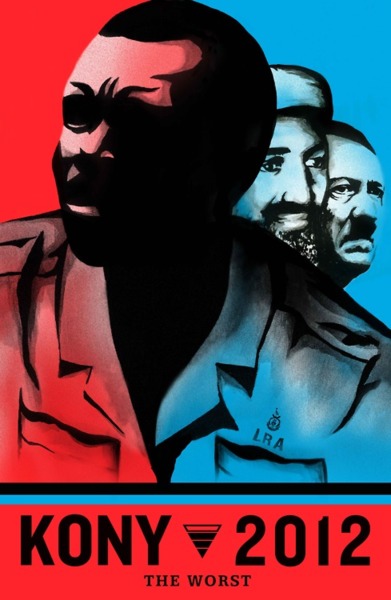
A poster from the 'Kony 2012' campaign. (Poster: Invisible Children)
Umm…what about northern Ugandans?
It is hard to respect any documentary on northern Uganda where a five year-old white boy features more prominently than any northern Ugandan victim or survivor. Incredibly, with the exception of the adolescent northern Ugandan victim, Jacob, the voices of northern Ugandans go almost completely unheard.
It isn’t hard to imagine why the views of northern Ugandans wouldn’t be considered: they don’t fit with the narrative produced and reproduced in the insulated echo chamber that produced the ‘Kony 2012’ film.
‘Kony 2012’, quite dubiously, avoids stepping into the ‘peace-justice’ question in northern Uganda precisely because it is a world of contesting and plural views, eloquently expressed by the northern Ugandans themselves. Some reports suggest that the majority of Acholi people continue to support the amnesty process whereby LRA combatants – including senior officials – return to the country in exchange for amnesty and entering a process of ‘traditional justice’. Many continue to support the Ugandan Amnesty law because of the reality that it is their own children who constitute the LRA. Once again, this issue is barely touched upon in the film. Yet the LRA poses a stark dilemma to the people of northern Uganda: it is now composed primarily of child soldiers, most of whom were abducted and forced to join the rebel ranks and commit atrocities. Labeling them “victims” or “perpetrators” becomes particularly problematic as they are often both.
Furthermore, the crisis in northern Uganda is not seen by its citizens as one that is the result of the LRA. Yes, you read that right. The conflict in the region is viewed as one wherein both the Government of Uganda and the LRA, as well as their regional supporters (primarily South Sudan and Khartoum, respectively) have perpetrated and benefited from nearly twenty-five years of systemic and structural violence and displacement. This pattern is what Chris Dolan has eloquently and persuasively termed ‘social torture‘ wherein both the Ugandan Government and the LRA’s treatment of the population has resulted in symptoms of collective torture and the blurring of the perpetrator-victim binary.
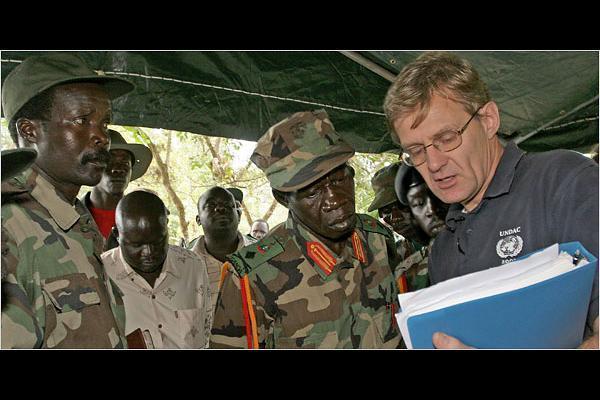
Kony and his former second in command, Vincent Otti, with former UN Undersecretary-General for Humanitarian Affairs and Emergency Relief Coordinator, Jan Egeland (Photo: New York Times)
The Solution?
Given Invisible Children’s problematic identification of the issue, it becomes impossible for them to come up with an appropriate vision of resolving the crisis.
Invisible Children is, perhaps rightly, proud that it put the ‘LRA question’ on the Obama administration’s agenda. In this context, last year’s announcement that the administration would send 100 military ‘advisors’ to Uganda was widely celebrated. But this triumphalism occludes key realities.
The sending of 100 troops was not, in any sense, an altruistic move by the administration. First, it went unreported that many of the troops were already in Uganda. Second, the announcement was, at least in part, a tit-for-tat response for the Government of Uganda’s military engagement in Somalia – where the US refuses to deploy troops. As Matt Brown of the Enough Project conceded:
“The U.S. doesn’t have to fight al-Qaida-linked Shabab in Somalia, so we help Uganda take care of their domestic security problems, freeing them up to fight a more dangerous – or a more pressing, perhaps – issue in Somalia.
It is clear that the ‘Kony 2012’ campaign sees the 100 US troop allotment as inadequate. Here they are right – 100 US troops is not the solution. But their own answer is highly problematic.
We know what the makers of “Kony 2012” believe should happen but they won’t say it explicitly, except to say that Kony must be “stopped”.
Obama’s orders for his 100 troops – presumably supported by those behind ‘Kony 2012’ – is to “kill or capture” Joseph Kony. I don’t think it is a stretch to suggest that many of the same individuals who will form the legion of participants in ‘Kony 2012’ were on the streets celebrating the killing of Osama bin Laden. It thus likely holds that they bought into the belief, proffered by Obama himself, that bin Laden’s killing amounted to justice and if you didn’t agree, you should get your head checked.
The solution then, is something similar: an American-led intervention into at least four countries where the LRA is or has been active (Uganda, the DRC, the Central African Republic and South Sudan) to hunt down Kony. Capturing him, after all, is secondary to “stopping” him.
The idea of “stopping Kony”, of course plays into the narrative created by the ‘Kony 2012’ campaign where what actually happens to Kony and the LRA is irrelevant. The unspecific aim of “stopping” him is sufficient. Who, after all, doesn’t want Kony “stopped”? But then what? If Kony is killed or captured, then what? What happens to the other members of the LRA? ‘Kony 2012’ offers no answers here.
In this context, it is worthwhile remembering that massive regional military solutions (Operations Iron Fist and Lightning Thunder most recently), with support from the US, have thus far failed to dismantle or “stop” the LRA. These failures have created serious and legitimate doubts that the ‘LRA question’ is one that can be resolved by military means.
Incredibly, there is no mention in the film or the campaign that northern Ugandans are currently enjoying the longest period of peace since the conflict began in 1986. Virtually every single northern Ugandan I spoke to during my own field research believes that there is peace in the region. While sporadic violence continues, particularly as a result of bitter land disputes, there have been no LRA attacks in years. In the mid 2000s, the ‘LRA problem’ was exported out of Uganda. The LRA is currently residing in the DRC, CAR, and perhaps parts of South Sudan and even Darfur. Today, land issues and the recent Walk to Work crisis are higher on the agenda than the LRA in northern Uganda.
Lastly, killing Kony cannot resolve the actual sources of the crisis which are far more structural than superficial (to put it lightly) analyses like ‘Kony 2012’ would like to admit. As respected scholars of northern Uganda, Mareike Schomerus, Tim Allen, and Koen Vlassenroot, recently argued,
“Until the underlying problem — the region’s poor governance — is adequately dealt with, there will be no sustainable peace.”

Kony (left) with Otti. (Photo: AFP)
The Need for a Sober Second Thought
In the end, ‘Kony 2012’ falls prey to the obfuscating, simplified and wildly erroneous narrative of a legitimate, terror-fighting, innocent partner of the West (the Government of Uganda) seeking to eliminate a band of lunatic, child-thieving, machine-gun wielding mystics (the LRA). The main beneficiary of this narrative is, once again, the Ugandan Government of Yoweri Museveni, whose legitimacy is bolstered and – if the ‘Kony 2012’ campaign is ‘successful’ – will receive more military funding and support from the US.
Of course, as a viral campaign launched through social media, ‘Kony 2012’ is impressive, if not unprecedented. It will, undoubtedly, mobilize and morph a horde of sincere American youths into proxy war criminal hunters. It will further succeed in increasing the ‘popularity’ of Joseph Kony and the LRA in the United States. But it will do so for many of – if not all – the wrong reasons.
I remember when I was in grade school and a teacher told the students that it was actually difficult to fail. “You have to try to fail,” he said. If ‘Kony 2012’ is to be judged by its reflection of the realities on the ground in northern Uganda and how it measures up against the empirical record, the makers of Kony 2012 tried – and succeeded.
——————————
UPDATE: I’ve now published a response to the main criticisms that this post has inspired. See here: Taking ‘Kony2012′ Down a Notch – Responding to Criticism.
Check out this excellent account by Daniel Solomon over at his blog, Securing Rights.
Also, big thanks to my friend and colleague, Paul Kirby, for his insightful comments on a draft of this post.