JiC welcomes Peter Quayle, a solicitor specialising in public international law and litigation and the author of an excellent blog on international law. In this guest-post, Peter considers the international legal parameters in responding to the ongoing crisis in Syria. Enjoy!
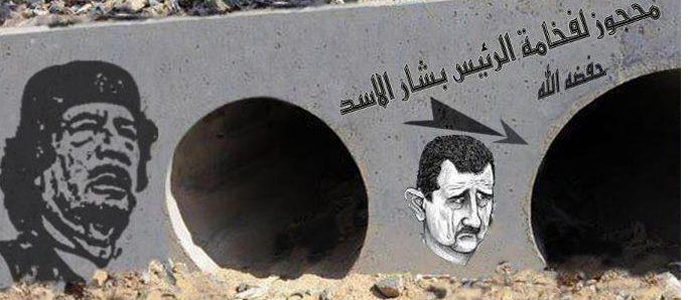
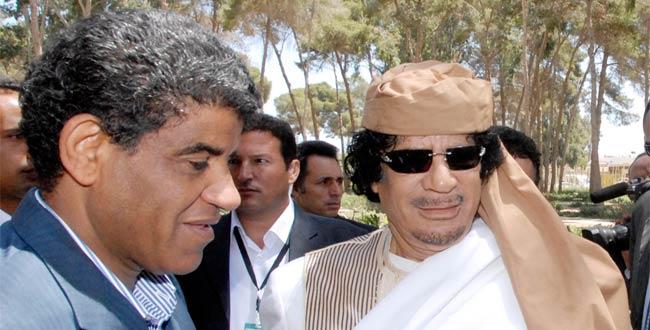
A not-so-subtle and quite grim use of graffiti to suggest that some would like to see Syria's Assad meet a similarly grisly fate as Libya's Gaddafi
During Syria’s scorching summer, visitors to the Souk Al-Hamdiye in central Damascus appreciate the shaded cool. They also remark on the slender beams of sunlight that lance the corrugated iron roof and scatter in the gloom. These are resulting from the profusion of penny-sized holes left by bullets fired in 1925 during an unsuccessful uprising against French colonial rule. It was not until 1945 that Syria gained its independence.
Today’s opposition to President Bashar al-Assad needs be no less protracted. All the more so since the recent veto by Russia and China of a UN Security Council resolution urging adherence to a peace plan proposed by the Arab League. Yet, last year’s interdiction of Libya’s long time leader, Muammar Gaddafi, unsettled the regional presumption of exemption from UN-sanctioned international intervention. Hence the strong supposition that the situation in Syria is surely akin to Libya but the politics in Moscow and Beijing differs. But if we can discern important categorical differences of international criminal law, does this account for apparently inconsistent policy? And if international institutions are inactive, is international law irrelevant?
Five months ago, the UN’s Office of the High Commissioner for Human Rights (OHCHR), reported to the General Assembly on a fact finding mission sent to Syria to investigate breaches of international human rights law. The mission had found “a pattern of human rights violations constituting widespread or systematic attacks against the civilian population, which may amount to crimes against humanity.” It had evidence that murder, disappearances, torture and persecution were all instruments of a policy to brutally suppress political opposition. The OHCHR urged the Security Council to consider referring Syria to the International Criminal Court (ICC).
However, it is noticeable that this categorisation has not cohered before the Security Council. The action taken against Gaddafi’s regime under UNSC 1970 (2011) – arms embargo, travel bans, asset freeze, and referral to the ICC’s jurisdiction – considered that “the widespread and systematic attacks currently taking place in the Libyan Arab Jamahiriya against the civilian population may amount to crimes against humanity.” In contrast, the doomed recent resolution against Syria was confined to the condemnation of “continued widespread and gross violations of human rights and fundamental freedoms.”

A pro-Assad protester in Damascus (Photo: Muzaffar Salman / AP)
Typically, atrocity crimes – crimes against humanity, war crimes and genocide – engage the Security Council’s prerogative to maintain and restore international peace and security. Human rights violations, under the UN Charter, Article 2(7), more often than not, are merely considered to be “essentially within the domestic jurisdiction” of members states. Action against Gaddafi was binding under Chapter VII, “[a]ction with respect to threats to the peace, breaches of the peace, and acts of aggression.” Action as drafted against Syria was under non-compulsory Chapter VI, “Pacific settlement of disputes.” The resolution passed by the General Assembly, adopts the vetoed Security Council version, and is non-binding. Continue reading