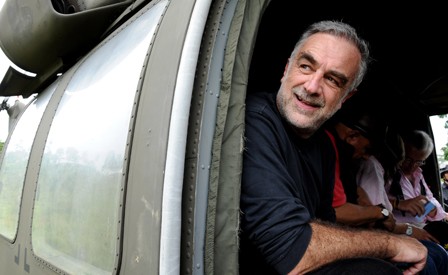
Mladic Reunited with Karadzic: Arrested and Heading to the Hague

Ratko Mladic will be reunited with his old ally Karadzic. This time it will be at the ICTY, in the Hague.

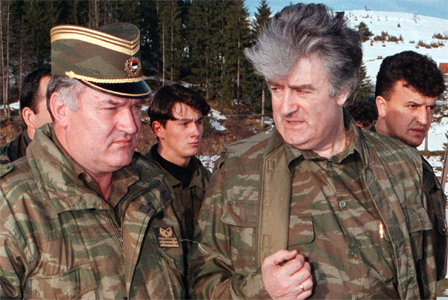
Ratko Mladic and Radovan Karadzic are united again, just not in the way they had hoped. Today, Mladic, seen by many as the Bosnian Serb architect of death for his role in the Bosnian war, was arrested by Serb authorities. He is set to be transferred to The Hague in the next few days, presumably to stand trial at the International Criminal Tribunal for the Former Yugoslavia (ICTY). (note: earlier reports incorrectly suggested he was already on his way to The Hague)

For many, this was a long time coming. As David Bosco rightly points out,

“Whatever the truth, the arrest is a long-delayed victory for Bosnian victims, for the international tribunal–and for the European Union, which has maintained pressure on the issue for years.”

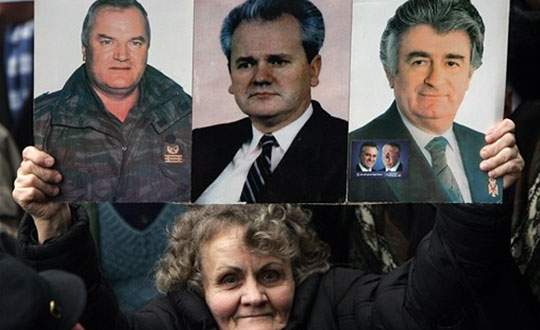
It is no doubt a great day for the ICTY, whose work has been winding down as it prepares to close its operations in the next few years. Mladic’s arrest signals the completion of the ICTY’s trinity: Milosevic, Karadzic and Mladic are the Balkan crises’ “big fish.” Indeed, it is remarkable that the ICTY will be able to say they had custody of every leading perpetrator of war crimes, crimes against humanity and genocide in the Balkans. Regardless of the trials and tribulations that characterized Milosevic’s trial and which may stain the record in Karadzic’s trial, the ICTY will forever be able to say that those most responsible for atrocities in the Balkans were detained and brought to the Court.

The Balkan Trinity: after today, each will have been delivered to the ICTY.

We are in unprecedented times for international criminal justice. Hardly a day goes by without major news that pertain directly to the pursuit of international justice and accountability. The dream of the architects of international criminal law that justice would be established as the deep grammar of international politics has been increasingly realized. Think of the headlines in the past few months: the ICC in Ivory Coast, Libya, and perhaps Syria; a truth commission for Ivory Coast; Egypt and Tunisia both expressing interest in joining the ICC, etc. Historians will undoubtedly note that at the epicenter, indeed at the very heart, of international politics in 2011 was the pursuit of justice and accountability.

Continue reading

Posted in Balkans, Genocide, Human Rights, ICTY, Peace Negotiations, Serbia, Slobodan Milosevic | 4 Comments

The ICC’s Next Top Prosecutor

Electing the next ICC Prosecutor

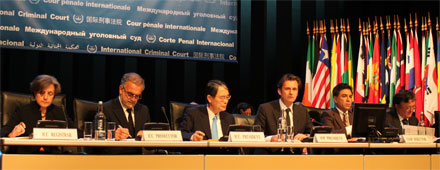
The Assembly of State Parties will decide who the next ICC Prosecutor will be in December 2011

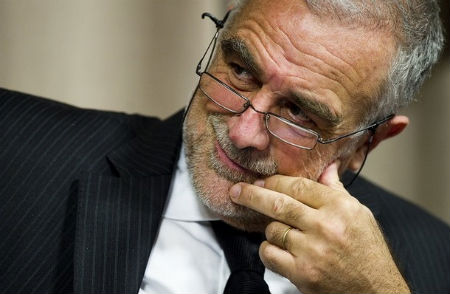
The term of the ICC’s first Prosecutor, Luis Moreno-Ocampo, is slowly, albeit dramatically, drawing to a close. In December 2011 the members of ICC’s Assembly of State Parties will convene to choose the Court’s next Prosecutor. He or she will officially replace Moreno-Ocampo in June 2012. Every member-state of the Court will have one vote in deciding the ICC’s second prosecutor. In early February, the ICC set up a search committee to identify some potential candidates.

Moreno-Ocampo is the only chief Prosecutor the Court has ever known. Since 2002, when the ICC came into being, he has managed to shine a tremendous amount of spotlight on the workings of the Court. He has also managed to rub a lot of people the wrong way. His record will be something for scholars of all stripes to pour over in the coming years. But what about the next ICC Prosecutor? Who will he or she be?

There are a number of issues member-states will consider as they take time over the next few months to decide who they will support. A range of factors will surely shape the calculus of states as they inch towards the December vote. Here are a few considerations.

The Politics of Location

The question of the region and nation from which the next Prosecutor comes from is perhaps where the political inclinations of every state and non-state actor involved in the election will be strongest. This is also where the danger of vote trading is highest – states trading and grouping votes together on the basis of political considerations (eg. a vote in another international institution) rather than basing their decisions on the quality of the candidate.

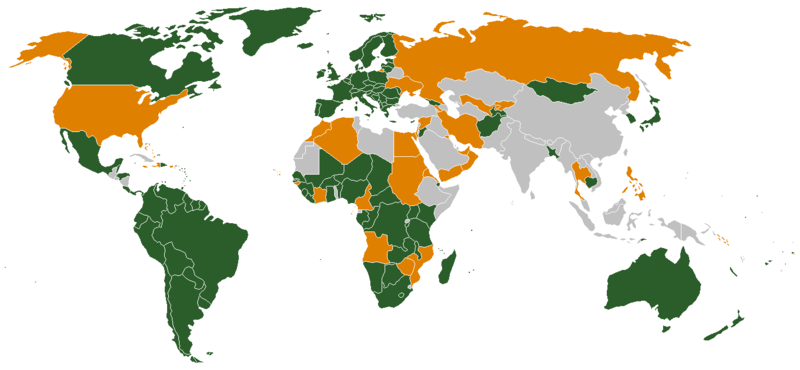
The majority of members of the ICC are outside of North America and Europe (ratified members in green; signatories in orange)

It is highly unlikely that the Prosecutor will be North American or European. The vast majority of member-states come from Africa, South America and Asia. Africa still makes up the largest contingent and the AU has already been clear that it wants an African Prosecutor to lead the Court. Noting that none of the ICC’s top positions (ie. the heads of the Court’s four organs) are filled by an African citizen, there is a strong case to be made that the next Prosecutor should be African. According to one report, the AU will nominate a candidate this summer.

Moreno-Ocampo is an Argentine. One of his earliest professional roles was as an assistant prosecutor in the trial of Argentina’s Dirty War leaders. Will the next Prosecutor also come from a non-Western state which has persevered through mass human rights atrocities? It seems at least a distinct possibility. Continue reading

Posted in ICC Prosecutor, International Criminal Court (ICC), Next ICC Prosecutor | 14 Comments

The ICC and the Tripoli Three: Time, It’s on our Side

ICC Prosecutor Luis Moreno-Ocampo has moved with unprecedented speed to request arrest warrants of the Tripoli Three (Photo: VoxAfrica)

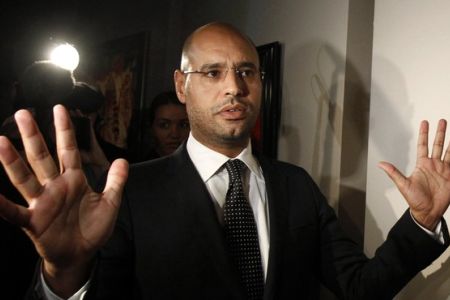
As other actors involved in the Libyan conflict have appeared to dither and issue mixed messages, the ICC’s Prosecutor has been remarkably decisive and concrete with his work. Within three months of having had the situation in Libya referred to the ICC, the Prosecutor has requested arrest warrants of the Tripoli Three – Gaddafi, his son Saif al-Islam Gaddafi, and the head of Libya’s Intelligence. Issues of time and timing go to the heart of the debates about the appropriateness of international criminal justice and the ICC’s work in particular.

On a fundamental level, transitional justice is about time. Decisions about whether and how to confront past atrocities are about negotiating the past, the present and the future. Differing choices prescribe differing timing. Granting amnesties to those responsible for past atrocities suggest that the past should never be confronted; the past is better left in the past. Truth Commissions are a long and arduous process intended to establish narratives of particular time periods. Trials are meant to bring a sense of justice to victims immediately.

Much of the debate regarding the relationship between peace and justice revolves around questions of timing. Those who voice the popular criticism that prosecutions provide incentives to leaders to entrench power and “fight to the death” believe that a political peace must first be established and only then should justice be pursued. The human rights community that says that trials are a moral necessity and the right of all victims argues that there is “no peace without justice” and justice must be pursued immediately after violations of rights have occurred.

At the heart of these competing views are assumptions about when accountability should be pursued. The result is a debate about the relationship between peace and justice where one side argues that justice must be sought immediately, regardless of the political landscape of a conflict or even if a conflict is ongoing, and the other side argues that justice must be a secondary goal to the cessation of violence and the establishment of order.

Saif Gaddafi, one of the Tripoli Three, is under investigation by the ICC. Less than three months since the investigation began, the ICC Prosecutor has requested arrest warrants.

Much of what has been said about the ICC’s judicial intervention into Libya can be understood within this debate. And the common denominator of virtually all supportive and critical arguments regarding the ICC’s role are contradictory claims about the time and timing of pursuing international criminal justice.

In this context, one of the most remarkable features of the ICC’s involvement in Libya has been how quickly the Court’s Prosecutor has investigated crimes and requested arrest warrants for the Tripoli Three.

The amount of time that Prosecutor Luis-Moreno Ocampo has taken before issuing his request is unprecedented. Libya was referred to the ICC by the UN Security Council on February 26, 2011. On March 3, the Prosecutor declared he was opening an official investigation into possible war crimes and crimes against humanity in Libya. This past week, on May 16th, the Prosecutor announced he was seeking an arrest warrant for the Tripoli Three. In about two and a half months, the case went from being referred to the ICC to having the Prosecutor request arrest warrants. The speed of the Court’s work is only more impressive in relation to past investigations.

Let’s consider two previous decisions of the Court to open investigations and subsequently request arrest warrants.

Continue reading

Posted in Amnesty, Darfur, International Criminal Court (ICC), Libya, Libya and the ICC, Lord's Resistance Army (LRA), Serbia, Slobodan Milosevic, Sudan, Truth Commission, Uganda | 5 Comments

A Few Things Worth a Watch and a Read: Terrorism and IL, bin Laden’s Death and Justice(s)

While JiC is almost only used as place for commentary rather than synopses or snap-shots of others views, I figured I would grant some respite to those tired of hearing what I think and highlighting three particularly interesting pieces.

First, there is a prescient and cogent piece at Xavier Rauscher‘s blog The International Jurist. His post considers the complex and somewhat conflicted relationship between contemporary international law and terrorism. Here are a few snippets, though I really urge all readers to read the entire piece.

Since September 11th, 2001, two different approaches to counter-terrorism have been opposed and found themselves at the source of much discussion between lawyers and policy makers both on a domestic and international level: the “War Model” and the “Law Enforcement” approach. In a nutshell, the former considers the United States and its allies to be “at war” in the military sense against al-Qaeda and that victory will be achieved against terrorism through the use of military force and extraordinary war-time powers, whereas the latter, more classical, considers terrorism to be first and foremost a crime and should be countered through police work and criminal trials. In each case, different types of law applies – whether International Humanitarian Law (jus ad bellum and jus in bello) or domestic and human rights law…

…The continuous debate between these two doctrines, furthermore fueled by contradicting State practice, is only generating more confusion and vagueness of the law which is clearly showing in the current debate about the legality of Osama Ben Laden’s killing…

…The debate following Osama Ben Laden’s death has made one thing clearer than ever before: the legal status quo is insufficient and therefore unacceptable and must be addressed head-on and without any taboos…

…Clearly, rules need to be set, and they need to be set sooner rather than later.”

The next two pieces are thanks to my fellow student and friend Paul Kirby, a contributor to the blog The Disorder of Things, who brought them to my attention.

Nuremberg Prosecution

Benjamin Ferencz, a prosecutor at the Nuremberg Trials, now 92, shared his remarkably thoughtful insights on BBC's Newsnight

First, there was a very interesting BBC programme last night on the death of bin Laden. In particular, the show focussed on the hypotheticals of what a trial of bin Laden would have looked like. The programme was only more remarkable for its participants, including a former US Attorney General and legal advisor under the Bush administration, and international criminal lawyer and Milosevic trial prosecutor Geoffrey Nice. The most insightful comments, however, were offered by Benjamin Ferencz, a former prosecutor at the Nuremberg Trials (yes, the ones in 1945!). Ferencz was remarkably thoughtful and persuasive in his comments. You can watch the show by clicking here, any time in the next 7 days.

Continue reading

Posted in Afghanistan, Human Rights, Justice, Middle East, Osama bin Laden, Osama bin Laden and international law, Pakistan, Terrorism | 3 Comments

Gaddafi Regime Decries Uneven Justice – And They’re Right

Syria Protests

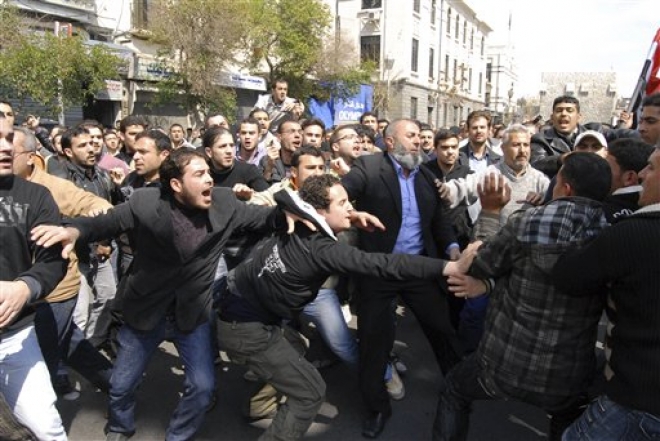
Protests continue to be crushed in Syria, raising the question why the ICC is investigating Libya and not Syria? (Photo: AP)

It appears that Gaddafi, his regime and the human rights community are on the same page about at least one thing: Libya should not be the only state investigated for committing crimes against its own people.

In reaction to yesterday’s announcement by the ICC’s Prosecutor, Luis Moreno-Ocampo, that he is seeking arrest warrants for Gaddafi, his son Saif al-Islam Gaddafi, and the head of Libyan intelligence, Gaddafi regime officials decried the uneven application of justice:

“Why is this not happening to Syria? By any measure what they have been proven to have done is far worse than what Gaddafi is alleged to have done. There is a clear double standard. It is beyond a joke.”

While it is certainly awkward, if not uncomfortable, to imagine that one sides with Gaddafi on anything, the Gaddafi regime is absolutely correct in raising the issue of a double-standard in international criminal justice. Irrespective of whose crimes are worse, it is not clear why Syria, Bahrain and Yemen have not received nearly the international attention that Libya has. Let’s focus on Syria for the moment.

Numerous observers and groups, most notably Amnesty International, have called on the UN Security Council to refer the situation in Syria to the ICC (see this post for an overview).

Yesterday ICC Prosecutor requested an arrest warrant for Gaddafi but it is a troubling reality that international criminal justice is selective and uneven.

In an eery resemblance to the words of the Gaddafi regime, Amnesty International released a statement yesterday demanding that similar attention be paid to Syria by the UN Security Council:

“…the international community that came together in such unprecedented agreement to refer Libya to the International Criminal Court, cannot allow justice to appear selective. By any standard, what is happening in Syria is just as bad as the situation was in Libya when the Security Council referred that country to the ICC.”

It seems almost obvious that both Libya and Syria should be investigated by the ICC. The ICC Prosecutor’s request for arrest warrants yesterday focuses almost exclusively on the initial targeting of those protesting against the Libyan regime. In Syria, remarkably similar crimes have been reported. So why is one brutal crushing of an uprising not the same as another? Why does one catch the attention of the world and the ICC while others do not?

Continue reading

Posted in International Criminal Court (ICC), Justice, Middle East, Syria, UN Security Council | 2 Comments

ICC to Seek Arrest Warrant for Gaddafi Today: Some Thoughts on What it Means (Updated)

ICC Prosecutor

Luis Moreno-Ocampo is seeking an arrest warrant for Gaddafi and two others (Photo: AFP)

It looks like the remarkably speedy investigation of the ICC Office of the Prosecutor (OTP) will produce its first request for arrest warrants for Libyan officials tomorrow. The Prosecutor of the ICC will be holding a press conference tomorrow, May 16th 2011. As the press release states:

The Prosecutor will announce his findings following the ongoing investigations of crimes allegedly committed since 15 February 2011 in the situation in Libya.

You can see live streaming of the announcements, in various languages, by choosing from the links here.

It is unlikely that we will see any surprises tomorrow. Given his report to the UN Security Council earlier this month, the Prosecutor will be seeking arrest warrants for three Libya officials “most responsible” for breaches of international criminal law. Luis Moreno-Ocampo has made it clear that, at least amongst this first batch of arrest warrants, no Libyan rebels will be targeted.

Interestingly, Julian Borger reports that there has been a game of tattletale going on: senior members of Gaddafi’s regime have apparently contacted the ICC in order to apportion blame on each other for war crimes. Moreno-Ocampo has also been quoted as saying that his investigation is so advanced that it is “almost ready for trial.”

Will anything change once the investigation churns out an arrest warrant? The short answer is: yes, absolutely. The divergent effects of investigations in contrast to arrest warrants and indictments remain largely under-explored. Here are some initial thoughts on what an arrest warrant will mean.

First of all, it must be made clear: until an arrest warrant is issued, no member-state is under any legal obligation to arrest Gaddafi. There seems to be a misunderstanding of the obligations that member-states have to the ICC during an investigation. Until the Pre-Trial Chamber issues an indictment, no state has any obligation to detain Gaddafi. The game changes when an arrest warrant comes into play.

An arrest warrant will alter the political landscape as well as shift the political calculations of all actors involved: member-states of the ICC, non-member states, Gaddafi and the Court itself.

For the ICC, the unprecedented speed of the OTP’s investigation is telling. It appears to be, at least in part, the result of a desire to get an arrest warrant issued against Gaddafi before he goes into exile. Another reason for the speed may be the increasing recognition that Gaddafi may be killed by a targeted strike by coalition forces. It serves the interests of the Court to get an arrest warrant before Gaddafi is killed. If he were to die, the investigation into the Libyan leader would stop immediately.

An arrest warrant is permanent. At least theoretically, an investigation can drag on. By virtue of being a process, it can also be suspended if the ICC’s OTP decides prosecuting is not in the interests of justice. However, an arrest warrant, once issued, can only be removed temporarily – if the UN Security Council invokes Article 16 of the ICC Rome Statute to defer a prosecution for up to 12 months. The Council can repeatedly defer a prosecution, but must commit to doing so yearly.

The permanence of arrest warrants is important in its implications for the process of negotiating peace. If Gaddafi thought that, despite the investigation, he had room to manoeuvre, as well as time to wage his war in an attempt to swing the momentum in his favour, he is likely to feel even more squeezed with an arrest warrant. In other words, his flexibility to leave Libya will be severely hampered. This is precisely what the Italian Foreign Minister implied when he declared that once the arrest warrant was issued,

“from that moment on an exit from power or from the country will no longer be imaginable” because “after the arrest warrant is issued all the international community would have legal obligations.”
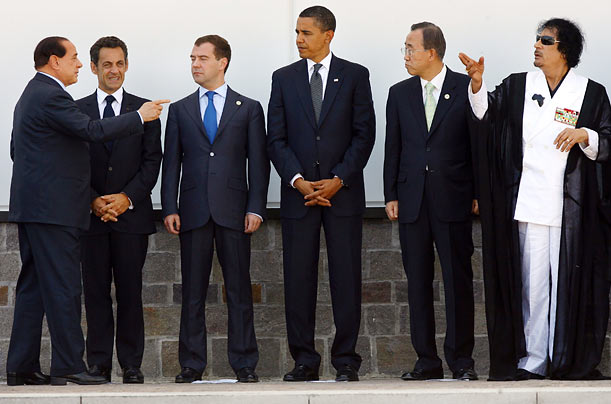
Gaddafi and the west

If an arrest warrant is issued for Gaddafi, it will put a squeeze on those states who would look the other way if he left Libya (Photo: Oli Scarff/Getty)

Will Gaddafi have a harder time finding sanctuary/asylum elsewhere if there is an arrest warrant against him? With an arrest warrant, it would be significantly less likely that a member-state of the ICC would accept him for exile. During earlier phases of negotiations, the US and others actively explored finding a state that would be willing to grant Gaddafi asylum, if he chose to leave Libya, including a member-state. Uganda, a member-state of the ICC, offered itself up as a possible destination for the Libyan leader. With an arrest warrant this option would surely be exhausted. The pressure by the court’s most ardent supporters in the international community as well as by domestic and international human rights groups on member-states considering an offer of asylum to Gaddafi would likely be unbearable. The persistent stream of criticism that human rights groups levy on those who don’t conform can have remarkably powerful effects on the behaviour of states.

Continue reading

Posted in Article 16, International Criminal Court (ICC), Justice, Libya, Libya and the ICC, NATO, Peace Negotiations, Sudan, The Tripoli Three (Tripoli3) | 12 Comments

ICC Prosecutor: On Film

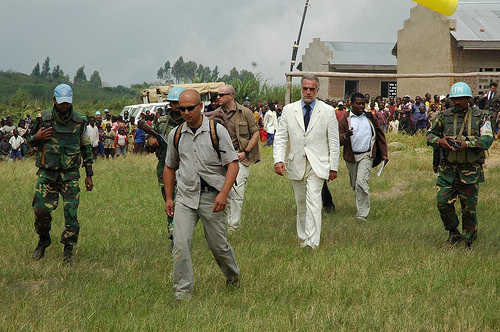
ICC Prosecutor Luis Moreno-Ocampo visits the Ituri region of the DRC.

Canadian Director Barry Stevens has come out with a film, Prosecutor, which examines the work of the ICC’s Prosecutor Luis Moreno-Ocampo, a figure who has brought much spotlight – and a significant dose of controversy – to the Court. It bills itself as follows:

A fascinating story with extraordinary inside access,Prosecutor follows the Chief Prosecutor through the first trials of the newly formed International Criminal Court. Luis Moreno-Ocampo investigates and prosecutes some of the world’s worst criminals for some of the world’s worst crimes. He’s a hero to genocide survivors, but has bitter enemies on both the Right and the Left. Prosecutor offers front-row seats to the historic events that will determine whether the ICC is a groundbreaking new weapon for global justice or just an idealistic dream.

The film will be airing around the world in the coming weeks. Here’s a trailer of the movie, showing a visit by Moreno-Ocampo to the Democratic Republic of Congo: For those who have invested time and energy into studying the Court, there is only so much one can learn from a 90 minute film on the subject matter, as evidenced by an earlier movie on the ICC, The Reckoning, which only examined the Court from a very narrow perspective. Nevertheless, these films always give an important insight into the machinations of the Court. Prosecutor should be particularly interesting in that, rather than exploring the ICC itself, it tackles the personality politics of the Court by following ICC Prosecutor Luis Moreno-Ocampo. I haven’t seen the film yet, but to be honest, this brief trailer doesn’t shine the best of light on the Prosecutor or the Court. It looks like video evidence of precisely what some of the Court’s sharpest critics contend: that the ICC intervenes in situations with men in suits and with briefcases, “dropping in” on weak, African states, confusing people who have little or no tradition of retributive, legal justice, and then leaves as if everything were all well and good. Even worse for the optics of the Court and Moreno-Ocampo, the facial expressions of those to whom he is speaking alternate between confusion, boredom and disinterest. I am curious as to why the makers of the film chose this particular section as a trailer. When I have a chance to see the film in its entirety, I will post a review. For those who happen to be in Ontario, Canada, the film will be showing May 12 and 15 on TVO. You can also buy the movie, but for a moronically high price: $398. You would think they don’t want anyone to see it: now there’s a deterrent effect!

Posted in Democratic Republic of Congo, Deterrence, Film, International Criminal Court (ICC), Justice | 2 Comments

Sudan’s President and ICC’s Most Wanted to Visit Uganda?

al-Bashir Uganda

Reports suggest that Omar al-Bashir will visit Uganda on May 12th (Photo: The Guardian)

UPDATED: Sudanese President Omar al-Bashir will not be in Kampalafor Ugandan President Yoweri Museveni’s presidential swearing in. According to Sudan’s Foreign Ministry, a senior advisor to al-Bashir will be sent instead “due to precommitments” of the President (probably a precommitment to not being arrested!). A Ugandan government spokesperson has now said the invitation was given to Bashir in accordance with regional and diplomatic protocol: “President Bashir was invited as our neighbor. But I think it is up to him to decide whether to come or not. In any case, he is free to delegate [somebody else].” 

I have chosen to leave the post as is. Most of it remains pertinent; the post mostly considers the implications of Uganda’s invitation rather than the possibility of al-Bashir visiting Kampala. This is a small but important victory for rights groups which reacted sharply against al-Bashir’s possible visit. Nevertheless, questions still remain as to why al-Bashir was invited by Museveni and about the wider implications of African-ICC relations. 

It has become a regular occasion that the human rights community gasps at the news that Sudanese President, Omar al-Bashir, gets invited to yet another country and yet another state party of the International Criminal Court. It has become an uncomfortable ritual that defies international criminal justice.

The international community’s outrage will be a little bit louder and their exasperation a bit deeper if, as reports suggest, al-Bashir visits Uganda, a key supporter of the ICC.

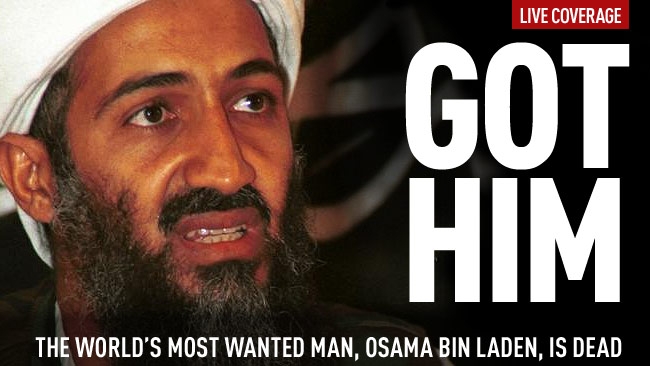
It has been a tough week for international criminal justice. Whichever way the cookie crumbles, the assassination of Osama bin Laden wasn’t a good thing for international criminal law. Egypt, in a rather schizophrenic moment, released two statements in one day: the first saying they would join the ICC and another defying the Court by saying it would not arrest President al-Bashir if he visited. This week, al-Bashir visited yet another ICC member-state, Djibouti for the swearing in of President Ismail Omar Guelleh (al-Bashir has also visited two other member-states: Kenya and Chad).

Now Yoweri Museveni, the President of Uganda, has invited al-Bashir to attend his Presidential swearing in set to take place May 12th in Kampala. According to reports, al-Bashir has not confirmed whether he will attend.

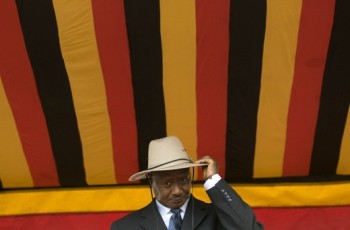
Ugandan President Yoweri Museveni has been a key supporter of the ICC (Photo: AFP)

This will come as a surprise, if not a shock, to many observers. First, Uganda has been one of the most enthusiastic supporters of the ICC. It referred the conflict in Northern Uganda between the government and the Lord’s Resistance Army to the Court in 2003. Last summer, Uganda hosted the Kampala Review Conference on the ICC. The ICC even has an office in Kampala.

Second, Uganda has not been in line with other African states in refusing to cooperate with the ICC on detaining al-Bashir. A significant group of African Union (AU) member-states have expressed their vehement opposition to the ICC’s intervention in Darfur and its arrest warrant against al-Bashir.  Uganda has previously said that it would arrest al-Bashir should he visit. On more than one occasion, al-Bashir has decided against visiting Uganda for conferences, presumably for fear of being detained. The relationship between Kampala and Khartoum has often been strained with allegations that both have supported each other’s enemies.

Given the above, why would Museveni invite al-Bashir? It is unclear what his intentions are but it is possible that his decision is in response to the ICC sending a team to monitor the government’s responses to ongoing protests in the country. According to one report, an anonymous source recently said:

“They [the ICC monitors] are here. They are watching this. Don’t forget that the ICC has never closed the northern Uganda file. And now this is happening; Museveni is still being watched.”

Continue reading

Posted in African Union (AU), Djibouti, Egypt, International Criminal Court (ICC), Sudan, Uganda | Leave a comment

Obama to those Questioning bin Laden Assassination: “Get your head examined”

Earlier this week, President Obama had an interview with CBS’s 60 Minutes. In it, Obama was rather candid about the developments that led to Osama bin Laden’s assassination. The President spoke openly about the dissent among his advisors about the plan to kill bin Laden. He says that the division of opinions amongst those around him was critically important in fleshing out all possible scenarios. Indeed, he says that differences in opinion are important, welcome, and make better policy.

At the end of the interview, however, Obama did something spectacularly hypocritical. Just minutes after acknowledging the importance of diversity of opinions he says:

“Justice was done and I think that anyone who would question that the perpetrator of mass murder on American soil didn’t deserve what he got, needs to get their head examined.”

Say what? Was that George W. Bush speaking? It sure sounds like it.

How is difference in opinion about the mission valuable, but the diversity of opinion about the justness of assassinating bin Laden the result of mental instability?

It’s not. Those who are uncomfortable with, or skeptical of, the legality, justice and legitimacy of killing bin Laden aren’t “crazy”. They have legitimate concerns.

Once more, the discussion that has proliferated about whether assassinations and target killings, like that of bin Laden, are just and legal is critically important. The skepticism of scholars, every-day observers, religious figures, politicians etc. has created a healthy debate. Simply discarding the views of all those who dissented with the US decision on killing bin Laden as being mentally ill is more 1984 than 2011. It is worth adding that it is the fumbled recanting of facts regarding the mission to kill bin Laden that has fueled much of the criticism.

It is a sad day, when freedom of expression is actively being quashed in places like Syria, Libya, Bahrain, that the President of the US equates “anyone who questions” his decision with suffering mental illness.

You would think, and indeed hope, that a President who has worked hard to foster the diversity of views in his country and around the world, would understand the importance of debating and discussing issues as important as the justice of target killings. You’d also think, as a former professor of constitutional law, Obama would be more careful with his words.

Here’s the last third of the video. Obama’s remarks come at the very end of the interview:

Posted in Osama bin Laden, Osama bin Laden and international law, United States | 9 Comments

Killing bin Laden: Justice, International Law and Legitimacy – A Compilation of Perspectives

The debate regarding the legality, justness and legitimacy of killing bin Laden continues. I figured it may be beneficial to create a post where some of the most sophisticated and fascinating perspectives on these subjects could be compiled. Keep in mind, this isn’t an exhaustive list. I will continue to add to it and opinions are certain to be revised as more facts emerge. Please feel free to send along any pieces you find particularly salient.

The debate thus far has been remarkably vibrant and, in my view, healthy. Talking about bin Laden’s death matters. It is a fundamentally good thing that we are having a global discourse on the parameters of legality and justice. As I argued before, the debate about justice and law instigated by bin Laden’s assassination has the potential to be the most important and fruitful consequence of his death. Hopefully this can act as a valuable and useful resource for those interested in the myriad of perspectives on the subject.

On the Hypothetical Trial of bin Laden

Obama on bringing Osama bin Laden to justice from 2008:

“[Obama] said he wouldn’t discuss what approach he would take to bring bin Laden to justice if he were apprehended. But he said the Nuremberg trials for the prosecution of Nazi leaders are an inspiration because the victors acted to advance universal principles and set a tone for the creation of an international order.”

Apparently, during his 2008 Presidential campaign, Obama vowed :

“We will kill bin Laden. We will crush al-Qaida. That has to be our biggest national security priority.”

Last year, Eric Holder Jr., the US Attorney General, declared that bin Laden:

“will never appear in an American courtroom…Let’s deal with the reality here. The reality is, we will be reading Miranda rights to a corpse.”

On Holder’s views at the time, also see this article from MSNBC: Holder – Bin Laden will Never Face US Trial.

In a post very similar to one posted here on the hypothetical trial of bin Laden, legal analyst Jeffrey Toobin has just published an article for CNN: 5 Hurdles if bin Laden had been taken alive. Holder focuses on five potential problems had bin Laden been put on trial: whether he would have been tried at a military or civilian court; where he would have been tried; whether bin Laden would have been granted access to US intelligence materials during the course of the trial; whether anyone would have defended him (I believe he wouldn’t have had a problem getting a defense team); and what would have been done with bin Laden’s body if, as Toobin predicts, he would have received the death penalty.

Jon Silverman also considers the challenges of holding a trial from a skeptical angle. Silverman’s analysis is particularly interesting in his use of past trials and the record of current tribunals.

Drawing on the precedence of Saddam Hussein’s capture and trial, Robert Fisk weighs in arguing that the political consequences of putting bin Laden on trial weren’t worth it. Oddly and without clarification, Fisk also calls international criminal law and process the justice of “old days”:

“Of course, there is one more obvious question unanswered: couldn’t they have captured Bin Laden? Didn’t the CIA or the Navy Seals or the US Special Forces or whatever American outfit killed him have the means to throw a net over the tiger? “Justice,” Barack Obama called his death. In the old days, of course, “justice” meant due process, a court, a hearing, a defence, a trial. Like the sons of Saddam, Bin Laden was gunned down. Sure, he never wanted to be taken alive – and there were buckets of blood in the room in which he died.

But a court would have worried more people than Bin Laden. After all, he might have talked about his contacts with the CIA during the Soviet occupation of Afghanistan, or about his cosy meetings in Islamabad with Prince Turki, Saudi Arabia’s head of intelligence. Just as Saddam – who was tried for the murder of a mere 153 people rather than thousands of gassed Kurds – was hanged before he had the chance to tell us about the gas components that came from America, his friendship with Donald Rumsfeld, the US military assistance he received when he invaded Iran in 1980.”

In a similar vein, Michael White writes in The Guardian that a trial of bin Laden would have been “easier said than done.”

Over at Foreign Policy, Joshua Keating notes that:

“There’s not likely to be too much of an outcry over the decision to kill bin Laden rather than take him alive — for one thing, we’ve avoided what would surely have been a massively controversial trial. But this question isn’t going away.”

For other challenges a trial would have incurred, check out this post.

Continue reading

Posted in Middle East, Osama bin Laden, Osama bin Laden and international law, Terrorism, UN Security Council, United States | 6 Comments