The following guest post was written by Dan Plesch, Professor of Diplomacy and Strategy at SOAS University of London and a Door Tenant at the Chambers of Stephen Kay KC at 9 Bedford Row. His books include, ‘Human Rights After Hitler’, ‘America Hitler and the UN’, and ‘The Beauty Queen’s Guide to World Peace’. His work on the modern relevance of the United Nations War Crimes Commission has featured in the Associated Press, the US National Public Radio, Amazon’s acclaimed documentary ‘Getting Away with Murder(s)’ and Netflix’s 9th episode of the ‘Greatest Events of WW2’.
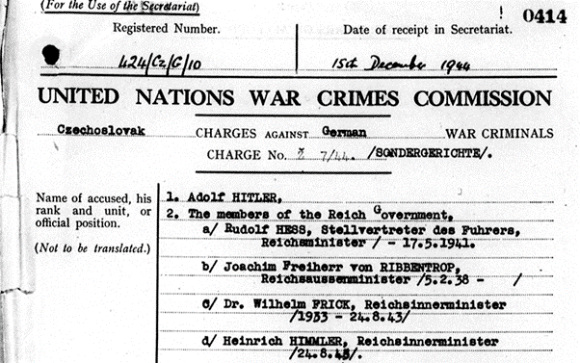
As a Head of State, Adolf Hitler was indicted for war crimes by several European states in the winter of 1944-45 under their domestic laws as well as international law. The three states, Belgium, Czechoslovakia and Poland were supported by a dozen others, including China, France, the UK and the USA who were all members of the United Nations War Crimes Commission. The legal documents were sealed for decades. When they were finally released in in the 2010s, their significance warranted a news story by the Associated Press in 2017, The documents were not available to the International Court of Justice as it considered the arrest warrant case over a decade earlier.
At a time when many are discussing and debating head of state immunity, the Hitler indictments point the way to further reducing the impunity of national leaders in the twenty first century.
As a historian observing and engaging with the community of International Criminal Law, I find it curious that this state practice has been given no weight by generations of judges, lawyers and scholars. The unanimous view of sixteen leading states that Hitler was personally and functionally liable for the atrocities committed in his name confounds the established view that individual states cannot legally prosecuted the sitting Heads of State of other governments.
The criminal liability of Heads of State and of Government, as well as Foreign Ministers is a live issue once more with the Paris Court of Appeal’s ruling that French investigating judges could issue an arrest warrant against Syrian President Assad and with the complaints before the Office of the Swiss Attorney General against Israeli President Herzog. For some commentators, these actions contravene the 2002 decision of the International Court of Justice (ICJ) in the Arrest Warrant case, in which the ICJ held that customary international law includes the rule that sitting Heads of State, Heads of Government, and foreign ministers are immune from criminal jurisdiction, including arrest warrants and indictments, by foreign national courts, including for war crimes and crimes against humanity. The ICJ distinguished personal immunity from functional immunity, and distinguished national criminal jurisdiction from international criminal jurisdiction such as the International Criminal Court (ICC)
The long overlooked customary state practice from the 1940s can be seen as contradicting the ICJ judgment and so reinforcing the validity of the Assad and the Herzog cases. The now unsealed documentary record in relation to efforts to prosecute Hitler provides individual and multilateral state practice from the 1940s that set the immunities of Heads of State and Government in a decision of the United Nations War Crimes Commission (UNWCC) and subsequent actions of that body and its members states. Thus, the ICJ overlooked the most important state practice precedent relevant to its inquiry – and in fact the only time prior to 2002 that the world’s most powerful states considered the issue together.
At a time when many are discussing and debating head of state immunity, the Hitler indictments point the way to further reducing the impunity of national leaders in the twenty first century. More details on these UNWCC-supported charges are now available in recent research into the unsealed archives of this multinational organisation of the mid-1940s. It has been presented in London and The Hague. The International Law Commission has recently received submissions to be considered in its work on the Immunity of State officials from foreign criminal jurisdiction.
Continue reading