How Three Words Could Change the ICC-Africa Relationship

(Photo: Getty Images)

Much of the fraught relationship between the International Criminal Court (ICC) and African states hinges on perceptions and misperceptions of the Court’s role on the continent. There are so many conflicting narratives of the ICC’s impact in Africa, so many divergent views, such little transparency, and such varied commitment from African governments, that it is hard for the most ardent of followers to make sense of the ‘core’ of the issues.

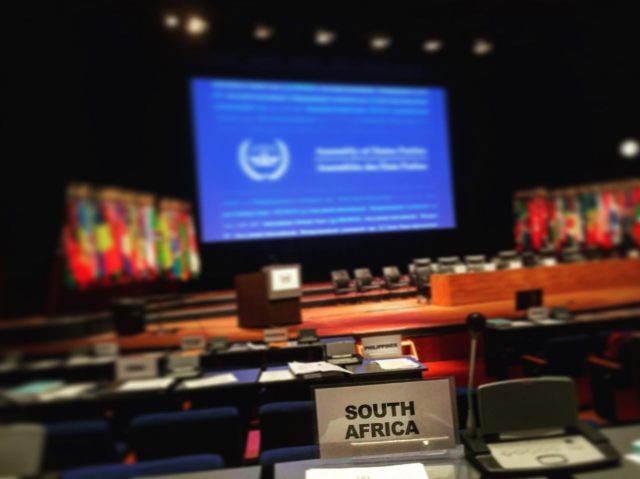
Think back to October and November of 2016. Burundi signalled that it would withdraw from the ICC. Not to be outdone, the South African government frenetically elbowed its way in front of Burundi in order to be the first state to leave the Court. The Gambia soon followed suit. States had previously dropped hints, and at times threatened that they would withdraw from the ICC. But no one predicted this spate of withdrawals or this rather awkward grouping of states abandoning the Court. Everyone wanted to know why, all of a sudden, these three states were leaving the ICC. What was at the core of their beef with the institution?

Burundi made some sense. It was threatened by the very real possibility of an ICC investigation and its brutal president, Pierre Nkurunziza, likely acted out of fear for what the Court’s ongoing preliminary examination might bring. The Gambia, then ruled by Yahya Jammeh, who is now exiled in Equatorial Guinea after being deposed earlier this year, also fit the profile of a dictator opposed to global justice. But, at the same time, The Gambia was no where near the Court’s radar; unlike Nkurunziza, Jammeh had nothing to fear from the ICC. South Africa made even less sense. Sure, they had their issues with the ICC over the visit of Sudanese President Omar al-Bashir and their obligations to arrest and surrender him to the ICC. But the issue didn’t — and doesn’t — seem pressing enough to risk the diplomatic, legal, and political fall-out of ditching the Court altogether. Other issues, like concerns over the effects of the ICC on peace processes and conflict resolution, or anger that the Court hasn’t taken African concerns seriously, are important. But they also don’t seem to justify such dramatic action. Fast-forward six months and all of this is only more peculiar today. The Gambia has re-stated its commitment to remaining in the ICC, and South Africa has, at least for the moment, decided not to withdraw from the Court. That leaves Burundi as the sole flag-bearer of the ICC withdrawal movement. Moreover, states that everyone predicted would be filing out the door — Kenya, Namibia, and Uganda in particular — haven’t moved an inch towards the ICC withdrawal door.

On some level, it may be that there simply isn’t any neat-and-tidy explanation for why the states that decided to withdraw did so. In international relations, we tend to assume that states act consistently as rational actors following heaps of cost-benefit analyses to determine their policy preferences. It isn’t clear that this transpired so neatly in the withdrawal countries. There were undoubtedly long-standing concerns held by African states. Many also felt those concerns were being actively ignored by the Court and many of its states, many of which were left festering by a community of ICC proponents that preferred to blame “bad apples” for African dissent. Some form of confrontation with the Court has long been brewing. But decisions on the ICC are often driven by politics and sentiment and only subsequently justified legally. This, of course, makes it challenging for those proponents who agree that the ICC can be improved and want to work with a constituency of African states to address their legitimate concerns. They need something to work with.

Somewhat counter-intuitively, the clearest glimpse into the state-of-mind of African governments didn’t actually come from any of those states that initiated their withdrawals from the Court in 2016. It came from the Open-Ended Committee on the ICC at the African Union (AU). This past January, at the AU’s summit in Addis Ababa, African heads of state passed a motion endorsing a so-called “ICC Withdrawal Strategy”. The strategy document had been requested by the AU and, in advance of the 2017 summit, it was drawn up by legal officers employed by the AU. It spelled out a laundry list of concerns regarding the functioning of the ICC. Despite its inflammatory name, the document is extremely useful for those interesting in ‘problem-solving’ tensions between the ICC and Africa. Not all of the proposals within it are feasible or desirable for the ICC. Outright jettisoning the warrant for al-Bashir comes to mind. But a lot of the proposals are useful, including but not limited to: dealing with the relationship between the ICC and the UN Security Council; addressing the prickly question of head of state immunity for indicted leaders of non-ICC member states; expanding complementarity to take into consideration regional courts; and ensuring that Article 16 requests to temporarily defer ICC investigations or prosecutions are taken seriously and thoroughly responded to. Continue reading

Posted in Africa, African Union (AU), International Criminal Court (ICC), International Criminal Justice, South Africa, UN Security Council | 4 Comments

Five Things to Know about the ICC’s Latest Target in Libya

(Photo: AFP)

There has long been speculation that the International Criminal Court (ICC) wasn’t done with its work in Libya. Earlier this week, the Court unveiled an arrest warrant for Al-Tuhamy Mohamed Khaled, the former Libyan security chief under Muammar Gaddafi. Prosecutors at the ICC have charged Khaled with four counts of crimes against humanity and three counts of war crimes for his role in the 2011 Libyan civil war. The Court originally issued the arrest warrant four years ago but only made it public this month. Here are five things to know about the warrant for Khaled.

This is only the second public arrest warrant issued under the current Prosecutor

The current chief Prosecutor of the ICC, Fatou Bensouda, has held her office since mid-2012. Until the warrant for Khaled was publicly disclosed, she had only issued one arrest warrant for international crimes in those five years. There are reasons for this. It is widely held that part of Bensouda’s mandate has been to clean the slate after a number of bungled investigations and prosecutions whilst pursuing more diligent investigations and building more thorough cases. Her style is certainly more under-stated and careful than cavalier and gung-ho.

Moreover, the ICC’s Office of the Prosecutor under Bensouda appears increasingly strategic and opportunistic in its decision-making. Its only other arrest warrant to date was issued against Ahmad al-Faqi al-Mahdi. Prosecutors alleged that al-Mahdi was guilty of the war crimes for his part in destroying historic and UNESCO-protected sites in Timbuktu, Mali. When they sought his arrest, the Ansar Dine extremist had already toiled in a prison in Niger for a year and had pledged to cooperate with prosecutors. Within a year of his surrender, al-Mahdi plead guilty to war crimes. His case exemplified how the prosecutors now seek to identify opportunities to pursue targets that will be effectively surrendered, prosecute individuals for crimes that resonate with the international community, and build cases that can be adjudicated efficiently.

Where does the warrant for Khaled fit into this? For the moment, it isn’t clear. The former senior Gaddafi regime figure resides in Egypt, which is not a member-state of the ICC, and the prospects of his surrender to The Hague appear dim.

Sealing and Dealing

There has been a long-standing debate in international criminal justice circles as to whether prosecutors should seek public or secret arrest warrants. The arguments on either side are understandable.

Some believe that the Court should issue warrants as publicly as possible. One NGO working on Libyan accountability issues, for example, has urged the ICC to publicly disclose arrest warrants because their existence may deter the commission of additional international crimes.

Others believe that the Court should use its ability to issue sealed arrest warrants if doing so would increase the prospects of those arrest warrants being executed. Any deterrence impact of the ICC surely relies on the Court’s targets being in the dock and surely suffers from languishing public arrest warrants.

The Office of the Prosecutor of the ICC struggles with the question of public versus sealed arrest warrants. In the case of Sudanese President Omar al-Bashir, for example, the Office decided that issuing a public warrant was most appropriate because, while it might undermine the prospects of surrender, it would openly signal to states that the Court was targeting Bashir and not seeking to have a secret warrant fulfilled thus leaving Sudan with an unstable political power vacuum. In some instances, the ICC be compelled to publicize its warrants in order to be seen to be active in a particular situations. In other cases, the dominant consideration for prosecutors will be the prospects of surrender.

Opposition Impunity

The ICC first intervened in Libya following a referral from the United Nations Security Council in 2011. That referral came in response to palpable fears that Gaddafi was preparing to slaughter civilians in order to quell Libya’s Arab-spring inspired uprising. The Court subsequently issued warrants of arrest for three regime figures — Gaddafi, his son Saif al-Islam, and spy chief Abdullah al-Senussi.  Continue reading

Posted in Al-Tuhamy Mohamed Khaled, ICC Prosecutor, International Criminal Court (ICC), International Criminal Justice, Libya | 3 Comments

As the Pendulum Swings – The Revival of the Hybrid Tribunal (New Paper!)

Inspired by M.C. Escher.

A fascinating trend in international criminal justice, one that contributors at JiC have covered over the last few months and years, has been the re-emergence of hybrid tribunals. Back in January 2016, I wrote about the evident ‘rebirth’ of hybrid courts following their long hibernation. With Kirsten Ainley of the London School of Economics, and the Wayamo Foundation (where I work as Director or Research), I am also working on a project to study hybrid tribunals and to generate guidelines for the establishment of new hybrid courts in the future (see our project website here).

In this context, I wanted to share with readers a book chapter that I have written for a volume edited by Mikkel Jarle Christensen and Ron Levi entitled “Internationalizing Criminal Law: Institutions, Elites and Practices” (Routledge 2017).  Below is the introduction to my contribution. The draft paper can be found here.

Reflecting on his six years as U.S. Ambassador-at-Large for War Crimes Issues, Stephen Rapp recently concluded that “there isn’t a global system of justice, just some cases in The Hague and a few other places.” Rapp’s assessment likely comes as a surprise to many proponents of international criminal justice. The 2002 establishment of the permanent International Criminal Court (ICC) was intended to entrench and consolidate a global system of international criminal law which had, until then, been piecemeal and unstable. A series of prior, ad hoc war crimes tribunals, such as the International Criminal Tribunals for the Former Yugoslavia (ICTY) and Rwanda (ICTR), the Extraordinary Chambers in the Courts of Cambodia (ECCC), and the Special Court for Sierra Leone (SCSL), relied on the periodic and sporadic confluence of political interest and will to permit their establishment and functioning. They each focused on specific theatres of mass atrocity and were restricted to examining crimes perpetrated in particular windows in time. In sharp contrast, the ICC was intended to be a “world court”, a promise of universal justice, and thus a provider of a permanent, reliable and consistent response to international crimes irrespective of where they occurred. As then-United Nations Secretary General Kofi Annan declared at the conclusion of the Rome Statute negotiations: “The establishment of the Court is still a gift of hope to future generations, and a giant step forward in the march towards universal human rights and the rule of law. It is an achievement which, only a few years ago, nobody would have thought possible.” According to Human Rights Watch, the ICC represented a promise to “transform the human rights landscape”; it demonstrated that “the international community of states [had] agreed… to embrace this essential institution for bringing the world’s worst human rights criminals to justice.”

The ICC was seen as a means to replace a fragmented approach to international criminal justice with a permanent system of global accountability. Yet renewed interest in establishing hybrid tribunals, evident by the remarkable uptick in the number that have been created over last two years, suggests that this is far from the case. There is still a place for hybrid courts as part of the international criminal justice network Continue reading

Posted in Academic Articles / Books, Ad hoc tribunals, Central African Republic (CAR), Hybrid Court for South Sudan, Hybrid Courts, Hybrid Tribunals, Kosovo, Kosovo Liberation Army (KLA), Kosovo Relocated Specialist Judicial Institution (KRSJI), South Sudan | 8 Comments

Between Disdain and Dependency — Uganda’s Controversial Place in the ICC-Africa Relationship

This article was written for a symposium, organized by the Italian Institute for International Political Studies, entitled “Africa vs the ICC: Searching for an Exit Strategy”. I encourage all readers to check out the other submissions, including those by ICC Judge Cuno Tarfusser, Maddalena Procopio, Juliet Amenge Okoth, as well as Gerhard Werle and Moritz Vormbaum. Special thanks to Chantal Meloni for organizing! 

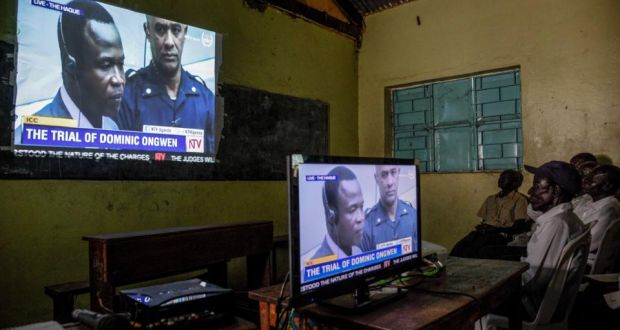
People in northern Uganda watch proceedings in the Ongwen trial at the ICC (Photo: Isaac Kasamani/ AFP / Getty Images)

Yoweri Museveni likes to present himself as the frontman for an allegedly pan-African movement against the International Criminal Court (ICC). According to the Ugandan President, the ICC is responsible for “blackmailing” African states and is composed of “a bunch of useless people”. Yet, in early 2016, the Ugandan government ensured that Dominic Ongwen, a senior commander in the notorious Lord’s Resistance Army (LRA), was surrendered to the Court. Ongwen’s arrival in The Hague marked a major victory for the fledgling ICC. Of the five individuals the Court has targeted in northern Uganda, Ongwen is the only one to face trial in The Hague. So how do we square the seemingly contradictory reality in which the most vociferous critic of the ICC’s role in Africa also gives the Court a boost in surrendering a prized perpetrator to The Hague?

This article seeks to provide an answer to this conundrum by weaving together three issues: 1) the politics around the ICC’s intervention in northern Uganda; 2) the trial of Dominic Ongwen at the ICC; and 3) the Africa-ICC relationship and the place of Uganda — and the Ongwen trial — within it. The somewhat counter-intuitive argument put forward is that the answer to the above-stated quandary has both nothing and everything to do with governments referring themselves to the ICC.

Africa and the ICC — Nothing to do with Self-Referrals

It is no secret that the relationship between some African states and the International Criminal Court is bruised and battered. There are numerous criticisms of the ICC’s role and impact on the continent. Some are self-interested and some are legitimate. Many of these have tapped into the perceived bias of the Court, a perception fed by the fact that, before 2016, the ICC had never opened an investigation outside of Africa and that the Court has never issued an arrest warrant for a non-African.

In recent years, the rhetoric emanating from African capitals to express their criticisms has picked up on this alleged bias and has become increasingly dramatic. The Court has been described by African leaders a “race-hunting” institution, an “International Caucasian Court”, and “a painfully farcical pantomime” that has become “the toy of declining imperial powers.” Substantively, however, the crux of the criticisms levied against the ICC has never been about the Court’s focus on African states. Rather, the fuel that feeds the fire of anti-ICC sentiment has been the ICC’s relationship with the United Nations Security Council (UNSC)and its permanent members. On two occasions, Darfur in 2005 and Libya in 2011, the UNSC referred situations to the Court. African states have voiced concerns following the ICC’s interventions in both cases and have generally opposed the ICC being invoked by the Council’s permanent member states — China, Russia, and the United States — which simultaneously refuse to submit to the Court’s jurisdiction themselves.

The orthodox response of the ICC and its defenders to criticisms against the ICC has been to focus on two counter-arguments: 1) that it is just the “bad guys” and dictators who claim that the ICC is biased because they are afraid of the Court, and 2) that African states, by-and-large, have invited the ICC to intervene in the first place through the issuance of self-referrals.

The first argument seems to suffer from a mild form of hypocrisy or, at the very least, a myopic and partial accounting of the Court’s history. There is no doubt that some awful leaders implicated in mass atrocities are vociferous critics of the ICC. It may even be that they fear being targeted by the Court. However, there seems to be zero concern with the fact that dictators and human rights abusers previously decided to join the ICC in the first place. This should be accounted for too. Additionally, it is important to recognize that there are many observers, including strong proponents of international criminal justice, who share the same concerns regarding the Court’s record and role in Africa and its relationship with the UNSC. It is deeply offensive, and counter-productive, to have their arguments lumped in with those of despots.

The second argument in defence of the ICC suggests that African critics of the Court are somehow hypocritical because the majority of situations under investigation in Africa were the result of self-referrals. This is a rather curious defence because no African governments have ever complained about self-referrals. The reason is obvious; as explored in more detail below, self-referrals are useful tools to get the ICC to target a state’s adversaries. Again, what African critics of the Court, and indeed many champions of the ICC, are primarily concerned about is the institution’s relationship with the Security Council. This mismatch of critique and defence has produced a rather stilted debate wherein concerns about what happens when the ICC accepts a UNSC referral are met with a defence of pertaining to self-referrals. Continue reading

Posted in Africa, Dominic Ongwen ICC, ICC Prosecutor, International Criminal Court (ICC), International Criminal Justice, Lord's Resistance Army (LRA), northern Uganda, Uganda | 4 Comments

Nigeria: the International Criminal Court’s Next Challenge in Africa?

Daniel Eyre joins Justice in Conflict for this guest-post on the International Criminal Court and the challenges of prosecuting alleged crimes committed by government forces in Nigeria. Daniel is a human rights consultant and formerly the Nigeria Researcher at Amnesty International. 

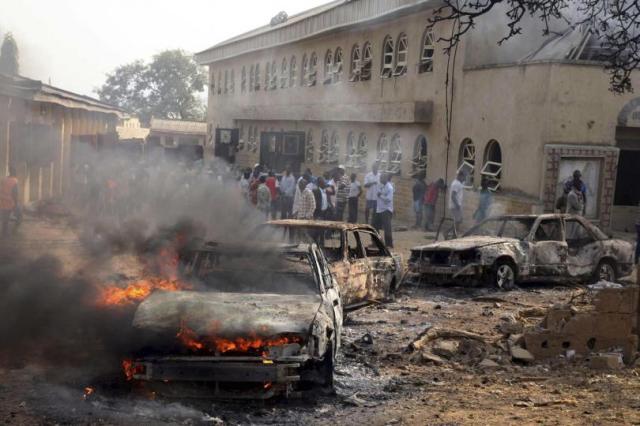
A car burns following an attack by Boko Haram in Madalla, Nigeria (Photo: Reuters)

A car burns following an attack by Boko Haram in Madalla, Nigeria (Photo: Reuters)

On 14 March 2014, Nigerian soldiers reportedly executed more than 640 unarmed men and boys in Maiduguri city. At 7am that day, Boko Haram fighters launched a daring attack on Giwa barracks, a military base on the city’s outskirts, where soldiers had detained more than 1,000 people. Outnumbered, the soldiers retreated. The assailants broke into the cells and took their members back to the group’s rural hideouts. Hundreds of other detainees were left to walk the streets of Maiduguri, begging residents for the necessities they had been denied in military detention: food, water and clean clothing.

After an hour or so, the army returned. Soldiers arrested the escaped detainees and assembled them in several locations around Maiduguri. Unarmed and posing no threat to person or property, the re-arrested men and boys were murdered. In most cases, soldiers shot the detainees. One particularly disturbing video – taken by the military – shows soldiers restraining detainees in front of a pit and cutting their throats.

Next month will mark the third anniversary of these killings. Despite compelling evidence, no-one has been held accountable for these war crimes. This incident sheds light on an under-reported pattern in Nigeria’s fight against Boko Haram. Security forces have committed serious violations of humanitarian law throughout the conflict. These crimes have not been investigated and their perpetrators remain unpunished. War crimes and crimes against humanity committed by Nigeria – a party to the Rome Statute – fall within the International Criminal Court’s (ICC’s) jurisdiction. The ICC Prosecutor has opened a preliminary examination into atrocities committed by both sides, but is rightly waiting to see whether Nigeria will begin domestic investigations. In this context, could the ICC’s involvement galvanize Nigerian politicians to hold their own accountable?

The evidence is mixed. A bill intended to punish perpetrators of war crimes and crimes against humanity continues to be debated. During his first week in office, Nigeria’s President Buhari pledged to investigate the military’s crimes. However, in the 18 months that have elapsed since that promise was made, the government has provided no information on how or when these investigations will be conducted. In the absence of genuine national proceedings, the ICC Prosecutor must decide whether to open her own investigations. At a time when the African Union has backed a “strategy for collective withdrawal” from the Rome Statute, the Prosecutor will be loath to open investigations into one of the ICC’s most reliable supporters. Yet anyone hoping that the Prosecutor will be spared this decision must contend with three obstacles to domestic proceedings: the extent of the crimes will stretch Nigeria’s criminal justice system; investigations that are likely to expose how the military could have, but failed to stop Boko Haram; and investigations that may lead prosecutors to some of the most powerful individuals in the country. These practical and political roadblocks should put the Prosecutor on notice: the interests of justice and the interests of the ICC are likely to diverge.

The Extent of the Crimes

The ICC’s preliminary examinations are based on evidence of mass arrests, torture, and summary executions committed systematically and repeatedly by security forces, resulting in thousands of deaths and disappearances. A UN report found evidence that detainees in military custody were denied food and water and, as a result, died on a daily basis. Research by Amnesty International reported that more than 7,000 men and boys died in military detention between 2011 and 2015 due to this abhorrent treatment.

The ICC Prosecutor will only open investigations if Nigeria is unwilling or unable to do so domestically. The scale of the crimes alone will test the ability of Nigeria’s criminal justice system, which already struggles to ensure due process. According to the National Human Rights Commission, 35,889 people in prison are awaiting trial, or 70% of the prison population. These figures do not include thousands of suspected Boko Haram fighters, who are detained by the military. Nigeria’s international partners have pledged their assistance to help investigate and prosecute these suspects, but military violations do not appear to be on the agenda. Nigeria would need to devote significant resources to investigating military crimes committed over several years, across three states, when witnesses are likely to be among 2.3 million displaced people. The chances of the justice system being able to handle such investigations in the near- to medium-term are slim.

The Military’s Failures

The second problem is that investigations will force a re-assessment of the military’s crimes. The horror inspired by Boko Haram’s abuses has led some to rationalize military violations as the ‘excesses’ of over-zealous soldiers, doing ‘whatever it takes’ to defeat an existential threat. But the military’s violations are not an unfortunate and unintended consequence of its determination to win the war. Such euphemisms are deeply misleading. They call to mind soldiers, in the heat of battle, using disproportionate force in a firefight. In fact, the crimes being considered by the ICC occurred outside of battle, when there was no threat to person or property.  Continue reading

Posted in Guest Posts, International Criminal Court (ICC), International Criminal Justice, Nigeria | 2 Comments

The Hybrid Court for South Sudan? Looking for a Way Forward (Part 2)

Patryk I. Labuda joins JiC for this second piece of a two-part series on the ongoing political and legal challenges facing the creation of the proposed hybrid tribunal for South Sudan. The first part can be read here.

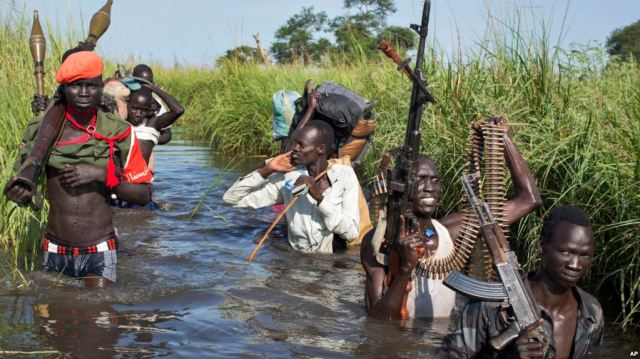
Rebel soldiers on patrol in South Sudan, in 2014. (Photo: AP)

Rebel soldiers on patrol in South Sudan, in 2014. (Photo: AP)

In the first post, I considered a number of challenges facing the establishment of the Hybrid Court for South Sudan (HCSS). The AU and civil society have been puzzling over these questions for well over a year. Under the 2015 peace agreement, it is the Chairperson of the Commission of the AU who will ultimately “decide the seat of the HCSS”, but the court’s success depend on the South Sudanese government’s willingness to cooperate. Whatever happens in the next few months, it seems clear that Moussi Faki of Chad, elected a few weeks ago to replace Dlamini Zuma of South Africa, will have his work cut out if President Salva Kiir refuses to sign a memorandum of understanding with the AU, as required by the peace agreement.

Looking for Alternatives

But what happens if the government’s obstructionism continues? Some observers argue that the government has already consented to the HCSS by virtue of the peace agreement, so either the AU or the UN should enforce the agreement regardless of the government’s current opposition. There is precedent for this in international criminal justice: when the Lebanese government reneged on its promise to legislate for the Special Tribunal for Lebanon, the UN Security Council enacted the text of a previous agreement by way of a Chapter VII resolution.

But if a Chapter VII resolution is needed to bring the HCSS into existence, the obvious question is whether it would not just be easier to refer South Sudan to the ICC? Although there has been little discussion of an ICC intervention, the South Sudanese government’s obstructionism coupled with the practical difficulties of operating a hybrid court against the wishes of a host government could make this possibility more appealing. Moreover, it is possible that the mere threat of ICC intervention could persuade the South Sudanese government to cooperate with the HCSS.

However, there are two major problems with the idea of a Security Council referral. First, the Council has on several occasions refused pleas for greater UN assistance, arguing that the HCSS is the AU’s sole responsibility, and – more generally – there seems to be little or no appetite among Council members for ICC-related action. The AU, in turn, continues to (publicly) denounce the ICC and champion ‘African solutions to African problems’, as evidenced by last month’s adoption of a ‘withdrawal strategy’ at the AU summit in Addis Ababa.

Unpacking the AU’s Role in South Sudan

The AU’s views on the HCSS and international criminal justice are not without controversy. While its leadership on justice issues in South Sudan is an obvious concession to the AU’s fierce criticisms of the ICC, skepticism remains about the AU’s resolve to tackle impunity. It does not help when leading African figures like Thabo Mbeki and Mahmoud Mamdani, both of whom remain deeply involved in the South Sudanese peace process (albeit in different roles), argue in the New York Times that “courts can’t end civil wars”. Although the AU’s official position is that it recognizes the need for criminal accountability in South Sudan, the parallels with Kiir and Machar’s self-interested pleas for ‘truth, not trials’ are hard to miss. Continue reading

Posted in Africa, African Union (AU), Guest Posts, Hybrid Court for South Sudan, Hybrid Tribunals, South Sudan | Leave a comment

The Hybrid Court for South Sudan? Looking for a Way Forward (Part 1)

Patryk I. Labuda joins JiC for this two-part post on the ongoing political and legal challenges facing the creation of the proposed hybrid tribunal for South Sudan. You can read Patryk’s previous contributions to Justice in Conflict here

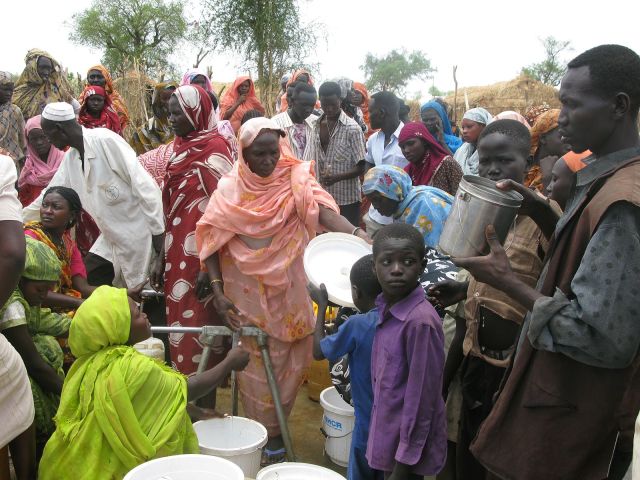
refugees_queue_for_water_in_the_jamam_camp_south_sudan_7118597209

Tens of thousands of refugees have been displaced by conflict in South Sudan, including these civilians in Jamam camp (Photo: Robert Stansfield / Department for International Development).

In December 2013, South Sudan erupted into civil war. Three years later, there is still no end in sight to the violence that has claimed tens of thousands of lives and displaced over three million civilians. In fact, the conflict may get worse. The UN’s Special Adviser on the Prevention of Genocide warned recently that there was ‘potential for genocide’, while a separate UN-mandated Commission of Inquiry cautioned that South Sudan stood ‘on the brink of all-out ethnic war’.

Although the root causes of the South Sudanese conflict remain stubbornly entrenched, a silver lining may be the role of justice and accountability in its otherwise moribund peace process. As is well known, an entire section of the August 2015 peace agreement covers transitional justice issues, including victims’ rights, compensation, and truth and reconciliation. Most notably, it also calls for the establishment of the Hybrid Court for South Sudan (HCSS) “to investigate and prosecute individuals bearing responsibility for violations of international law and/or applicable South Sudanese law”, in particular war crimes, crimes against humanity, and genocide.

Eighteen months later, however, the transitional justice provisions have – like most of the peace agreement – yet to be implemented, and a host of questions about the HCSS remain unanswered. To make matters worse, a perfect storm of political and military developments in the region and at the international level raise difficult questions about the future of the hybrid court. In this two-part post, I will consider some of the challenges awaiting the HCSS (part 1) and what can be done to overcome them (part 2).

Delayed Justice

It is no secret that the establishment process of the HCSS is severely delayed. In line with the 2015 peace agreement, the hybrid court was expected to be fully operational one year from the date that a transitional government was sworn in, which translates into an estimated start date of April 2017 (Appendix VI). It is clear that this and other deadlines will not be met. Mandated to “provide broad guidelines” on the “infrastructure, funding mechanisms… [and] number and composition of judges”, the African Union (AU) has made little progress on legislation and other arrangements that are needed to bring the HCSS into existence. As of today, eighteen months after the peace agreement, the hybrid court exists only on paper.

There are various reasons for this delay, not least of which is the continued fighting between forces loyal to Salva Kiir, the country’s current president, and Riek Machar, his former deputy who launched a rebellion in 2013. But the biggest obstacle facing the HCSS is resistance from the government of South Sudan. This is not entirely surprising. Unlike other conflicts where hybrid tribunals eventually emerged as a tool of transitional justice, the war in South Sudan is far from over. Crucially, in South Sudan it is governmental forces – not the rebel movement led by Machar – who are allegedly responsible for most of the violence. In its October 2015 report, an AU-mandated commission of inquiry concluded that, while both sides were responsible for war crimes and crimes against humanity, evidence also “point[ed] to the existence of a state or organizational policy to launch attacks against civilians based on their ethnicity or political affiliation”. Leaders on both sides “dread the proposed hybrid court”, but it is the prospect of prosecutions against governmental actors that makes the HCSS inherently contentious. Continue reading

Posted in Uncategorized | 8 Comments

Re-Setting the Clock – South African Court Rules ICC Withdrawal Unconstitutional

(Photo: Mark Kersten)

(Photo: Mark Kersten)

For proponents of the rule of law, today’s ruling that the South African government’s withdrawal from the International Criminal Court (ICC) was unconstitutional is a major victory. Set aside opinions on membership in the ICC itself; the decision by the High Court in Pretoria defended something more fundamental: the country’s parliamentary democracy. Specifically, the High Court declared that the government cannot ignore the country’s democratically elected parliament when taking decisions of the magnitude of withdrawing from an international organization. Proponents of the ICC have also been quick to hail the ruling as a victory for the Court, for human rights, and for victims of international crimes. But to permanently keep South Africa in the ICC, much more needs to be done.

There should be no doubt: the High Court’s finding that the government’s withdrawal from the ICC is “unconstitutional and invalid” should provide a significant boost to efforts to keep South Africa in the ICC. But it should not be treated as a fait accompli or any sort of guarantee that the country will remain a member of the Court. The High Court’s decision is an important rebuke of the means used to withdraw South Africa from the ICC. But it should not be confused with a defence of South Africa’s membership in the ICC itself. The ruling alone won’t keep the country inside the Rome Statute system. The hard work of convincing the government to stay still needs to be done.

It is important to stress that neither the ruling African National Congress (ANC) government nor President Jacob Zuma have changed their position on withdrawing from the ICC. For them, the High Court’s order is likely being interpreted as an annoying impediment and not an opportunity to re-think their position regarding ICC membership. As the BBC’s Andrew Harding has observed:

The High Court’s decision marks a pause, rather than a full stop, for the South African government and its plan to withdraw from the International Criminal Court.

The government may choose to appeal the judgment, or it may simply do as the judges ordered and take the proposal to parliament where the governing African National Congress (ANC) continues to enjoy a comfortable majority.

In response to the ruling, Justice Minister Michael Masutha has clarified that the government will press ahead with its withdrawal from the ICC. Reacting to the High Court decision, he declared that “[t]he intention to withdraw still stands, as [withdrawing from the ICC] is a policy decision of the executive.” There is no doubt that the ANC government is peeved at any use of courts that obstructs their intention to join Burundi (and, to date, only Burundi) in withdrawing from the ICC. Last month, Masutha made controversial remarks criticizing the role of South African courts in limiting the powers of the government and insisted that he would not allow the judiciary to dictate the government’s position on the ICC.  Continue reading

Posted in Africa, African Union (AU), International Criminal Court (ICC), International Criminal Justice, International Law, South Africa | 5 Comments

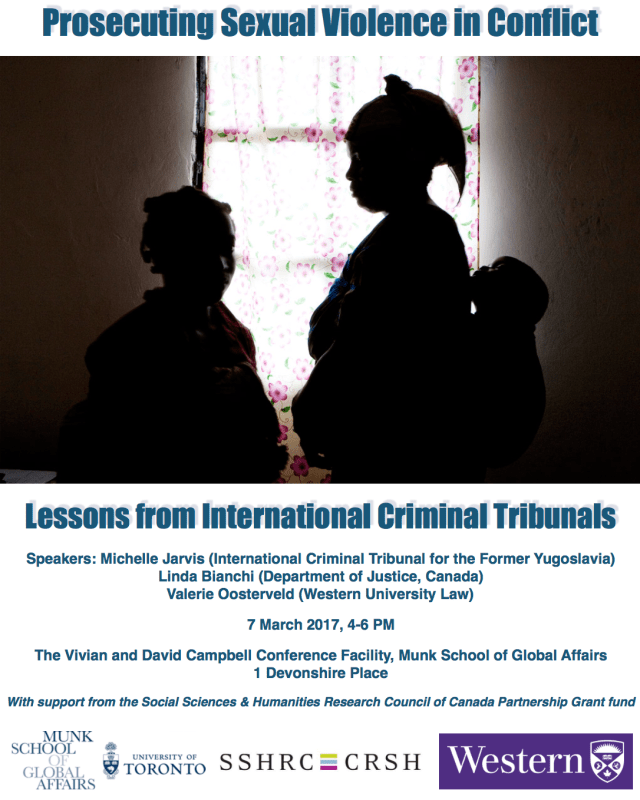
Event: Prosecuting Sexual Violence in Conflict – Lessons from International Criminal Tribunals

screen-shot-2017-02-21-at-12-56-35-pm
For all interested and in Toronto (or nearby!), I have co-organized an event with Valerie Oosterveld at the Munk School of Global Affairs on the prosecution of sexual violence crimes. The event, which would not have been possible without the support of the Social Sciences and Humanities Research Council of Canada Partnership Grant fund, will take place 7 March 2017, from 4-6pm.

The event is headlined by Michelle Jarvis, Deputy to the Prosecutor of the International Criminal Tribunal for the Former Yugoslavia, Linda Bianchi of the Department of Justice, Canada, and Valerie Oosterveld of Western University’s Law Faculty.

Here is the abstract of what promises to be a fascinating and timely event and discussion:

Over the past two decades, international criminal tribunals have adopted groundbreaking judgments convicting individuals for rape, sexual slavery and forced marriage committed during armed conflict and genocide in the former Yugoslavia, Rwanda, Sierra Leone, the Democratic Republic of the Congo and elsewhere. At the same time, these tribunals have had some very public setbacks, with sexual violence cases dismissed, charges acquitted, and investigations failed. What lessons can be learned from these experiences that can inform future cases at the International Criminal Court and other tribunals?

This session will feature a keynote address by Michelle Jarvis, Deputy to the Prosecutor of the International Criminal Tribunal for the Former Yugoslavia (ICTY), on her new book, “Prosecuting Conflict-Related Sexual Violence at the ICTY”. Responses will be provided by Linda Bianchi (formerly of the International Criminal Tribunal for Rwanda, now Department of Justice) and Valerie Oosterveld (Western Law) on whether the ICTY’s lessons can be applied on a global scale.

For all interested, please see the events page here. Hope to see some of you there!

Mark

Posted in JiC News | 3 Comments

The Human Rights Agenda and the Struggle Against Impunity

image
I recently reviewed an excellent new collection of essays Anti-Impunity and the Human Rights Agenda, edited by Karen Engle, Zinaida Miller and D.M. Davis (Cambridge, 2016). The book should be of interest to anyone working in the field of human rights and in particular those engaged with issues of international criminal justice. Below is an excerpt from my review, the full version of which is available on Lawfare here.

Towards the end of the twentieth century, the global human rights movement embarked on a major shift in its agenda and priorities. From the mid-1970s through the late 1980s, human rights groups tended to direct their advocacy in opposition to State criminalization of political activity and abuses within domestic criminal justice systems. The primary tactic was naming and shaming; the principal target was the State. From at least the early 1990s, however, the human rights movement underwent a “criminal turn,” increasingly directing its resources towards the promotion of criminal prosecution as an indispensable requirement for securing justice, peace and truth in the aftermath of mass atrocity situations. Under the banner of “ending impunity,” the primary tactic became the promotion of criminal accountability before domestic and international courts; the principal target was the individual.

Now, almost two decades into the twenty-first century, the correspondence between criminal prosecution and human rights has become so entrenched that to be anti-criminal prosecution is increasingly viewed as anti-human rights.

It is this turn towards an anti-impunity norm that forms the focus of a stimulating new collection co-edited by Karen Engle, Zinaida Miller and D.M. Davis: Anti-Impunity and the Human Rights Agenda. Arriving at a time when the international criminal justice project is increasingly under scrutiny and a surge in divisive and isolationist populism has put many in the human rights community on the defensive, this collection offers a timely problematization of the anti-impunity agenda that has come to dominate human rights thinking over the past two decades.
Continue reading

Posted in "Peace versus Justice" Debate, Academic Articles / Books, Amnesty, Brazil, Colombia, Economics of Conflict, FARC, Human Rights, International Criminal Court (ICC), International Criminal Justice, International Criminal Tribunal for Rwanda (ICTR), Justice, Latin America, Nuremberg, Peace Processes, Rwanda, Rwandan Genocide, South Africa, South America, Traditional Justice Mechanisms, Transitional Justice, Truth and Reconciliation Commissions | Tagged , , , , | 1 Comment