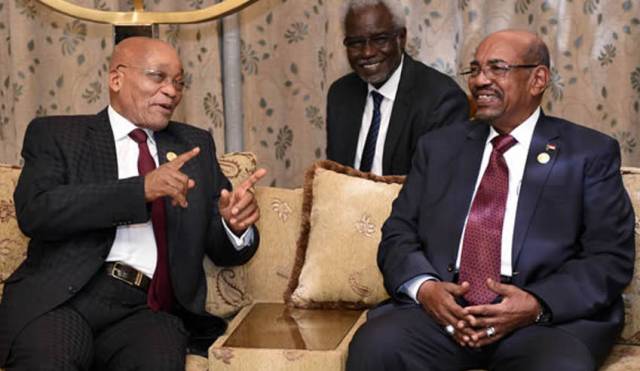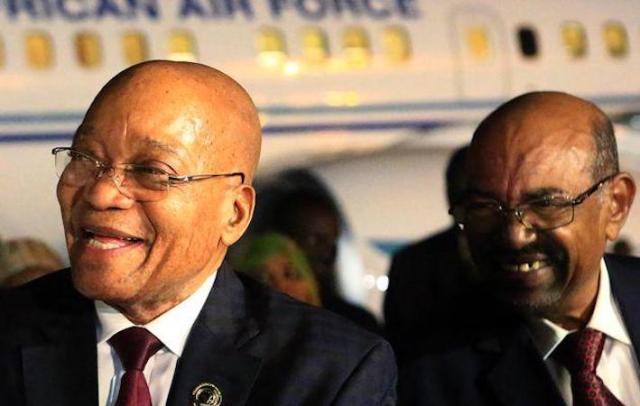
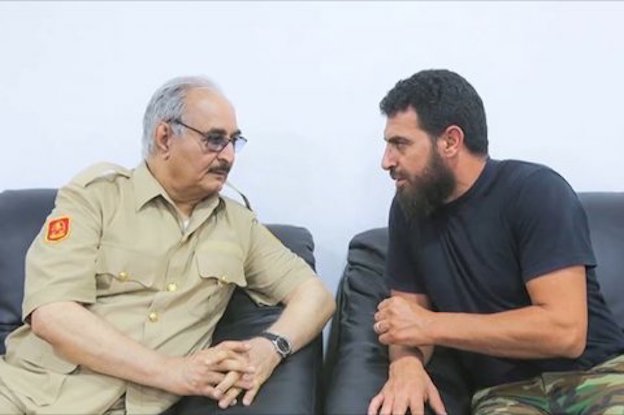
Mahmoud al-Werfalli (right) with LNA leader General Khalifa Haftar (Photo: The Libya Observer)
A version of this article was originally published at the Washington Post’s Monkey Cage website.
The International Criminal Court (ICC) has issued an arrest warrant for Libyan militant Mahmoud Mustafa Busayf al-Werfalli. The court claims that Werfalli — who operates under the Libyan National Army (LNA) — committed the war crime of murder over a series of brutal executions. With so many deserving perpetrators around the world, why go after Werfalli and what might this mean for Libya and the ICC itself?
The ICC has sought to address atrocities in Libya since the U.N. Security Council referred the country to the court in 2011. That includes its ongoing and tumultuous struggle to prosecute Colonel Muammar Gaddafi’s son, Saif al-Islam. But in those six years not one of the ICC’s five targets in Libya has ever faced judges in The Hague.
Under current chief prosecutor Fatou Bensouda, however, the ICC is increasingly opportunistic in its approach. Rather than targeting the most responsible perpetrators of international crimes, the court increasingly issues arrest warrants under circumstances the prosecutor believes there to be a high probability that suspects will be surrendered.
In Mali, Bensouda indicted Ahmad al-Faqi al-Mahdi for the war crime of destroying UNESCO-protected heritage sites in Timbuktu. When the warrant was issued, Mahdi was already in a Niger prison. Unusually for ICC targets, it took just days from the court issuing an arrest warrant to al-Mahdi standing before judges in The Hague. This seems to be the logic behind the targeting of Werfalli.
The LNA’s potential response
The self-styled LNA, for which Werfalli fought, is “a coalition of army units, ex-revolutionary groups and tribal militias” based in Eastern Libya that purports to combat Islamist terrorism. In May, following a series of brutal executions caught on film, LNA leader General Khalifa Haftar stood by his commander, rejecting Werfalli’s resignation and declaring that he was “one of the sincere fighters who has given a lot in the battlefields for years.”
The ICC prosecutor initially and secretly requested an arrest warrant for him on Aug. 1 and, according to the LNA, Werfalli was arrested, and investigations into his alleged crimes were launched, the very next day. While details remain sketchy, the proximity of these events is too close to be coincidental.
The LNA has three options: 1) to genuinely investigate and prosecute al-Werfalli and concomitantly challenge the admissibility of the case at the ICC; 2) give only the appearance of a genuine investigation of al-Werfalli with little or no punishment; or 3) surrender al-Werfalli to the ICC.
In response to the ICC’s actions, a LNA official said, “[w]e announce our readiness to cooperate with you [the ICC] in informing you of the result and course of the judicial case.” Neither the LNA, nor its supporters, have any intention of surrendering al-Werfalli to the ICC. But it remains to be seen whether they will genuinely investigate and prosecute Werfalli or simply run a sham probe into his alleged crimes.
Undermining victors justice
Some see the move against Werfalli as significant in part because it breaks with a controversial pattern of ICC interventions. The ICC generally pursues only one side of a conflict — rarely both. When the court initially intervened in Libya in 2011, it singularly targeted officials from the Gaddafi regime, overlooking or actively ignoring a litany of opposition atrocities. As a result, many subsequently criticized the court for practicing one-sided justice and entrenching impunity in order to curry favor for anti-Gaddafi forces and U.N. Security Council member-states. Continue reading