
Aidan Hehir joins JiC for this post examine the state of contemporary human rights advocacy and offering a preview of his co-edited volume, Protecting Human Rights in the 21st Century. Aidan is a Reader in International Relations at the University of Westminster. He has previously written for JiC on the new Kosovo hybrid tribunal.
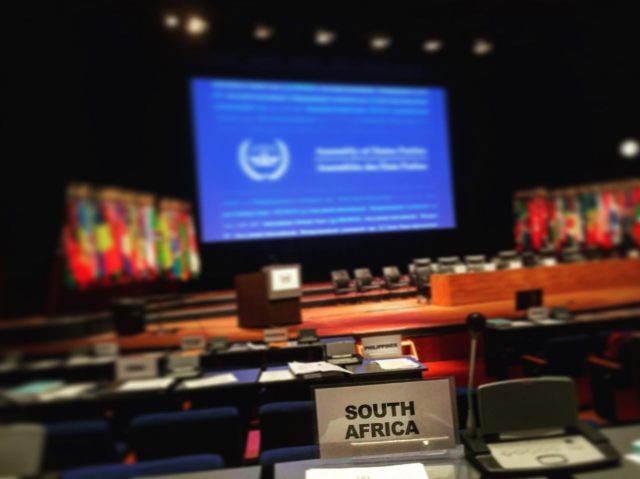
(Photo: Ghrnpostgradcluster)
The evidence is widespread and unequivocal: human rights are under attack across the globe. A 2015 report by the UN High Commissioner for Refugees, pointed to the “rapid acceleration” of “spiraling crises”, evidence of an evolving “paradigm change” characterized by “an unchecked slide” into a new era of violence and human suffering. In his 2016 report on the Responsibility to Protect (R2P), the UN Secretary General admitted that “the frequency and scale of atrocity crimes have increased”. Freedom House’s 2017 annual report recorded the 11th consecutive year of decline in global freedom. Amnesty International’s latest report likewise lamented the “unrelenting misery and fear” spreading across the world. The number of major civil wars has increased three-fold in the past decade with an attendant increase in war-related crimes against civilians. For the first time in seventy years, famines are on the increase as a direct consequence of the increase in “war and atrocities”. Add to this the spread of insular, xenophobic populism in Europe, the election of Donald Trump in the US, and the ongoing travails of the International Criminal Court (ICC), and the picture looks decidedly bleak. Surely, the proverbial “something” must be done?
Protecting Human Rights in the 21st Century is a response not just to this precipitous decline in respect for human rights, but also to the two dominant responses to this trend, which Robert W. Murray and I have termed fatalism and denialism. Motivated by our belief that both are not just illogical, but ultimately unhelpful, we offer a collection that addresses what has gone wrong since the end of the Cold War, what has worked, and what may work in future.
Remember the “End of History”?
The end of the Cold War inspired many effusive analyses predicting the dawn of a new era for human rights. While these perspectives were far from homogeneous, the widespread optimism then prevalent, coalesced around one central theme: the inevitability of progress. This was a time when people believed in the “End of History”, in the exponential spread of liberalism, democracy and respect for human rights; a time when “global civil society” was touted as a force that would increasingly compel states to act when “something” had to be done; when the UN was, according to the then US President, “poised to fulfil the historic vision of its founders” and usher in, “A world in which freedom and respect for human rights find a home among all nations”.
The debacle in Somalia, the bloody dissolution of Yugoslavia, and the Rwandan genocide deflated this teleological fervor somewhat. But, by the end of the 1990s, the adoption of the Rome Statute of the International Criminal Court (ICC) and the interventions in Kosovo and East Timor restored faith in the “progress” narrative; indicatively, in their 2000 World Report Human Rights Watch celebrated a “new willingness” on the part of the international community to act in defense of the oppressed, and heralded “a new era for the human rights movement”. Suffice to say, this optimism has since vanished.
Fatalism and Denialism
Today, Human Rights Watch’s (not unique) faith in the international community of course looks hopelessly naïve. Clearly the efficacy of “global civil society” was greatly exaggerated as indeed was the inherent benevolence of Western states. Commitments to protect human rights have certainly permeated to the very center of international political discourse but, ultimately, talk is cheap. As Amnesty International noted bitterly in its 2016 report, while governments have increasingly employed the language of human rights, “….the gap between rhetoric and reality, was stark and at times staggering”. Continue reading




 Justice in Conflict