
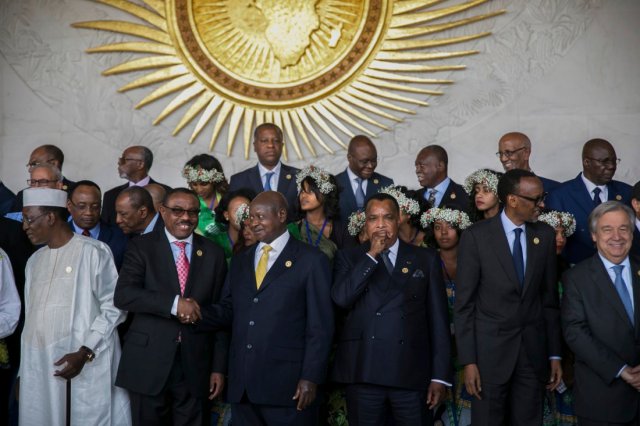
Leaders gather for an photo opportunity at the recent African Union Summit (Photo: Mulugeta Ayene / AP)
I want to make something clear from the outset: what follows is not a defence of the International Criminal Court (ICC). Seriously. It may sound like one or be interpreted as one, but it is not one. What follows is an attempt to clarify what actually happened last week when states at the latest African Union (AU) summit adopted an “ICC Withdrawal Strategy”. In doing so, they set parts of the internet ablaze with a new round of reports of a mass exodus of states from the ICC and the Court’s pending demise. It’s not going to happen — at least not now.
First, let’s tackle the actual resolution of the AU adopting the ICC Withdrawal Strategy. It is purposefully weak. Like, really, really weak. The non-binding resolution includes reservations from eight states. As Elise Keppler has pointed out, “Nigeria, Senegal, and Cape Verde ultimately entered formal reservations to the decision adopted by heads of state. Liberia entered a reservation to the paragraph that adopts the strategy, and Malawi, Tanzania, Tunisia, and Zambia requested more time to study it.” That’s a lot of reservations.
Further, the resolution’s operative paragraph declares that the Assembly of the AU “ADOPTS the ICC Withdrawal Strategy along with its Annexes and CALLS on member states to consider implementing its recommendations”. There are few things weaker in the vernacular of international legalese than calling on states to consider something.
But what about the ICC Withdrawal Strategy that was adopted? Its title certainly sounds menacing. But in substance, it is anything but. For one, it doesn’t actually call on a mass withdrawal of states from the Court. Here’s what the Strategy lists under “objectives”:
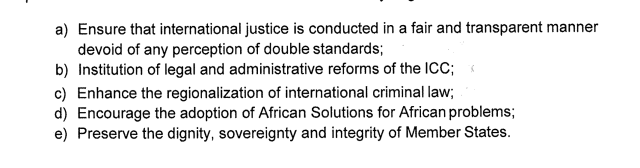 In reading the strategy, it is difficult not be left with the impression that African states remain engaged with the ICC. It certainly doesn’t sound like they’re collectively jumping ship. That’s because the Strategy reads like a largely reasonable list of possible reforms to the Rome Statute and the Court. Indeed, the arguments contained within the Strategy should be taken seriously and continue to be debated. There are at least a handful that should be acceptable to the Court and its champions, such as the long-standing request from Kenya to include “regional criminal jurisdictions” in the section of the Rome Statute’s pre-amble pertaining to the principle of complementarity. More attention also needs to be paid to the fact that the majority of the grievances and concerns expressed within the Strategy ultimately relate to the ICC’s relationship with the UN Security Council.
Perhaps the most unfortunate aspect of the Strategy is its misleading title. It is difficult, if not impossible, to read it and conclude that it proposes a roadmap for states to withdraw en masse from the Court. It really should be called “ICC Reform Proposals” or something similar. However, is clear that certain states prefer to muddy the waters and perhaps even want the media and observers to dramatize the possibility of a mass withdrawal. Advocates of the Court shouldn’t play into that game and, instead, ought to focus on encouraging African ICC member-states to advocate more accurate, and less inflammatory, titles for their documents and resolutions. That alone would help re-balance the narrative. Continue reading








 Justice in Conflict