
Angela Mudukuti joins us for this take on the decision by the International Criminal Court (ICC) regarding South Africa’s failure to arrest and surrender sudanese President Omar al-Bashir to the ICC. Angela Mudukuti is an international criminal justice lawyer with experience in advocacy and strategic litigation gained from her time in civil society, the ICC, and in private practice. The piece was written in Angela’s personal capacity and does not necessarily reflect the views of the Wayamo Foundation. Look out for a response to this piece tomorrow – and, as always, share your own thoughts!
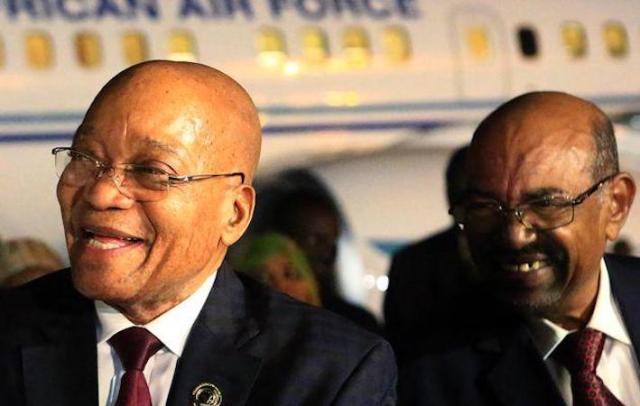
South African President Jacob Zuma with his Sudanese counterpart Omar al-Bashir (Photo: Mohamed Nureldin Abdallah / Reuters)
Last week, the judges at the International Criminal Court (ICC) handed down their long-awaited judgment regarding South Africa’s failure to arrest Sudanese President Omar al-Bashir. The Court was tasked with determining whether South Africa failed to comply with its obligations and, in the case that it had, if a formal finding of non-compliance and a referral to the Assembly of States Parties (ASP) and/ or the United Nations Security Council (UNSC) was warranted. The ICC found that South Africa had indeed failed to comply with its obligations, yet curiously, the judges failed to make a referral to the ASP or the UNSC. Not only is this a significant departure from previous rulings on non-compliance with respect to Bashir’s presence in signatory states, but it may do the ICC more harm than good as far as being taken seriously as a legal institution.
Bashir’s June 2015 arrival in South Africa for the 25th African Union Summit is where South Africa’s woes began. Legally obligated in terms of domestic and international law to arrest Bashir, the South African government chose instead to welcome him. Not only was this a breach of domestic and international law as well as the beginning of what many referred to as a constitutional crisis, it was also a significant departure from South Africa’s previous stance on Bashir’s presence in the country.
In 2009 Bashir was invited to the inauguration of President Jacob Zuma. He was told behind closed doors that should he arrive, he would be immediately arrested and subsequently surrendered to The Hague. The then director general of the Department of International Relations and Cooperation made this very clear in a public statement released by the government.
Unfortunately, in 2015, the government chose to disregard its domestic and international obligations. The South Africa based non-governmental organisation, Southern Africa Litigation Centre (SALC) took action to address this blatant disregard for the rule of law (as SALC’s international criminal justice lawyer at the time, this case was my responsibility). They approached the domestic courts seeking the implementation of the arrest warrant. The High Court began by issuing an order to prevent Bashir from leaving the country and later, it ruled that failure to arrest Bashir was unlawful. The Supreme Court of Appeal made a similar finding.
Having lost the battle at the domestic level, South Africa still had to face the proverbial music before the Pre-Trial Chamber on 7 April 2017.
A non-compliance hearing of this nature, though unprecedented, provided a vital opportunity for the South African government to defend its actions. In addition to questioning the Article 97 consultation process, the South African government submitted that the ICC’s previous judgments in this regard were inconsistent and that head of state immunity in terms of customary international law prevented South Africa from arresting Bashir. Continue reading









 Justice in Conflict