
Mark Drumbl joins JiC for this post on the role and relevance of international law in the Colombia peace process. Mark is the Class of 1975 Alumni Professor of Law & Director, Transnational Law Institute, Washington & Lee School of Law. To read the other contributions to JiC’s symposium on peace and justice in Colombia, see here.
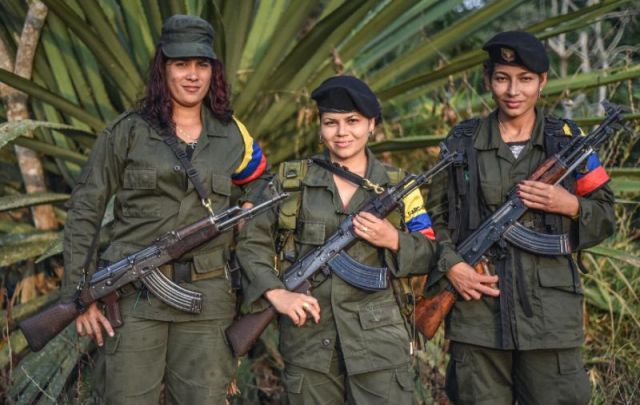
Members of the FARC rebel movement pose for a photograph (Photo: Luis Acosta / AFP)
“Breakin’ rocks in the hot sun
I fought the law and the law won.”— Sonny Curtis and the Crickets (1959), redone by many (my favorite being The Clash (1979)).
International criminal lawyers take the ‘duty to prosecute’ seriously. This duty fuels the powerful normative calling that systematic human rights abusers are to face the reckoning of the courtroom and, if convicted, the sanction of the jailhouse. Amnesties and pardons have become démodés. These duties and callings, in turn, color the self-portraiture of international criminal lawyers: they tincture how we see (our)selves. And, mostly, my impression is that we see (our)selves as fulfilling progressive causes and energizing the march of history and national politics eschatologically towards freedom, fairness, and justice.
Colombia however tells a different, less comforting, slightly more confronting, and certainly a much more complicated story. This story involves how the duty to prosecute international crimes, and to convincingly punish, can energize a right-wing ‘law-and-order’ agenda to the detriment of progressive interests. In light of the tangibility of a firm duty to prosecute, a decision by a state to prosecute too little and to sentence too leniently can unleash anger. All sorts of politics (ant-leftist, anti-Chávez, anti-establishment, anger over evictions and land ownership, relations with Cuba) can be pretextually articulated under the guise of a palatable and otherwise attractive oriflamme, that is, the duty to prosecute FARC members. Certainly the need to prosecute and punish the FARC presented as a powerful rhetorical device for Álvaro Uribe. It allowed him to chastise the peace agreement as too soft, too permissive, and as simply wrong on moral grounds. What is more, the peace agreement failed to comport with best practices and international standards, which require prosecution and punishment. The peace agreement, painstakingly negotiated over four years, was seen my many as a ‘dubious giveaway’ that imperiled Colombia’s ‘judicial integrity.’ The ICC in its increasingly permanent preliminary examination was consistently skeptical of reduced sentences, though it grudgingly tolerated them. Continue reading

 Justice in Conflict