How Long Can the ICC Keep States in the Purgatory of Preliminary Examinations?

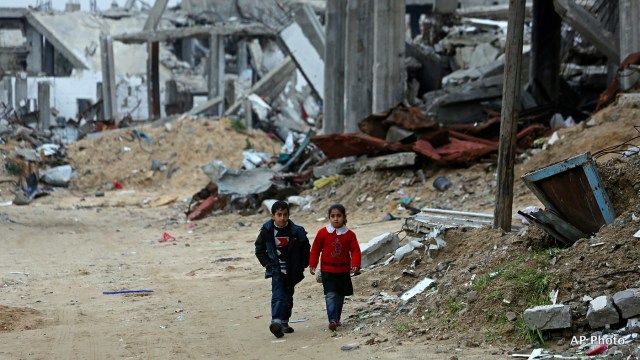
Children walk along a street in a heavily damaged neighbourhood in Gaza (Photo: AP)

Children walk along a street in a heavily damaged neighbourhood in Gaza (Photo: AP)

The Chief Prosecutor of the International Criminal Court (ICC) recently told journalists that she would not provide a time-frame for the ICC’s preliminary examination into alleged war crimes perpetrated in Palestine during the 2014 war in Gaza. Officials in Israel may derive some comfort in knowing that ICC action against the Israeli Defence Forces (IDF) isn’t coming any time soon. But Tel Aviv will certainly take little-to-no comfort in knowing that an official investigation and the issuance of arrest warrants could come at any time — and likely with little warning. At the same time, it may be a decade or more before victims and survivors in Israel and Palestine know whether or not they’ll ever get ICC justice for the crimes perpetrated against them. This brings forward an important question: is it fair to keep states in the potential purgatory that is the preliminary examination stage of an ICC intervention?

It stands that states under preliminary examination want to have some idea of what that entails — including how long they might be under the microscope of ICC investigators. Without a doubt, one of the most potentially combustable interventions by the Court would be in Palestine. Both opponents and champions of a role for the ICC in Palestine can agree on that. Predictably, then, observers want to know if and when such an intervention might come. According to The Jerusalem Post, ICC Chief Prosecutor Fatou Bensouda wasn’t about to divulge that information and would not even say whether the preliminary examination would be concluded by the time her tenure ran out in 2021 – over five years from now. Bensouda insisted there was no time-frame for her office’s examination:

I cannot sit here and say that it will take seven years, or it will take ten years or it will take any number of years…all of this depends on the facts and the circumstances. The preliminary examination cannot be given a timeline.

Interestingly, if somewhat puzzlingly, on a visit to the Palestine’s Mission to The Netherlands last year, Ambassador Nabil Abuznaid responded to my students by declaring he believed the ICC would not act or come to any significant decision in “less than ten years.”

Legally, Bensouda is on solid ground. The Rome Statute says nothing about how long a preliminary examination should take. While the yearly Preliminary Examination reports released by the Office of the Prosecutor indicate that the institution views increased transparency in its activities as useful and important, the Office is under no legal obligation to be forthright about its preliminary examinations. Some would argue that not divulging timelines is politically astute. After all, no prosecutor would voluntarily pigeon-hole themselves by declaring a cut-off date for a decision.

But is it fair? Should preliminary examinations be allowed to persist indefinitely? The domestic analogy leaves one dumbfounded. Imagine someone being informed by legal authorities that they were under investigation for murder and that they would be seen as a potential suspect indefinitely. At some point, an arrest warrant might be issued for the individual in question. But it also might not. The individual has no ability, let alone right, to know. In this scenario, neither does the victim or survivor. For a potentially indefinite period of time, they are told that justice is on the horizon. Or it might not be.

Of course, using a domestic analogy to measure or illustrate international phenomena is limited and problematic. But still, it seems troublesome to potential targets of prosecution, affected communities in general, as well as the victims and survivors of international crimes, to let preliminary examinations drag on indefinitely. Granted, the ICC has closed some preliminary examinations, most recently in Honduras. However, of its long-lasting examinations like Afghanistan and Colombia, it has often been said that they are left on the ‘low-heat’ of preliminary examination status as a means for the Court to be able to say it is interested and active in those situations and not because it actually is. Continue reading →

Posted in Gaza, International Criminal Court (ICC), International Criminal Justice, International Law, Israel, Preliminary Examinations | 12 Comments

JiC Turns Five – Some Thoughts on Half a Decade of Writing

highfive_1x

It’s hard to believe, but five years ago today, the first-ever post at Justice in Conflict was published. The occasion and anniversary spurred me to reflect on writing at JiC over the last half-decade and to share a bit of the story behind the blog.

I decided to create JiC in late February 2011, during the first year of my PhD in the International Relations Department at the LSE. The push to set up the site came from numerous sources, including a moment of failure. In late 2010, two close friends and I lost an election to become the editor’s of the LSE’s Millennium Journal of International Studies. Our failed bid was to be a blessing in disguise in that it left me with both the time and space to create and maintain the blog. At the same time, my father, Gregory Kersten, an esteemed academic in his own right, had been encouraging me to use my excess energy to create a website. Sometimes, it seems, fathers really do know best. My sister, Marta Kersten, a researcher in image-guided surgery/medical imaging at the McGill University, helped come up with the name of the site. I immediately embraced the idea of calling the blog Justice in Conflict for its double meaning — the pursuit of justice in the midst of active conflict as well as conflicting perspectives on the nature of justice itself.

In creating the blog, I didn’t have any expectations of what I — or the site— could achieve. Of course, I wanted an audience, but I was also largely happy to write for myself. Writing helped me put my thoughts in order — as well as spur new ones. As one American novelist once put it: “I write to know what I think.” Writing on JiC helped me to access, trigger, and string together thoughts and theories that were otherwise obscured or inaccessible.

After it’s launch (if it can even be called that), the blog started to take off rather quickly. Within the first few days, Kevin Jon Heller, whom I did not know at the time but who has since become a close friend, was gracious enough to welcome JiC to the blogosphere on Opinio Juris. I still recall not only my own excitement but the e-mails and comments of people saying: “Did you see? You’re on Opinio Juris!”

With time, more people began subscribing to the site. Today, JiC is closing in on 1.3 million visits and 15,000 subscribers across various platforms. Dozens of both regular and periodic contributors have enriched the discussions and debates we’ve had at JiC (with a special shout-out to Elke Schwarz and Patrick Wegner, both indispensable in the early years of the blog). These are bewildering and humbling numbers and I can’t thank readers for their interest enough.

In subsequent years, there have been other significant achievements for the site. Two stand out: in particular first, my critique of Invisible Children’s Kony 2012 documentary that went viral and ultimately garnered the site some 420,000 hits in two days; and second, when a source gave me permission to publish a draft UN Security Council resolution referring Syria to the ICC, making JiC the first and only place where the full text of the referral was available.

Of course, writing takes time and, as I tell anyone who asks for advice in creating a sustainable blog, new content has to be published on a regular basis. Capturing the interest of readers is one thing — maybe even the easy part; retaining their attention over time is another matter altogether. Looking back at the first-ever comment on the site, Xavier Rauscher wrote: “Very nice, Mark. Good luck with this blog. Whatever you do, don’t stop writing!” And he was right. The trick is to never lapse in producing new content. Thus the single achievement I am most proud of is the consistency of new and original material the blog has been able to put out since it was established. On average, JiC has published just under 100 articles per year since its inception.

It isn’t an exaggeration to say the consistency that the blog achieved wouldn’t have been possible without support from my two PhD supervisors, Kirsten Ainley and Mark Hoffman. Not once did they suggest that I put my blogging aside in order to focus on the thesis or more ‘academic’ pursuits. The end result was, perhaps for some, counter-intuitive. Rather than the thesis being delayed, it took less time because of my engagement with the blog; when I did finally submit the thesis, it was well before its due-date. Writing for JiC kept me constantly involved and interested in ongoing developments. I can’t recall a moment during my research when I wasn’t fascinated by what was happening at the ICC and in the world of international criminal justice more broadly. JiC helped me maintain that fascination and also made me feel like a part of that world. Rather act as a distraction from my research and thesis writing, JiC kept me engaged and allowed me to streamline certain arguments that I worked through on the blog. Writing was also something I could always rely on. I take great pleasure and indeed comfort in crafting posts and doing the necessary research for each piece I publish. Writing gives me what Mihaly Csikszentmihalyi would call “flow” — a state of mind so focused that everything else seems to melt away. Continue reading →

Posted in JiC News | 8 Comments

Concessions from the Half-Way House – Leveraging Membership in the ICC

(Illustration: Robert Neubecker)

In the world of the International Criminal Court (ICC), there are two types of states: the member-states who accept the jurisdiction of the Court and the non-member states who don’t. The ultimate goal of the international criminal justice project, beyond making itself irrelevant by eradicating mass atrocities altogether, is to move as many states from the latter camp into the former. But the relationship of African states, as well as that of the United States, with the ICC, should give us pause. The categories of member states and non-member states may make sense in the black-and-white of legalese, but they occlude the existence of a spectrum states that engage differentially with the Court. We need a new category that encompasses a half-way house of states that fall somewhere between being member-states and non-member states.

In recent months and years, threats — empty or not — of African states withdrawing from the ICC have proliferated. In just the last month, it was widely, if incorrectly, reported that the African Union was establishing some sort of ‘roadmap’ for states withdrawing from the Court. In a Presidential debate in Uganda, current head of state Yoweri Museveni reiterated his view that Uganda should pull out of the “partisan” institution. Observers can debate and discern the validity of such threats but it is undeniable that they currently dominate perceptions of the role and impact of the Court on the continent. But beyond determining whether any state’s intentions to withdraw membership is real, there is a clear need to understand a simultaneous and underlying trend: the leveraging of membership within the ICC for political gain by states occupying the middle ground between member and non-member state status.

Consider recent events across the African continent. In Uganda, Museveni has masterfully employed a schizophrenic policy on the ICC. Going full-throttle janus-faced, Museveni has decried the Court as unfair and racist whilst ensuring that Uganda cooperates with the institution’s investigators, poses for photo-ops with Chief Prosecutor Fatou Bensouda and, most importantly, plays hot potato with the fate of Dominic Ongwen rather than having him prosecuted in the able and functional Ugandan courts. The result is an admittedly brilliant ploy: the only ‘leader’ Uganda has enjoyed in thirty years poses as the rally boy for anti-ICC sentiment on the continent whilst ensuring that the Court remains dependent on him for cooperation and that he enjoys de facto immunity from the institution.

In Kenya, the government famously responded to the charges against current President Uhuru Kenyatta and Deputy President William Ruto with a fully-fledged and devastating attack on the ICC and encouraged a handful of other states to threaten withdrawal from the Court. Moreover, not only have Nairobi’s efforts managed to have most, and at some point likely all, of the charges against its politicians dropped, they have also managed to achieve the appeasement of ICC member-states in the process. In short, Kenya has leveraged its membership, as well as that of others on the continent, in exchange for various ‘victories’ at the ICC. Continue reading →

Posted in International Criminal Court (ICC), International Criminal Justice, Kenya, Kenya and the ICC, South Africa, Uganda, United States | Tagged , , , , | 1 Comment

A Threat to Justice – Ruto Decision a Cautionary Tale on ICC Independence

Elizabeth Evenson joins JiC for this take on recent developments in the cases against Kenya’s William Ruto and Joshua Arap Sang as well as the political appeasement of Kenya by states at the International Criminal Court. Elizabeth is senior international justice counsel at Human Rights Watch.

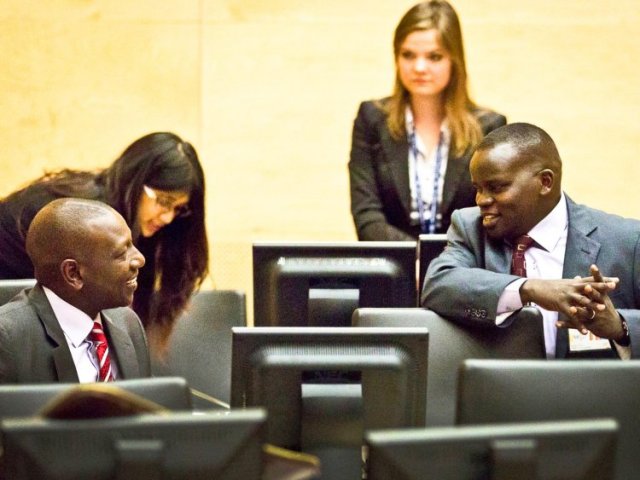
William Ruto and Joshua Arap Sang (Photo: ICC)

William Ruto and Joshua Arap Sang (Photo: ICC)

Last week, appeals judges at the International Criminal Court (ICC) threw out prosecution evidence in the crimes against humanity case against Kenya’s deputy president, William Ruto, and his co-defendant, Joshua Arap Sang. The decision is significant, and the loss of prosecution evidence casts a shadow on the case’s future. But while the focus has been on Ruto’s co-called “big win,” the background to this decision should be a cautionary tale about the importance of protecting the ICC’s independence, a task its member countries seem at risk of failing.

The ICC’s Assembly of States Parties meets once a year to make decisions that should bolster the court’s work. Last November, however, the vast majority of the meetings were devoted to addressing demands from an out-sized Kenyan government delegation. The government wanted the Assembly to declare that a revised rule used by the Ruto trial court and adopted by the Assembly in 2013 was never intended to apply to the case, because it began before the rule was changed.

The use of the revised rule was the subject of last week’s appeals decision. The Ruto trial court had used the rule to admit evidence—essentially written statements or transcripts of statements recanted by four witnesses when they took the stand—because they found that the witnesses had been improperly influenced to recant, part of a systematic effort to interfere with witnesses in the case, they said. Statements from a fifth witness who disappeared altogether were also accepted. On appeal, however, the judges found that use of the evidence was incompatible with fair trial rights.

Whether the rule could be used in the Ruto case clearly was a legitimate question, as evidenced by the outcome on appeal. But it was squarely before the ICC judges at the time of the Assembly meeting. Putting this issue before the Assembly was a clear attempt by Kenya to apply political pressure on the judges’ decision-making, part and parcel of the government’s long-running campaign against the ICC.

That campaign, unfortunately, is not surprising. Until last year, Kenyan President Uhuru Kenyatta himself faced charges before the ICC. Neither his government nor the previous one have taken any real steps to bring to justice those responsible for atrocities committed during Kenya’s 2007-2008 post-election violence. As a court of last resort for the gravest international crimes, the ICC will inevitably rub up against powerful political figures who have everything to fear from accountability.

But what is perhaps most surprising is how anemic and cowed many other ICC members have been in the face of Kenyan pressure.

At the Assembly, member countries were dragged into days of closed-door negotiations over Kenya’s request. They agreed, in the end, to include a paragraph responding to Kenya’s request in the meeting’s report. The language is best described as a dodge on substance, but one that gave Kenya enough room to claim that the Assembly had backed their version of events regarding the rule’s history.

In their ruling last week, the appeals judges were not persuaded that member countries never intended for the rule to apply to pending cases, and based their decision, instead, on treaty law regarding the application of amended rules. They dismissed the language from November’s Assembly meeting as irrelevant. Nonetheless, the decision risks being seen as tainted by political pressure — and acquiescence. Continue reading →

Posted in Assembly of States Parties, Guest Posts, International Criminal Court (ICC), International Criminal Justice, Kenya, Kenya and the ICC | Tagged , | 4 Comments

Why is the International Criminal Court stepping out of Africa and into Georgia?

(Photo: Osinform Information agency)

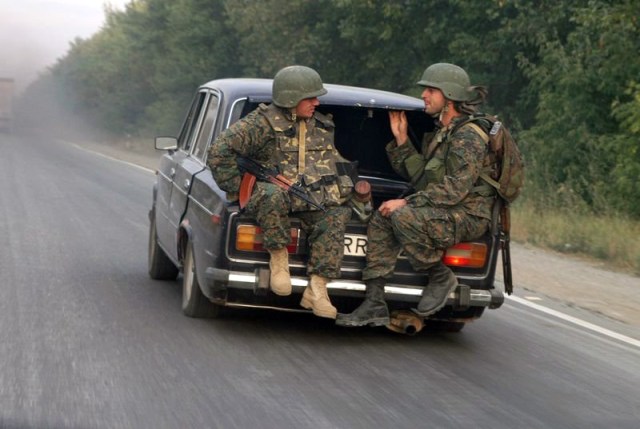
Georgian soldiers leaving South Ossetia during the 2008 war (Photo: Osinform Information agency)

After three months of deliberations, judges at the International Criminal Court (ICC) have finally approved the opening of an official investigation into the 2008 war in Georgia. Prosecutors will focus on the ethnic cleansing of Georgians from the breakaway region of South Ossetia, as well as an attack by Georgian forces on a Russian peacekeeping base. The ICC’s intervention into the conflict between Georgia, Russia and Moscow-backed belligerents in South Ossetia represents the court’s first investigation into a situation outside the African continent. It also marks the first time that the alleged crimes of a major power, Russia, will be placed under official investigation by the court’s prosecutors.

This raises a number of questions: Why did the court decide to open an investigation outside Africa now? Who will be targeted for prosecution? And what could be the fallout for the states involved in the 2008 war?

The ICC continues to suffer from the widespread perception that it is biased against African states. Prior to its intervention in Georgia, every official investigation launched by the court was in Africa. Despite the fact that African states themselves have requested the majority of these interventions, African leaders have labeled the ICC a “race hunting” institution and a “tool of Western imperialism.” African states and the African Union have consistently — and increasingly — threatened to withdraw from the court. Even its most traditionally staunch supporters, like South Africa, are reconsidering their relationship with the ICC. It may be tempting to conclude that the ICC opened an official investigation in Georgia to combat perceptions that it is biased against Africa. That, however, would be wrong.

Only the most cynical observer would suggest that the ICC identified Georgia as its road out of Africa. Not only would such a strategy be too risky and brazen for a generally cautious court and a prosecutor, but it would also make very little sense given the timeline of decisions made at the court. As Alex Whiting, a former member of the ICC’s Office of the Prosecutor and currently a professor of practice at Harvard Law School, writes: “If the Prosecutor simply wanted to use the Georgia case to get out of Africa or to take on a major power, she could have done so years ago. … A prosecution strategy that simply tried to respond to criticisms from the outside, many of which are politically motivated, would be doomed to fail.” So why Georgia — and why now?

The decision to intervene in Georgia is likely due to a confluence of factors. First, the court had the 2008 war under preliminary examination for nearly half a decade. Had Georgia demonstrated that it was willing to investigate, and potentially prosecute, the crimes itself, it could have foreclosed any ICC intervention. However, when Tbilisi ended its investigations into the alleged crimes perpetrated in 2008, it became untenable for the ICC to simply keep those crimes under examination indefinitely. Second, for an institution that seeks to command relevancy in international politics, it certainly does not hurt that there is a broader narrative vilifying Moscow and its role in the region. Whether or not the court targets Russian officials, investigating Russian conduct captures that broader, if not always helpful, international narrative condemning Russian aggression. Continue reading →

Posted in Georgia, International Criminal Court (ICC), International Criminal Justice, Justice, Russia, South Ossetia | 4 Comments

Spies at the International Criminal Court?

(Image: Julian Hibbard)

(Image: Julian Hibbard)

Is international criminal justice worth spying on? Do states invest in penetrating the halls of international criminal tribunals with their intelligence officers? While these aren’t exactly questions that one typically encounters, a recent article by Julian Borger sheds light on how one intelligence agency, Russia’s Federal Security Bureau (FSB), infiltrated the International Criminal Tribunal for the former Yugoslavia (ICTY) in order to protect Ratko Mladić, a Bosnian Serb general accused of genocide and war crimes who was a fugitive of the ICTY for a remarkable fourteen years.

According to Borger, Russia viewed Mladić as a former ally unjustly hunted by Western states seeking to expand their influence in Serbia, a historically close ally of Moscow’s. At the same time, Russia feared that Mladić’s arrest or surrender would lead to embarrassing revelations about Moscow’s support for the Republika Srpska during Mladić’s campaign of ethnic cleansing. Borger describes how Miodrag Rakić, the lead investigator in the hunt for Mladić, was consistently frustrated in his efforts. Anyone who could potentially cooperate in the search for the former Bosnian Serb general was intimidated by FSB agents. And then this bombshell:

Rakić also felt the unmistakable presence of the FSB looking over his shoulder. In 2008, he and a colleague made a clandestine trip to the Hague tribunal to discuss the Mladić case. They flew a roundabout route and Dutch protection officers drove them straight into the tribunal’s underground car park. On his return, however, Rakić received a visit from one of Mladić’s supporters in the security services, warning him that his family would be in peril if he continued to cooperate with the court. Lest there be any doubt over the seriousness of the threat, he recited details of Rakić’s young son’s daily routine.

Shocked at the threat, Rakić angrily denied he was collaborating with the court, insisting he had never even been to The Hague. Without a word, the visitor took a piece of paper and drew a diagram of a conference table. Then he wrote out the name of every person who had attended his meeting in The Hague, indicating precisely where each of them had been sitting. Rakić described it as the most chilling moment of his life. From that moment on, until his death from cancer in 2014, he travelled with a two-man protection team.

There was little doubt in his mind that only the FSB had the sophistication to penetrate the Hague Tribunal so thoroughly.

This raises the question: if spies could infiltrate the ICTY, what about the International Criminal Court (ICC)?

The issue of spying has been raised on a handful occasions at the ICC. In Darfur, where no ICC official has ever stepped foot, the Court’s intervention into the alleged genocide has been met with regular accusations by the Sudanese government that civil society organizations and human rights advocates are “spying” for the Court. More recently, during the 2011 Libyan civil war, the ICC indicted Abdullah al-Senussi, Colonel Muammar Gaddafi’s notorious “spy chief”. Months later, four members of the Court’s staff were detained and accused of espionage after attempting to meet and consult with Gaddafi’s son and Senussi’s fellow ICC-indictee, Saif al-Islam Gaddafi. According to Benjamin Dürr, there have also been allegations that some states, including Germany, have spied on the ICC. Continue reading →

Posted in ICTY, International Criminal Court (ICC), International Criminal Justice, Russia | Tagged , | 3 Comments

Please Stop Bean-Counting Syrian refugees

For months, the international community has been clamouring to find an appropriate response to address the plight of hundreds of thousands of refugees fleeing violence and terror in Syria. But much of the debate about what states can and should do has been framed as a ‘numbers game’, as a matter of the volume of refugees any given state accepts. In this article, a version of which was first published at Open Canada, I argue that our moral responsibility to refugees cannot solely be measured by the number we take in. The piece focuses on the current debate in Canada but, hopefully, will also resonate with readers in communities facing similar situations.

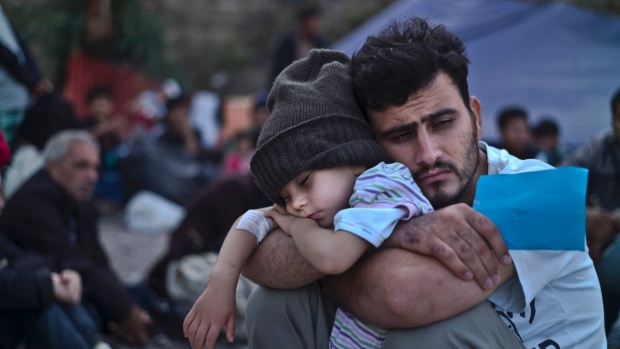
A Syrian man holds his son at a refugee camp (Photo: Muhammed Muheisen / Associated Press

A Syrian man holds his son at a refugee camp (Photo: Muhammed Muheisen / Associated Press

Numbers have power. They determine both politics and policies. We are comforted when we are told that hundreds of billions of dollars will go towards combating climate change — even if few know what that amount of money actually buys. We are shocked and appalled when we hear that 300,000 people, and counting, have perished during the Syrian civil war. We are concerned when confronted with the disparity in wealth and opportunity between the wealthiest one percent and the other 99 percent.

Numbers underpin the decisions we make, the ideas we propagate and the rationales we employ to support both. But numbers don’t always add up. And in some instances, they obfuscate more than they elucidate. The current debate over the acceptance of Syrian refugees to Canada is a case in point.

Since the harrowing images of Alan Kurdi’s lifeless body on a Turkish beach captured the world’s attention, there has been a welcome, if belated, debate about what Canada can do to help the plight of refugees fleeing violence and atrocity in Syria. In part because this debate emerged so powerfully in the midst of last October’s federal election, politicians distilled it into a numbers game. The Conservatives, then under Stephen Harper, promised to bring in and settle 10,000 Syrian refugees by September 2016. The Liberals, led by now-Prime Minister Justin Trudeau, countered that they would accommodate 25,000 refugees from the region by the end of 2015. The question of who would promise to do the most for Syrian refugees thus became a matter of who would offer to accept the most Syrian refugees. But these are not one and the same.

The current Liberal government came under fire for being over-confident, perhaps even naive, in declaring that it could settle 25,000 refugees within three months of assuming power. Subsequently, it revised its target to 10,000 by Dec. 31, 2015, extending the deadline for 25,000 until March.

Now, well into the New Year, the government has reached approximately 25 percent of its target. Are they to blame? Have they failed? Some would certainly claim so. NDP MP Jenny Kwan declared that not only did Immigration Minister John McCallum “irrefutably fail to live up to the promise Liberals made to Canadians in the last election, but he even failed to meet his own lowered expectations.” In a recent op-ed, columnist John Ibbitson has added that, based on the numbers, “the Conservative goal is looking more realistic than what the Liberals promised.”

There is no doubt that the government should be held to account for the promises it makes and breaks. But basing our judgment of appropriate political and moral action to help Syrian refugees should not be a numbers game. The political challenge we face isn’t to ‘fit in’ as many refugees as the government promises in as short a period of time as possible. Bean-counting people and families fleeing terror cannot meet the moral test we are confronting. To do so misses the point: that what we need is a nation-wide conversation about how we can create and maintain a coherent, comprehensive and, above all, compassionate program that not only brings refugees, along with their immense energy and courage, into the country, but ensures that they are adequately supported once they arrive.

Such a program could also serve as an example for how to handle future refugee crises, or, better yet, lead into a debate around the effectiveness of Canada’s process on the whole, considering the many refugees worldwide who are waiting in camps or have been put on years-long waiting lists to be provided entry into Canada. Unless there is a declared global emergency or politically driven attention on their plight, those others are clearly not being served under our current system.

Continue reading →

Posted in Canada, Refugees, Syria | 3 Comments

Mass Atrocity Monday, 2/1/2016: The Andijan Massacre

Greetings, Justice in Conflict readers.

For those who don’t know me, I’m a political scientist and former human rights lawyer, currently based at Stanford’s Center for International Security and Cooperation. I also run the blog Wronging Rights. I spend most of my time writing and thinking about the dynamics of mass atrocities and the politics of justice for serious international crimes. For obvious reasons, the rest of my time is spent consuming a steady diet of brightly-colored, loosely-plotted TV comedies, bourbon, and chocolate.

I’ll be here on the first Monday of every month with the details of a lesser-known atrocity and any efforts to bring those responsible to justice. This feature, a.k.a. Mass Atrocity Monday, originally ran on Wronging Rights in 2014 as a companion piece to the dataset of atrocities I coded for my PhD dissertation. Now I’m revisiting that dataset and Mass Atrocity Mondays as I turn the dissertation into a book. (It’s called Just Enough: The Politics of Accountability for Mass Atrocities. Look for it in bookstores any year now.)

In general, I’ll be covering events from the post-WWII era, because that’s when the possibility of prosecuting the perpetrators of atrocities became A Thing. But I reserve the right to make an occasional side trip into Ye Olde Historical Carnage. So, buckle up.

Today’s atrocity is the 2005 massacre in Andijan, Uzbekistan.

President Islam Karimov of Uzbekistan. By Ernests Dinka, Saeimas Kanceleja [CC BY-SA 2.0 (http://creativecommons.org/licenses/by-sa/2.0)], via Wikimedia Commons

Islam Karimov, President of Uzbekistan.
Photo credit: Ernests Dinka, Saeimas Kanceleja via Wikimedia Commons

Uzbekistan’s president, Islam Karimov, has been in office since before the country declared its independence from the U.S.S.R. in 1991. He’s kept a tight grip on power by repressing civil society, censoring the independent media, and occasionally boiling his opponents to death. Harsh anti-Islamist policies have routinized targeting and harassment of Uzbekistan’s Muslim community. After the 9/11 attacks, Karimov’s regime benefited from the opportunity to recast these policies as part of the Global War on Terror, in part because of Uzbekistan’s role as a critical partner in the U.S.’s campaign in Afghanistan. Human rights groups say that more than ten thousand Uzbek Muslims have been jailed since 2002, many of them facing torture during their detention.

In May of 2005, the arrest and trial of 23 local businessmen sparked a conflagration in the eastern city of Andijan. The men were accused of membership in the Islamist organization, Akramiya. At the time, observers suggested that this was pretext, and that the men were simply being targeted for a refusal to pay bribes. When their verdict was postponed, armed supporters staged a prison break the night of May 12 and seized control of a nearby government building. Emboldened by their actions, crowds of protestors gathered nearby calling for an end to injustice. But instead of meeting their demands, the government responded with deadly force.

According to eyewitness testimony, Karimov’s forces opened fire on the protestors with no warning. Unarmed civilians were killed as they attempted to flee. In the aftermath, the death toll was hotly contested. Rumors spread about covert military operations to remove the bodies and mass graves outside of town. Eventually, the Uzbek government acknowledged the deaths of 187 people, most of whom were “terrorists”. Human rights groups put the total much higher. On the 10 year anniversary of the massacre, Human Rights Watch reiterated its belief that hundreds of unarmed civilians were killed by their government that day.

Some of the Andijan protesters escaped across the border into Kyrgyzstan. For those who remained, the situation was precarious. In the aftermath of the massacre, Karimov launched a vicious crackdown against anyone who might threaten his stranglehold on power. Journalists who had covered the events at Andijan were forced to flee, and almost every foreign NGO found itself expelled from the country. While members of the international community called for an independent investigation into the massacre, the government pursued criminal charges against those suspected of involvement in the “uprising”, and convened a window-dressing parliamentary commission to validate the official narrative of an attempted Islamist revolution.

In the months following the massacre, the Karimov regime’s relationship with the West soured. Uzbekistan lost millions of dollars in aid and arms sales, and, angry about Western interference, ended its air-base agreement with the U.S. But the estrangement didn’t last. The EU lifted its arms embargo in 2009, the U.S. in 2012. And just in time for the Andijan massacre’s 10 year anniversary last May, the U.S. announced a new five-year plan for military cooperation with Uzbekistan.

In retrospect, Karimov’s approach of brutal repressing civil society while waiting for international attention to wane looks smart. With domestic demand for justice suppressed, and international demand subordinated to strategic concerns, for now, at least, he’s gotten away with murder.

Posted in Mass Atrocity Monday, Uzbekistan | Tagged | 2 Comments

Mattresses and “Democratic Bombs”: Charles Blé Goudé in his Own Words

Sophie T. Rosenberg joins JiC once again for her analysis of ICC-indictee Charles Blé Goudé’s recently published book. For her previous post on Laurent Gbagbo’s book, please see here.

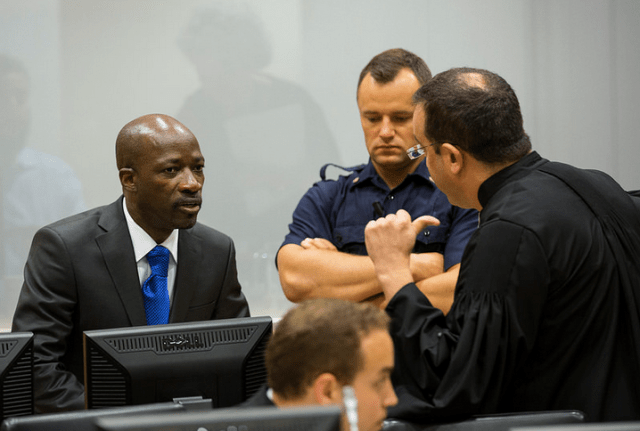
Charles Blé Goudé consults his defence counsel at the International Criminal Court (Photo: ICC)

Charles Blé Goudé consults his defence counsel at the International Criminal Court (Photo: ICC)

At the end of his book, which very few people even know about, Charles Blé Goudé rejects all the accusations made against him. “No, I am not anti-French. No, I am not a militia leader. No, I am not the alleged assassin of northerners. No, I am not a supporter of violence!”

Though his trial at the ICC is set to begin, Blé Goudé has already made his defence. Indeed, after fleeing Côte d’Ivoire in April 2011 at the peak of post-election violence, the former leader of the political youth movement “Young Patriots” wrote a book from exile entitled Traquenard Electoral (The Electoral Trap).

Published in December 2011, the book is framed as a plea of innocence to a fictional judge. Blé Goudé, whose charisma and magnetism easily rallied huge crowds, was already subject to an arrest warrant issued by Côte d’Ivoire. But it would be nearly two years until the ICC would unseal an arrest warrant against him in September 2013.

He is now being tried for crimes against humanity in a joint trial with ex-president Laurent Gbagbo, whom Blé Goudé refers to in his book as his political mentor and even a father figure. Following the 2010 disputed elections, Gbagbo appointed Blé Goudé as Minister of Youth, though his government was not recognised internationally. Their proximity is key to the trial, as the prosecution aims to establish that Blé Goudé held a crucial role in Gbagbo’s “inner circle” and served as the link to the pro-Gbagbo youth militias during the 2010-2011 crisis.

The situation in Côte d’Ivoire has calmed down since Blé Goudé galvanized crowds and ignited feelings of vengeance in politicized youth. But, in a tug of war with the past, his defence at the ICC could bring back to the fore those tense times for Ivoirians following the trial.

So, besides being a consultant of political communication, as he introduced himself to the ICC judges, how does Blé Goudé want to be seen and how does he view the court?

A Pacifist on Trial?

In his book, Blé Goudé seeks to counter the perception of himself as a demagogue who incites youth to xenophobic violence. He wants to be seen, instead, as a non-violent resistance fighter in a two-front struggle. For him, he peacefully defended his country against an armed revolt and French neo-colonialism – but ended up as a victim of international criminal law, governed not by fairness but by power.

Though a clearly self-serving and biased portrait – and one that I do not endorse – Blé Goudé’s crafted persona is a pacifist who models himself after Mahatma Gandhi and Martin Luther King, Jr. but who has the misfortune of living in the era of the ICC.

A Life-Long Youth Leader

Now in his forties, Charles Blé Goudé has been a youth leader for quite a long time. Having served as Secretary-General of the infamous student union, Federation of Students and School Pupils of Côte d’Ivoire (FESCI), he was also involved in creating and leading several political youth movements, including the Alliance of Youth Patriots for National Survival (AJPSN), or “Jeunes Patriotes”.

When, in September 2002 a coup took place that triggered a long civil war, Blé Goudé was in England studying at the University of Manchester. “Sacrificing my scholarship and the occidental freshness” (possibly a jab at British weather?), Blé Goudé returned to Côte d’Ivoire to “defend my land” against the perceived aggression by the armed group Forces Nouvelles.

Throughout the 2002-2011 conflict, President Gbagbo benefitted from Blé Goudé’s talent to mobilise pro-Gbagbo youth. It isn’t difficult to understand how he became known as the “Street General.”

Placed under UN sanctions in 2006, Blé Goudé has been accused of inciting violence against foreigners (namely the French) and those deemed to be non-Ivoirians, primarily those with links to neighbouring countries such as Burkina Faso who were viewed as being pro-Ouattara. Blé Goudé’s ICC trial concerns such targeted attacks against opposition supporters by pro-Gbagbo youth, who were allegedly acting under his instructions during the 2010-2011 crisis.    Continue reading →

Posted in Guest Posts, International Criminal Court (ICC), International Criminal Justice, Ivory Coast / Côte d'Ivoire, Ivory Coast and the ICC | Tagged | 1 Comment

On the Rebirth of Hybrid Tribunals

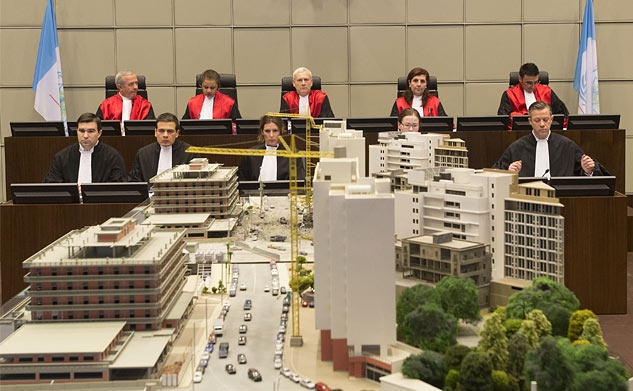
Judges at the Special Tribunal for Lebanon look over a model of the area of Beirut where former Prime Minister Rafiq Hariri was assassinated (Photo: STL)

Judges at the Special Tribunal for Lebanon look over a model of the area of Beirut where former Prime Minister Rafic Hariri was assassinated (Photo: STL)

International criminal justice is an emerging marketplace. It has a diversity of stakeholders, different ‘business’ models, and is based, like all markets, on supply and demand — although demand clearly and vastly outstrips supply. Something of a political economy of international criminal justice is developing and a growing number of observers and scholars are concluding that no tribunal type can or should have a monopoly over the provision of international accountability.

In this context, I have recently written about renewed interest of hybrid international criminal tribunals. In broad terms, such tribunals (as well as ad hoc courts more generally) have been justified on the basis that they can act as stop-gaps for the short-comings of the International Criminal Court (ICC). Because the ICC can’t be everywhere it is needed, we need to explore alternatives. This is undoubtedly true. But in thinking through a marketplace of international criminal justice, is it useful to create a pecking-order of tribunal types that views the ICC as its apex and other courts as second best options? I’m less and less convinced.

There is no cookie-cutter concept of what a hybrid tribunal should look like. As Sarah Williams has written:

While there is no definition, such tribunals tend to apply a mix of national and international law (both procedural and substantive) and feature a blend of international and national elements, in particular international and national judges and personnel. While there is some disagreement as to those institutions that are properly considered hybrid or internationalized, the following tribunals are generally included in this category: the Special Court for Sierra Leone (SCSL), the Extraordinary Chambers in the Courts of Cambodia (ECCC), the Special Panels for Serious Crimes in Timor Leste (SPSC), the International Judges and Prosecutors Program in Kosovo (IJPP, or Regulation 64 Panels), the War Crimes Chamber in the State Court of Bosnia and Herzegovina (WCC), and the Special Tribunal for Lebanon (STL).

The above excerpt and list of hybrid tribunals was published in April 2014. The most recently created tribunal Williams lists is the Special Tribunal for Lebanon, established in 2009 to prosecute those responsible for the terrorist attack in Beirut that killed then Prime Minister Rafic Hariri and twenty-two others.

Fast-forward just two years from Williams’ observations and the proof of the hybrid tribunals’ rebirth is in the pudding. According to Beth Van Schaack, a professor of international law at Santa Clara and a former Deputy U.S. Ambassador-At-Large for War Crimes Issues,

the international community in 2015 considered new hybrid accountability mechanisms for a range of historical and current atrocity situations, including Syria, the Central African Republic (CAR), the Democratic Republic of Congo (DRC), Colombia, Sri Lanka, Chad, Kosovo, and even the July 2014 downing of Malaysian Air Flight 17 over rebel-controlled Ukraine.

In other words, the international community considered creating eight additional hybrid tribunals. If all came to fruition, the number of hybrid tribunals established to date would rise by 133%. But why this sudden surge of interest in hybrid tribunals? Continue reading →

Posted in Hybrid Tribunals, International Criminal Court (ICC), International Criminal Justice, Kosovo, Kosovo Relocated Specialist Judicial Institution (KRSJI) | Tagged | 9 Comments