
Chantal Meloni joins JiC for this first post in our symposium on Palestine and the International Criminal Court. Chantal is a Lecturer in International Criminal Law at the University of Milan and a visiting researcher at the Humboldt University of Berlin.
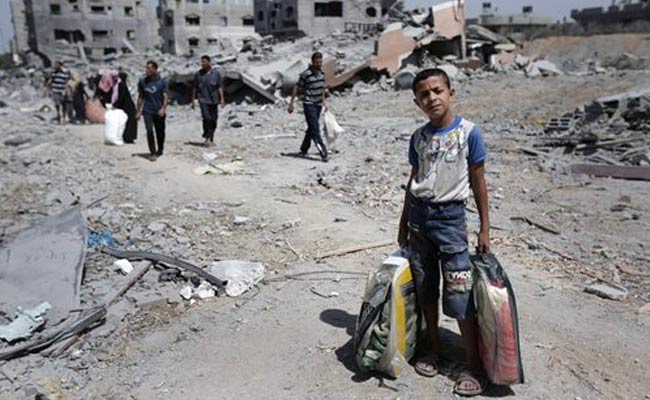
A Palestinian boy carries his belongings following heavy bombardment of Gaza by Israeli forces in August 2014 (Photo: Associated Press)
Until recently, the idea of using international law with regards to the Israeli-Palestinian conflict was mostly a theoretical exercise, something invoked by academics and activists, and in debates within political bodies of the United Nations (Schabas, Foreword, in Is there a Court for Gaza?).
For decades, the issue did not reach the docket of international courts and tribunals. To some extent this is because the institutions themselves did not previously exist or because they were unavailable to the Palestinians. A result of its uncertain international legal status, Palestine could not ratify the Statute of the International Criminal Court (ICC), nor could it accede to human rights law instruments and international treaties.
Thus for a long time it appeared that there was no court capable of providing a forum for the Palestinian situation. As we know, this is no longer the case: Over the past twelve years, both the International Court of Justice – with the 2004 Advisory Opinion on the Wall – as well as the ICC have been confronted with aspects of the Israeli-Palestinian conflict. Following its ratification of the Rome Statute and a new declaration lodged under Art. 12(3) of the ICC Statute accepting the jurisdiction of the Court since 13 June 2014, on the 1st April 2015 Palestine will become the 123rd member State of the ICC. Both Palestinian governmental officials and human rights organizations and lawyers representing the victims are anticipating their filing of a series of complaints and ‘communications’ to the ICC Office of the Prosecutor (OTP), covering the whole spectrum of alleged crimes committed by Israeli officials against the Palestinian people, from the war crimes in Gaza, to the settlements in the West Bank. Meanwhile, the OTP has opened a ‘preliminary examination‘ into the situation in Palestine.
This increased recourse to international law by the Palestinians has been labelled by some commentators as ‘lawfare’. The lawfare accusation in this case appears to be improper and malicious. As professor Schabas wrote: “The ‘lawfare’ label is nothing more than frustrated resistance to the availability of new mechanisms and institutions whereby international law can be applied to present conflicts, including those involving Israel and Palestine.” (Foreword, in Is there a Court for Gaza?).
It is anyhow notable given how dangerous the recourse to international law mechanisms by Palestine is perceived by Israel and its allies. It is also important to recall the incredible amount of pressure that was put on Palestine at the time of its ‘UN bid’ in 2011, when some Western States, as Italy and the UK, conditioned their support for the resolution at the UN: Palestine was asked to “refrain from applying for membership of the International Criminal Court or the International Court of Justice, which could both be used to pursue war crimes charges or another legal claim against Israel” (see K.J. Heller, Britain to support Palestine’s UNGA Resolution?).
It shall be remembered that after the so-called ‘Operation Cast Lead’ in Gaza, in January 2009 Palestine made a first attempt to activate the jurisdiction of the ICC. In the person of the then-Minister of Justice, it lodged a declaration under Art. 12(3) of the ICC Statute, accepting the jurisdiction of the Court retroactively since July 2002. Then, in September 2009, the UN Fact Finding Mission on the Gaza Conflict issued a very detailed and comprehensive report (so called ‘Goldstone Report’) outlining the commission of crimes by both sides, but in particular by the Israeli side. As Richard Falk put it: “the Goldstone Report broke the sound barrier” (The Goldstone Report and the Goldstone Retreat, in Is there a Court for Gaza?) The fact that the UN established such a high profile mission to investigate and document allegations of war crimes committed by Israel marked a novelty in the politics of the UN towards Israel. But the importance of that Report rested in particular in its precise recommendations, which emphasized the need for accountability measures, including recourse to the ICC.
At the same time, a Committee of Experts was established by the UN with the mandate to evaluate the internal investigations in Israel and Palestine. However, notwithstanding its endorsement by the UN and beyond, the political pressure to block and minimize the Report’s impact within the UN and in other fora, as the ICC, unfortunately meant that the Goldstone Report’s powerful recommendations remained un-instituted. The rights of the victims once again were cynically sacrificed vis-à-vis political calculations and treated as bargaining chips in the name of an empty and long-failed ‘peace-process’. Continue reading







 Justice in Conflict