
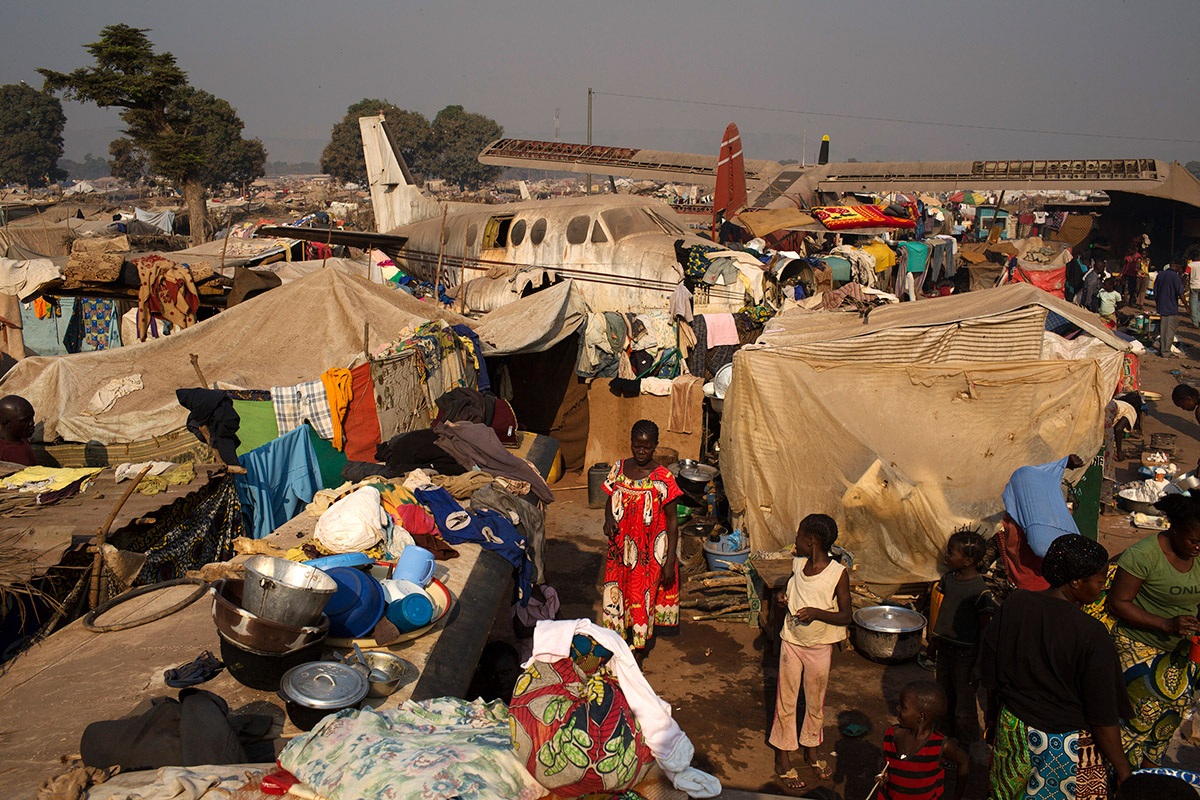
People shelter around a derelict plane at a temporary camp for internally displaced persons at the airport in Bangui, Central African Republic (Photo: Reuters)
A new international criminal tribunal is born. Following pressure from international human rights groups and the United Nations, the Central African Republic (CAR) has established a hybrid tribunal with the aim of prosecuting atrocities committed by Séléka and anti-Balaka forces during the country’s latest spate of political violence. As readers will know, the International Criminal Court (ICC) is already investigating crimes in CAR. But if the Special Criminal Court (SCC) of CAR emerges as something more than a stillborn institution or paper tiger, it could set new precedents for shared responsibility between domestic and international institutions in prosecuting international crimes.
When the ICC became a reality in 2002, there was a widespread sense that the institution would be a court to end all courts. Proponents were convinced that the ICC was the solution to what had been, until then, piecemeal international criminal justice. With a permanent ICC, there would be no need for ad hoc tribunals. Whatever ad hoc or hybrid tribunals would otherwise investigate would now be handled by the ICC.
In recent years, however, the idea of the ICC being the only game in town has slowly withered. Where the prospects of ICC interventions are slim, members of the international community have instead called for the creation of ad hoc or hybrid tribunals. This has been the case in Syria and, more recently, South Sudan.
The potential hybrid tribunal in the CAR, however, is an altogether different beast insofar as it represents an attempt to complement an ICC intervention rather than present an alternative to the Court.
A number of the SCC’s features have now been clarified. In line with being a hybrid tribunal, key positions at the SCC will be divided amongst domestic and international actors. The court will have twenty-seven judges: 14 from the CAR and 13 from abroad. It will have an international “special prosecutor”, but its chief judge will come be a citizen of CAR. Its jurisdictional reach will extend to all war crimes and crimes against humanity committed on the territory of the Central African Republic since 2003. Crucially, it will not compete with the ICC for cases. Senior officials in CAR have consistently reiterated they will cooperate with the ICC. Those perpetrators from both the anti-Balaka and Séléka forces deemed to be “most responsible” and who are eventually indicted by the ICC will be sent to The Hague.
Of course, important and unresolved questions remain. First, early versions of the law that created the Special Criminal Court included provisions which would prohibit the granting of immunities, presumably via government-issued amnesties. However, these provisions are no longer present, suggesting that the government may offer immunity from prosecution in certain cases. What remains unclear is whether and why Bangui is planning on bartering accountability for peace with some anti-Balaka or Séléka fighters. Moreover, under what conditions will the CAR grant amnesties and will such offers of immunity be conditional on, say, participation in a Truth Commission?
Second, it remains unclear exactly how the SCC will be funded and, as importantly, who will fund it. The CAR is a desperately impoverished state and international criminal justice doesn’t come cheap. It seems almost certain that the lion’s share of funding will have to come via external sources. This, however, comes with certain risks, namely leaving the tribunal susceptible to political manipulation by interested international actors which may seek to guide the tribunal’s focus by tugging on its purse strings. To avoid this fate, international funding must be transparent and should go through the United Nations rather than directly from states. Continue reading






 Justice in Conflict