
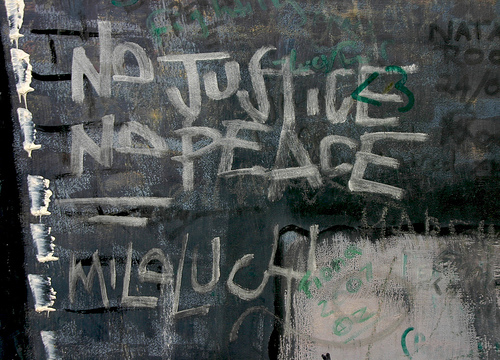
(Photo: Still Burning)
Fatou Bensouda, Chief Prosecutor of the International Criminal Court (ICC), recently issued a ‘state of the union’ address from the ICC on the “peace versus justice” debate. The intervention, penned as a New York Times op-ed entitled ‘International Justice and Diplomacy’ introduced Bensouda’s voice into a timely debate that isn’t going away any time soon.
To readers of JiC, the “peace versus justice” debate is old-hat. On the one hand, there are those who believe that peace (in the form of stability and order) must precede and take priority over the pursuit of justice and accountability; otherwise, justice risks undermining efforts to resolve conflict peacefully. On the other, there are those who argue that peace and justice must be pursued simultaneously; there is “no peace without justice” they argue. Of course, this is an over-simplified version of a debate that is multi-layered and more sophisticated than this harsh dichotomy suggests. Nevertheless, it is important to note that it is a debate that is indelibly linked to the ICC’s work. The reason is simple: as a permanent institution, the ICC intervenes in ongoing and active conflicts where attempts to establish and maintain peace may be vulnerable to the demands of international criminal justice.
So what did Bensouda have to say about the ‘peace versus justice’ debate?
You Do Peace, We’ll Do Justice
To begin, Bensouda notes that the pursuit of justice and the pursuit of peace should be separate:
“As the I.C.C. is an independent and judicial institution, it cannot take into consideration the interests of peace, which is the mandate of other institutions, such as the United Nations Security Council.”
This is a long-standing position in the Office of the Prosecutor. In a 2007 policy paper, Bensouda’s Predecessor, Luis Moreno-Ocampo similarly argued that the interests of international justice and the interests of international peace were separate. The former, he maintained, was the prerogative of the ICC, the latter of “other institutions”, including the UN Security Council.
On the surface, this is a reasonable division of labour. Indeed, the indepedence of the ICC from the politics of institutions like the UN Security Council is vital the Court’s legitimacy. However, it is questionable whether proponents of international criminal justice actually believe in the division of the interests of peace and those of justice. Echoing sentiments commonly voiced in international justice circles, Bensouda goes on to claim that
“The debate about peace versus justice or peace over justice is a patently false choice. Peace and justice are two sides of the same coin. The road to peace should be seen as running via justice, and thus peace and justice can be pursued simultaneously.”
Therein lies the rub. If peace and justice are “two sides of the same coin” and peace can only be achieved through the pursuit of justice, then it cannot be argued that the interests of peace and the interests of justice are separable. You can’t have it both ways.
This latter position is closer to what many ICC proponents believe; the pursuits of peace and justice should be combined rather than separated. Indeed, this helps explain why human rights advocates celebrate rather than critique the increasingly close relationship between the ICC and the penultimate guardian of international peace, the UN Security Council – however problematic that may be.
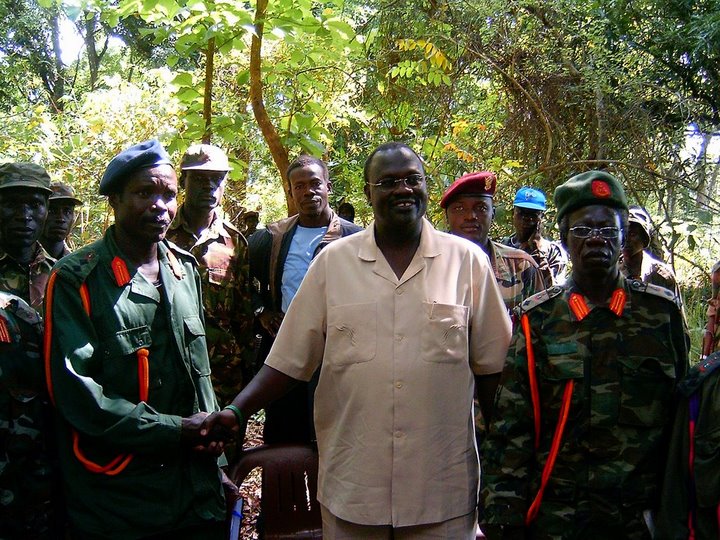
Joseph Kony (left) and his former second in command Vincent Otti (right), stand with Dr. Riek Machar, chief mediator of the Juba Peace Talks
But We Can Do Good
Bensouda subsequently argues that, while the ICC should take a hands-off approach to questions of conflict resolution and peacemaking, the Court nevertheless can have – and has had – positive effects on peace negotiations. As she writes:
“justice can have a positive impact on peace and security…
…if anything, the “shadow of the Court” has helped to isolate individuals wanted by the I.C.C., or to kick-start negotiations. Continue reading






 Justice in Conflict