
Andrea Russell joins JiC for this fascinating guest-post on the potential implications of the ICC’s intervention on Kenya’s upcoming Presidential elections. Andrea teaches International Criminal Law at the University of Toronto Faculty of Law, where she also serves as Executive Director of the Office of the Dean.
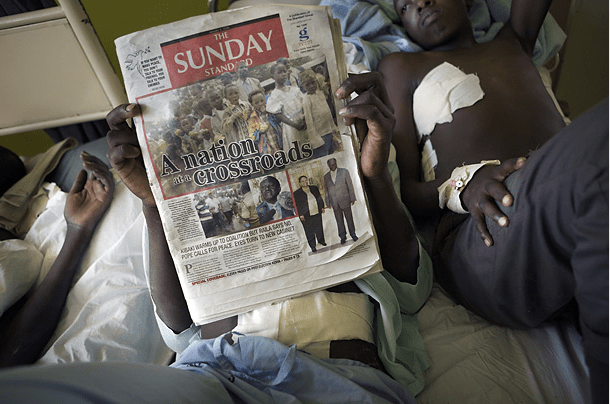
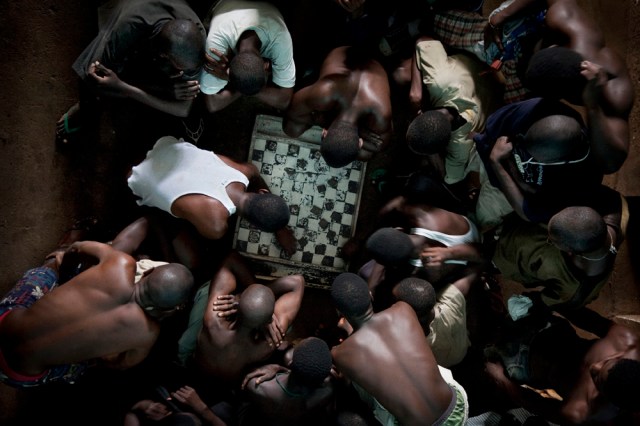
(Victims of the 2007 post-election violence. Photo: Jonas Bendiksen)
For many, Kenya’s reputation as one of sub-Saharan Africa’s more stable nations was shattered by the post-election violence of five years ago. However, the horrifying atrocities that followed the general election of 2007 did not shock many long-time observers of Kenya’s political system who knew that similar violence, albeit on a less dramatic scale, has followed or preceded every general election since Kenyan multi-party elections began.
The introduction of a new catalyst in Kenya’s current general election campaign—the International Criminal Court (ICC) — nonetheless presents the welcome possibility of a clean break in the cycles of election violence in that country.
Upon the ICC’s creation in 1998, one of the Court’s more controversial features was the Prosecutor’s proprio motu powers enabling him, with the approval of the ICC’s Pre-Trial Chamber, to launch investigations in any Rome Statute member state upon his own volition. Having examined evidence that indicated systematic organization of the violence that plagued the 2007 Kenyan elections, the Court’s Prosecutor launched just such an investigation. Luis Moreno-Ocampo ultimately charged six individuals (the “Ocampo Six”), claiming they were responsible for organizing the ferocious violence which killed over 1,100 and led to the displacement of over 660,000 Kenyans. The charges against four of these individuals, confirmed by the Court early this year in two separate cases within the Kenya Situation, make for frightening reading.
In one of the two Kenya cases, Uhuru Kenyatta, son of the country’s first post-independence leader and current Deputy Prime Minister, together with then Head of the Public Service and Secretary to the Cabinet Francis Muthaura, are charged with using a Mafia and cult-like organization, the Mungiki, as well as the Kenyan police forces, to carry out murder, forced expulsion, and even forced circumcision of alleged supporters of their political rivals.
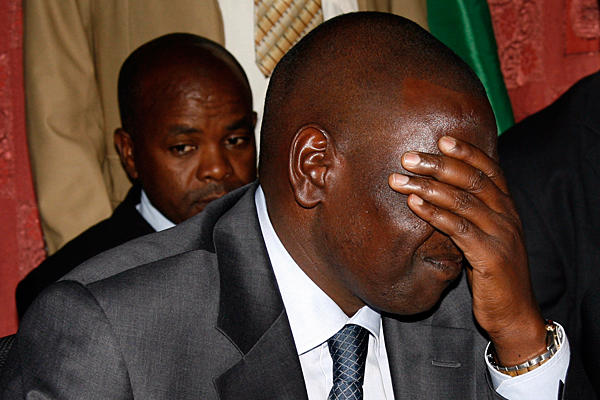
William Ruto during a press conference in December 2010 (Photo: Reuters)
In the second case, Mr. Kenyatta’s former political rival, the former Minister of Higher Education of the country and current MP William Ruto is charged with similarly organizing a network of paid killers to murder and expel supporters of opposing parties, going so far as to recruit a well-known radio broadcaster, now his co-defendant, to fan the flames of violence on air. Their alleged goal was to create a unified voting block that would support their Orange Democratic Movement party.
Shockingly, not only are both Kenyatta and Ruto running for re-election in 2013, but the two former sworn rivals declared on December 4th that they have formed a new political alliance, raising the possibility that both the Presidential candidate and his running mate from the newly-formed Jubilee Alliance may be indicted international criminals. And in a rather astounding confluence of events, their respective trials are set to begin on April 10 and 11, 2013, mere weeks following the first election date in March, with April 11 being the very day scheduled for any required second round electoral run-off. Continue reading



 Justice in Conflict