
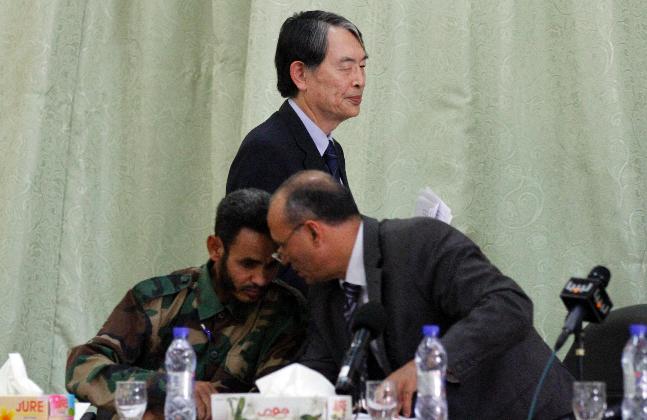
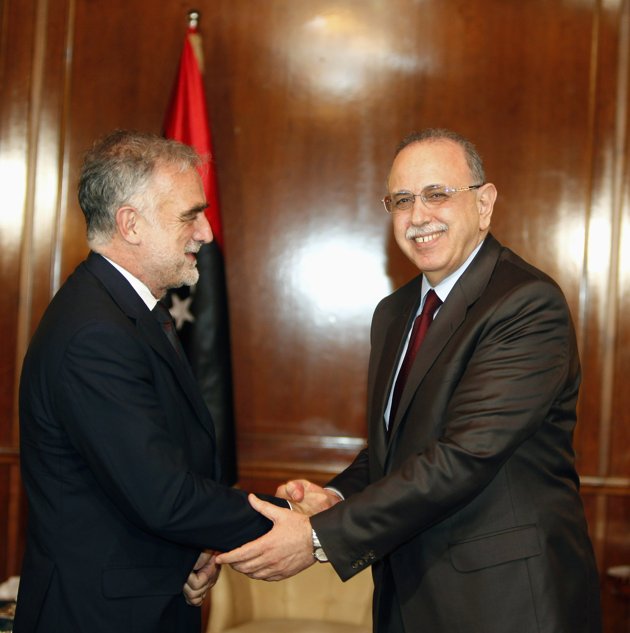
ICC President Song, Zintani Brigade commander Ajmi Ateri and Libya’s Deputy Foreign Minister Mohammed Abdel Aziz shortly before the release of the ICC’s staff in Zintan (Photo: Anis Mili / Reuters)
It is a huge relief to be able to write that Melinda Taylor, Helene Assaf, Alexander Khodakov, and Esteban Peralta Losilla were released from Libya on Monday and have returned to be reunited with their families. The four had spent nearly a month in Zintan after being detained following a meeting with Saif al-Islam Gaddafi. Their detention and its consequences have been a focal point of JiC over the past few weeks (see here, here, here, here, here and here – phew!)
While it is likely to be some time before any of the ICC staff members openly discuss their experiences – and rightfully so – there are a number of pressing questions that need to be answered in the coming weeks. Here are five.
1. What led the Zintani and Libyan authorities to agree to Taylor et al’s release?
There were many rounds of negotiations between Libya and the ICC. Assuredly, there were likely as many rounds between Libyan authorities and Zintani militia leaders. But it remains unclear what finally tipped negotiations in favour of releasing the ICC staff?
I, for one, am unconvinced that it was the initial statement of regret or apology from the ICC. Libyan authorities were quick to say that the apology would not result in Taylor’s release, that the statement wasn’t enough.
But the reasons given by Libya for Taylor’s release are contradictory. Libya’s representative to the ICC, Ahmed al-Jehani, maintained that it was because Taylor had diplomatic immunity (see also here). The country’s Prosecutor General, however, declared that Taylor would face a court hearing in Libya in late July but that an in absentia hearing could also take place. These two statements can’t be reconciled unless each is playing to a different constituency – which they likely are. This brings us to question two.
2. Who got and gave what?
A rather large group of actors have vested interests in this saga. Let’s consider the Zintani militia, Libya’s interim government, the ICC and the detained ICC staff themselves. Each played a part in the eventual release of Taylor et al. But, by and large, it remains unclear what was required of and demanded by each party.
For the Zintanis, it is clear that getting a direct apology from the ICC was part of the deal – and they got it. ICC President Song explicitly used the word “apologize” in an address in Zintan prior to Taylor’s release. But did the Zintani militia get anything else? Remember, they have leveraged their custody of Saif for political gain before. Moreover, there have recently been indications that Libya’s interim Defense Minister Osama Juwaili, who is from Zintan and whose appointment was linked to Zintan’s custody of Saif, was recently livid about his treatment and role. It would not surprise me if improvements in his position were linked into negotiations between Libyan authorities and the Zintani brigade over the ICC staff.
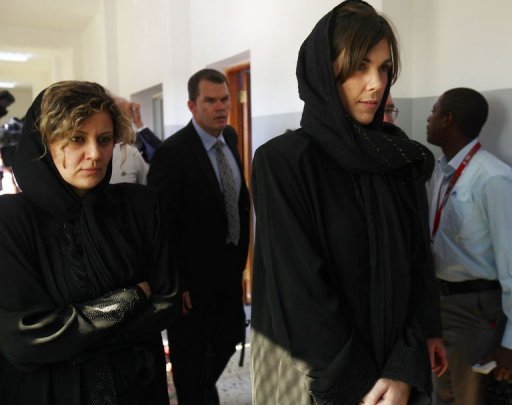
Melinda Taylor (right) and Helene Assaf in Zintan shortly after being released (Photo: AFP)
It is a distinct possibility that Libyan authorities simply wanted this debacle to end. The country’s first-ever free and democratic elections are due to take place within days and having ICC staff members in detention is a distraction any emerging democracy would want to avoid. Nevertheless, the apology and statement of regret from the ICC was surely spurred by Libyan authorities as well. They have consistently voiced disappointment and sought to counter international perceptions of the country as lawless and unstable. Having the Court reaffirm that Libya is a legitimate and lawful government with legitimate grievances fits into these efforts.
The ICC never seemed to have much leverage in this case. Moreover, the Court was largely left hung out to dry by the international community. Statements by the UN Security Council had the political weight of a feather and it appears the Council actually did nothing else to press Libya. Of course, this is unsurprising. The Security Council has generally been disinterested in the ICC’s mandate in Libya (see here and here). The one area of leverage the Court had was with issuing their statement of regret. Over at Opinio Juris, Kevin Jon Heller has opined about the potential consequences of the Court taking the blame for their staff’s predicament. Indeed, the potential consequences seem grim. But with barely a modicum of international support and having been put on the spot by Australian Foreign Minister Bob Carr, I’m not sure the Court had any choice but to issue an apology. Importantly, however, al-Jehani’s statement that Taylor had diplomatic immunity may have been a small victory for, and perhaps even demanded by, the Court. Continue reading




 Justice in Conflict