The UN Security Council and the ICC: Between a Rock and a Hard Place

UN Security Council referral of Libya to the ICC

What are the costs of the UN Security Council referring situations to the ICC?

What are the implications of the UN Security Council referring situations to the International Criminal Court? Judging by most accounts of UN Security Council referrals of the situations in both Darfur and recently Libya to the ICC, referrals are a cause for celebration. This post suggests that contrary to this view of referrals as fundamentally good, they may be the best option but one with high costs for international criminal justice.

Previous posts have considered some of the problems of referrals including the inclusion of certain provisions – the immunity of individuals from non-member states, the limits set by the Security Council on the temporal jurisdiction, the possible “outsourcing” of peace by the Security Council to the ICC, etc. But what about the costs of referrals on the quality and legitimacy of international criminal justice?

It bears remembering that, during the Rome negotiations to establish the ICC in 1998, the most fervent state and civil society advocates in favour of creating the Court sought to ensure that the ICC would be independent from the power-politics of the UN Security Council. A compromise was reached which gave the Court’s Prosecutor three avenues of initiating an investigation: by state referral, proprio motu (through the Prosecutor’s own volition) and by UN Security Council referral.

For some, this was no doubt a costly compromise. The most keen states and human rights organizations argued that a separation of politics and justice was necessary if pursuing justice was to be legitimate and that tethering the justice of the Court to the politics of the Council would politicize the ICC.

In a recent post at Radio Netherlands Worldwide, Geraldine Coughlan noted that:

“The so-called Trias Politica – the separation of power between politicians and the judiciary – is more absent than present in international criminal law.”

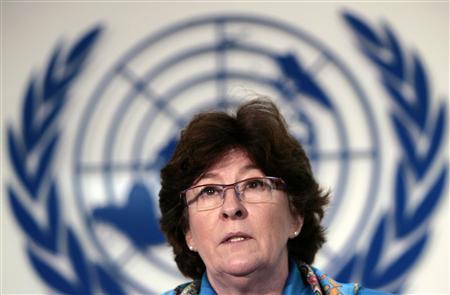
Justice Louise Arbour

Louise Arbour recently noted that UN Security Council referrals to the ICC may not be in the interests of justice (Photo: Andrew Winning/Reuters)

In a recent speech in London, Louise Arbour, the former chief Prosecutor for the ICTY and the ICTR, similarly acknowledged:

“…international criminal justice cannot be sheltered from political considerations when they are administered by the quintessential political body: the Security Council. I have long advocated a separation of the justice and political agendas, and would prefer to see an ICC that had no connection to the Security Council. But this is neither the case nor the trend.”

Continue reading

Posted in International Criminal Court (ICC), Libya, Libya and the ICC, Sudan, Transitional Justice, UN Security Council | 5 Comments

The Justice and Legality of bin Laden’s Assassination: Is What is Legal Necessarily Just?

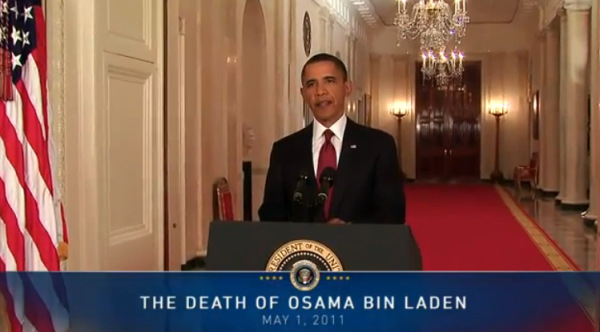
Obama on Osama

Ever since President Obama said that "justice had been done" and Osama bin Laden had been killed, a debate about the legality and justice of bin Laden's death has raged

The debate rages on: was the assassination of bin Laden the right thing to do? What is it the legal thing to do? Was it “justice”?

In my assessment, the vast majority of the debate regarding the assassination of bin Laden has focused on its legality, whether his killing was legal under International Human Rights Law, International Humanitarian Law, US domestic law, and whether or not the US impinged on Pakistan’s sovereign territory.

The questions surrounding the lawfulness are critical, especially as the US administration backpedals their earlier statements sequence of events that led to bin Laden’s death. However, it is important to remember that what is legal not necessarily equals what is just. Justice requires more than law. It requires that acts are morally and ethically justifiable.

It would be a fair and persuasive argument that the most remarkable trend of the last century has been the legalization of international politics. The legalization of international relations began with the liberal internationalists and was propelled onto the political scene following WWI, with the leadership of US President Woodrow Wilson. Wilson envisioned the replacement of “entangling alliances, secret diplomacy, and attempts to maintain balances of power,” with “open diplomacy, democratically controlled and a concert of power instead of rival balances of power.” That concert was the League of Nations, in Wilson’s words, “the most essential part of the [post-WWI] peace settlement itself.” The League would be the penultimate institution which would guarantee the primacy of international rule of law: “What we seek is the reign of law, based upon the consent of the governed and sustained by the organized opinion of mankind.”

Was the assassination of Osama bin Laden just? Was it legal?

Since Wilson, virtually all major developments in international relations have had links to international law: the United Nations, which is considered, by many, to be the ultimate institution responsible for guaranteeing the law of states and peoples; the human rights regime which would be impotent without legal grounding; the legal arbitration of the World Trade Organization; the evolution of international criminal law, culminating with the permanent international criminal court; and, most recently, the criminalization of aggression.

The result has been that our views of what is just is increasingly conflated with what is legal. The very purpose of legalizing international politics is to establish a universal and codified consensus about what justice and morality is, represented within the strictures of international law.

There are numerous problems with this, not the least of which is the reality that different streams of international law may have different interpretations of the legality of any particular act. Of course, it also assumes that reaching the codified consensus is possible and a fundamentally good thing. More broadly, the conflation of justice with law may obscure important questions about the nature of particular acts. The bin Laden assassination is a perfect example.

As it stands, the question of the legality of the US’s killing of bin Laden seems destined to live within the grey zones of law. Some will argue it was absolutely legal, others that it was not. Still others, will argue that regardless of its legality, bin Laden should have been tried. But what about whether it was just?

There are five possible positions regarding the killing of bin Laden:

Woodrow Wilson was an early advocate of regulating international relations through international law

1) It was both legal and just: either killing bin Laden was a legal action and because it was legal it must be just, or it was a legal action and also happens to have been a just action, relying on the moral calculus that killing some people is ethically sound. Either way, this seems to be the implicit belief of observers who have written that bin Laden’s assassination was legally permissible.

Continue reading

Posted in Justice, Osama bin Laden, Osama bin Laden and international law | 1 Comment

Bin Laden and International Law: Death or Trial?

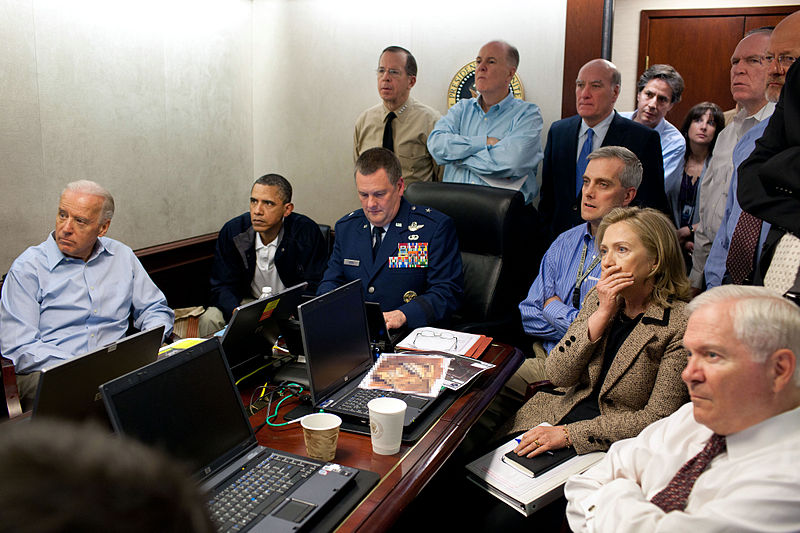
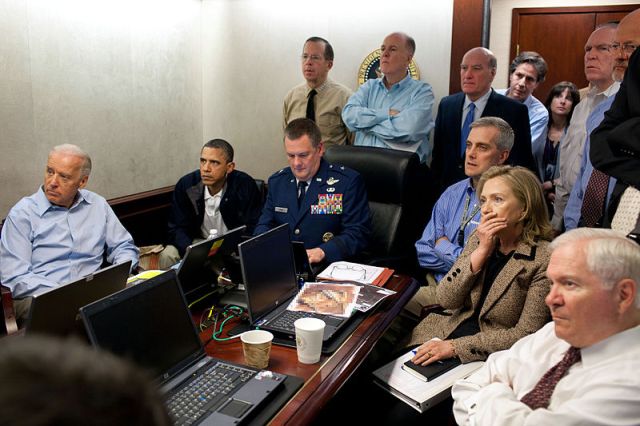
US officials including President Obama, VP Joe Biden, Secretary of State Hilary Clinton and Secretary of Defense Robert Gates watch as the bin Laden mission unfolds. The mission was to kill bin Laden, not to capture him.

A debate regarding the legality of killing Osama bin Laden is raging across the internet. Everyone wants to know: was the assassination of bin Laden in accordance with international law? Yesterday, I weighed in on the broader question of whether it was in fact an act of “justice” to kill bin Laden.

It strikes me that if assassinating bin Laden was, in fact, illegal (note there is no consensus on this question), then the prescription that follows would be that the US should have captured, detained and subsequently tried bin Laden for violations of international law.

Lindsay Beyerstein sums up the views of those uncomfortable with the assassination who would have prefered that bin Laden had been brought to trial:

I see his killing as a lost opportunity to capture and try him…Americans have just decided that it’s okay to kill suspects without trial if it seems obvious enough that they’re guilty of terrorism.

This post is an attempt to think through the kinds of issues that a trial of bin Laden would encounter. While there is no doubt an argument that putting bin Laden on trial would better serve the interests of justice than his assassination, it is not entirely clear just how “just” such a trial would be. Human rights expert, Joe Hoover, for example, commented that there is a need to be skeptical about what trials of this nature can offer:

“trials, especially international ones, are political acts and the desire to legalise the act of holding to account, of delivering justice, is hardly innocent or unproblematic.”

In what ways would a trial be problematic? I suggest four major challenges that a trial of bin Laden would have had: its fundamentally political (rather than impartial, judicial) nature, the question of where his trial would have taken place, which crimes would have been adjudicated, and, more practically, the cost of trying him. In the end, the debate about justice that has been instigated by bin Laden’s death is critically important for how we conceive of justice and the legitimacy and appropriateness of future action against individuals like bin Laden.

Politics of Law

Would bin Laden have received a fair trial? If justice was to be served and achieved by a trial, impartiality would have been absolutely necessary.

Greg Barns, a former Australian MP, writes that, if the leader of al-Qaeda had been put in front of a tribunal,

“Bin Laden could then have been tried according to law and given all the resources that every human being is entitled to in defending themselves against criminal charges.”

It isn’t entirely clear, however, that bin Laden would have been given all those resources. For example, individuals being prosecuted are granted the benefit of the doubt: they are assumed innocent until proven guilty. I don’t think it is controversial to maintain that bin Laden would have undoubtedly been presumed guilty. In 2001, when the Taliban offered to hand over bin Laden to a third country for trial, President Bush replied:

“When I said no negotiations I meant no negotiations…We know he’s guilty. Turn him over. There’s no need to discuss innocence or guilt.”

While bin Laden’s responsibility in terrorist attacks is clear, even by bin Laden’s own admission, with regards to the standards of international criminal law, he would have had to be presumed innocent nonetheless.
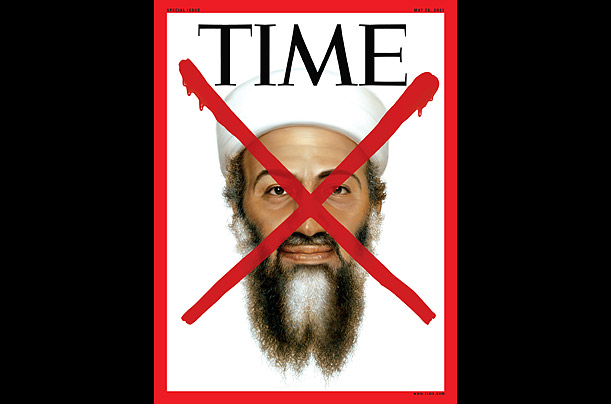
Time magazine cover bin laden

The upcoming cover of Time Magazine

There would also have been the risk that bin Laden’s trial might have become a show trial, intended to illustrate the moral superiority of America rather than guarantee an even-handed, fair judicial prosecution. It is entirely possible, given the precedence of past high-profile cases, that bin Laden himself would have used a trial as a pulpit to spread propaganda.

In this context, it’s not obvious that bin Laden would have received a fair defense. Would the US be have been willing to hand over evidence against him as well as the names of witnesses who would have testified against him? If the trial were to be fair, they would have had to.

One problem that bin Laden may not have had is with finding legal representation. While some have suggested that bin Laden would have had a difficult time finding representation, this seems very unlikely. There is no shortage of lawyers who would dream to make their career defending individuals like bin Laden. A lawyer like Jacques Verges would seem a logical candidate. Dubbed the “Devil’s Advocate”, Verges has represented the likes of Slobodan Milosevic, Carlos the Jackal and Klaus Barbie.

Where would he have been tried?

Yesterday, Jan Triska commented that:

“the…big unspoken issue here, as well: whether bin Laden or even one of his lieutenants could have ever received a fair trial, anywhere”

Triska is right to point out that it remains unclear where bin Laden would have been tried. The initial presumption may have been that bin Laden would be tried in the US. If bin Laden had, however, been brought to Guantanamo first, a very possible scenario, he would be unable to be tried in the US, as Congress has virtually barred any Gitmo detainees from having trials on US soil.

Even if he had not been transferred to Gitmo, there has been little to suggest an appetite for a trial of bin Laden in the US. Last year, Eric Holder Jr., the US Attorney General, declared that bin Laden:

“will never appear in an American courtroom…Let’s deal with the reality here. The reality is, we will be reading Miranda rights to a corpse.”

It also seems unlikely that bin Laden could have been tried at the ICC. The ICC does not have jurisdiction over the events of 9/11 as they occurred prior to the Court’s creation in 2002. It also does not have jurisdiction of bin Laden’s prior terrorist attacks.

Continue reading

Posted in Afghanistan, International Criminal Court (ICC), Iraq, Osama bin Laden and international law, Terrorism, United States | 6 Comments

The “Justice” of Killing bin Laden and What it Means for Gaddafi

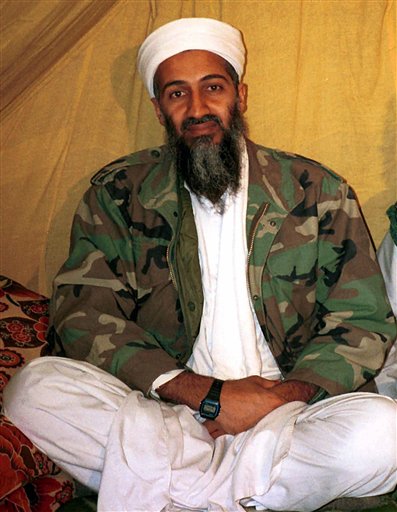
bin laden dead

Last night, US President Obama announced that a US special mission had killed Osama bin Laden. Many had described bin Laden's death as "justice" (Photo: AP)

Last night, President Barack Obama announced to eager audiences around the world that America’s most wanted man, Osama bin Laden, had been assassinated. Obama described bin Laden’s death by declaring that “justice has been done.” People around the globe are echoing this sentiment – that bin Laden’s death amounts to “justice”.

Looking at my twitter feed and facebook page, dozens of people are  invoking the same notion of justice in bin Laden’s death. Leaders and former leaders around the world have also expressed their views:

George W Bush: “The fight against terror goes on, but tonight America has sent an unmistakable message: No matter how long it takes, justice will be done.”

Tony Blair: “The operation shows those who commit acts of terror against the innocent will be brought to justice, however long it takes”

Canadian PM Stephen Harper “death of Osama bin Laden…secures a measure of justice.”

Kenyan President Mwai Kibaki: The killing of Osama Bin Laden is an “act of justice” for the victims of the 1998 bombings at the US embassy

Executive director of the 9/11 Commission, Philip Zelikkow: “We take a great deal of satisfaction in the news that Bin Laden has been brought to justice.”

Former US Vice President Dick Cheney: “bin Laden has been brought to justice…Today, the message our forces have sent is clear — if you attack the United States, we will find you and bring you to justice.”

Blair and Bush

Both former Bush and Blair called the death of bin Laden "justice" (Photo: PA)

But is bin Laden’s death really “justice”? Can killing someone ever be justice? If so, what type of justice is it? If it is just to assassinate bin Laden, who will surely go down as one of history’s most brutal antagonists, shouldn’t that mean that killing Gaddafi amounts to “justice” as well?

First, it is important to note that the legality of assassinating bin Laden rests on shaky grounds, at best. The US justifies killing members of al Qaeda by virtue of being at “war” with terrorism and thus considering al Qaeda operatives as “enemy combatants”. Nevertheless, the legality of targeting individuals with extra-judicial assassinations under international law is precarious. The US has recognized this fact in the past.

Of course, this is not to say that justice equates with what is legal or that what is legal equals what is moral. In 1964, Judith Shklar, warned us of the dangers of legalism, conflating morality with law which risked neglecting or obscuring context.

The instinct of those celebrating bin Laden’s death is that some things, or better some people, are so exceptionally bad that they make law irrelevant. The legality of killing bin Laden doesn’t really matter, it is the “right thing to do” and therefore constitutes “justice”.

Justice is more complicated than it is simple. Justice may be retributive, restorative, distributive, or procedural. For some, justice is primarily moral, for others it is legal, and for others still it is emotional. For many it is all of the above and there may be no difference between the moral, legal and emotional arguments for what is just.

Photo: Reuters/Chip East

If the “justice” of bin Laden’s death cannot be supported by international law, what kind of justice is it? What people appear to be invoking is a sense of physical, non-legal retributive justice: the killing of bin Laden is his due punishment. The extermination of his life avenges the lives he extinguished. And it must be reiterated, that this was always about killing bin Laden. The US special operations mission was to kill bin Laden, not to capture him.

Continue reading

Posted in Afghanistan, International Criminal Court (ICC), Libya, Libya and the ICC, Middle East, Osama bin Laden, Pakistan, Terrorism | 11 Comments

No Joke: States Praised Libya’s Human Rights Record in 2010 UN Report

Universal Periodic Review

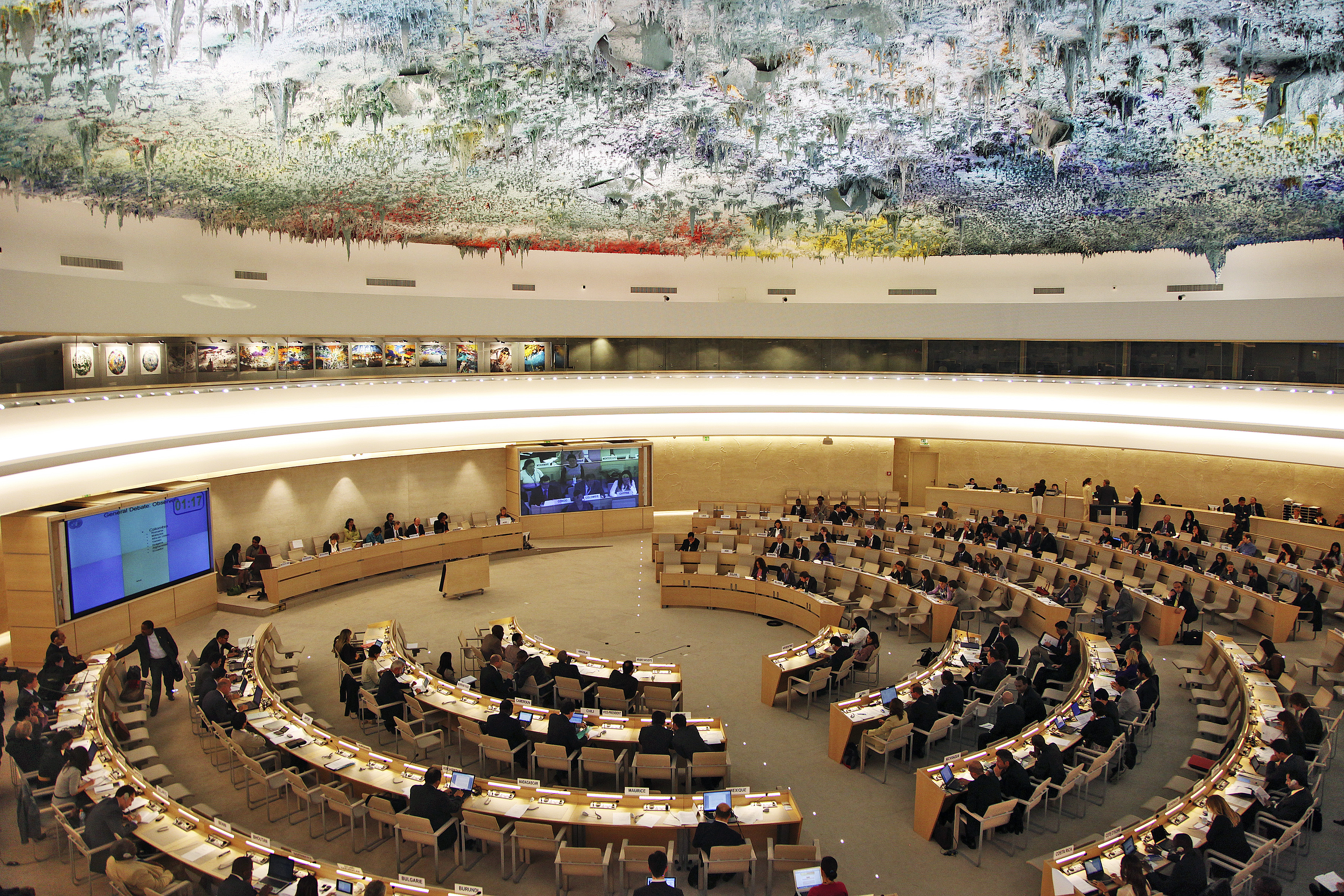
In November, 2010, Libya was the topic of the UN Human Rights Council's Universal Periodic Review

Last night, I attended a lecture by Louise Arbour, the former Chief Prosecutor at the ICTY and ICTR, former UN High Commissioner for Human Rights, and former Supreme Court Justice in Canada. Arbour reminded the audience of something that piqued my interest: In November 2010, just a few scant months before Libya dissolved into chaos, the UN Human Rights Commission’s Universal Periodic Review looked into the state of human rights in Libya. Considering the violence and human rights abuses in Libya since February, the Council’s findings and the opinions of states responding to the Review’s findings are astonishing.

I have had the chance to go through the Report and highlight some of the most interesting findings, declarations by the Libyan declaration regarding its human rights records, and the responses of states below. Note that this is not an exhaustive list and that the sections below were taken directly from the UNHRC’s Report.

What becomes readily apparent is the extent to which no states believed that a spiral of brutal repression in Libya was on the horizon. This is not to apportion blame on them for not predicting the upheavals in the Arab world. Few, if any, observers predicted the extent and reach of the ‘Arab Spring’, much less the brutality with which democratic movements would be met.

Yet it remains remarkable that, with the exception of a handful of states, virtually all participating nations, democratic and autocratic, expressed some level of praise for human rights standards and improvements in Libya. It is worthwhile asking whether the encouragement expressed by Western states, in particular, with regards to Libya’s human rights standards was part of a broader strategy of engaging with Libya and recognizing Gaddafi’s regime as legitimate.

Libya’s Presentation to the Council:

The Libyan Arab Jamahiriya believed that the promotion and protection of human rights was one of the most important factors for the progress and development of the people…

The Libyan Arab Jamahiriya was party to most human rights treaties and the protocols thereto, and those instruments took precedence over national laws and could be directly applied by the courts once they had been ratified…

The delegation noted that all rights and freedoms were contained in a coherent, consolidated legal framework. The legal guarantees formed the basis for protection of the basic rights of the people. Further, abuses that might occur were dealt with by the judiciary, and the perpetrators were brought before justice. The judiciary safeguarded the rights of individuals and was assisted by other entities, most importantly the Office of the Public Prosecutor…

Protection of human rights was guaranteed in the Libyan Arab Jamahiriya; this included not only political rights, but also economic, social and cultural rights. The Libyan Arab Jamahiriya referred to its pioneering experience in the field of wealth distribution and labour rights…

The delegation indicated that women were highly regarded in the Libyan Arab Jamahiriya, and their rights were guaranteed by all laws and legislation. Discriminatory laws had been revoked…

The Libyan Arab Jamahiriya believed that human rights education was a duty that should be fulfilled in the school system and the family system and by relevant civil society organizations…

The Libyan Arab Jamahiriya noted that laws safeguarded freedom of expression through principles enshrined in the Great Green Document. Article 5 promoted the right of expression of every person.

rebels in Libya

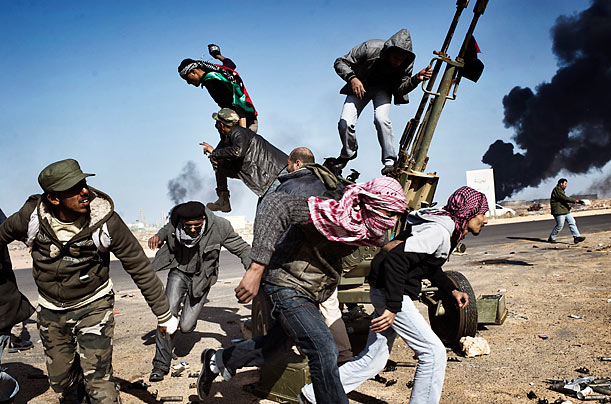
It remarkable to think now, with fighting ongoing in Libya, that states, both democratic and autocratic expressed praise for Libyan human rights standards (Photo: Yuri Kozyrev)

State Responses

Qatar praised the legal framework for the protection of human rights and freedoms, including, inter alia, its criminal code and criminal procedure law, which provided legal guarantees for the implementation of those rights.

The Syrian Arab Republic praised the Libyan Arab Jamahiriya for its serious commitment to and interaction with the Human Rights Council and its mechanisms. It commended the country for its democratic regime based on promoting the people’s authority through the holding of public conferences, which enhanced development and respect for human rights, while respecting cultural and religions traditions.

The Democratic People’s Republic of Korea praised the Libyan Arab Jamahiriya for its achievements in the protection of human rights, especially in the field of economic and social rights, including income augmentation, social care, a free education system, increased delivery of health-care services, care for people with disabilities, and efforts to empower women.

Egypt commended the Libyan Arab Jamahiriya for progress in building a comprehensive national human rights framework of institutions and in drafting legislation and supporting its human resources in that area.

Continue reading

Posted in Human Rights, Libya, Universal Periodic Review (UPR) | 6 Comments

France and Italy Call for Closed EU Border: An Abrogration of Moral Responsibility

Tunisian refugees

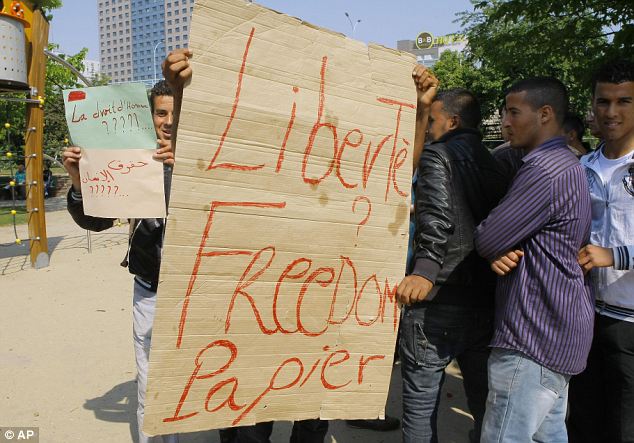
Thousands of migrants from North Africa have fled to Europe following the ‘Arab Spring’. Tunisian migrants in Paris (Photo: AP)

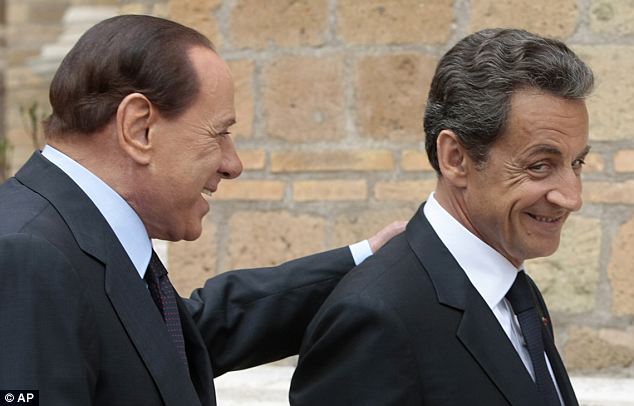
Readers of Justice in Conflict will know that the posts rarely, if ever, step out of the bounds of issues concerning transitional justice and conflict resolution. Sometimes, however, issues that aren’t directly related to either are so morally outrageous that they spur my eager fingers to type. The joint announcement by French President Nicolas Sarkozy and embattled Italian Prime Minister, Silvio Berlusconi that the EU’s borders should be closed because of the “emergency” in the Arab world is one of those issues. My apologies if some of what follows sounds exasperated and overly polemical.

From The Guardian:

“France and Italy have thrown down the gauntlet over Europe’s system of passport-free travel, saying a crisis of immigration sparked by the Arab spring was calling into question the borderless regime enjoyed by more than 400 million people in 25 countries.

Challenging one of the biggest achievements of European integration of recent decades, Nicolas Sarkozy and Silvio Berlusconi also launched a joint effort to stem immigration and demanded European deportation pacts with the countries of revolutionary north Africa to send new arrivals packing.”

According to reports, some 25,000 migrants have arrived in Italy since the beginning of the so-called ‘Arab Spring’. France and Italy have recently been feuding over the fate of the migrants, with French officials fuming over the issuance of visas in Italy to migrants, thus allowing them to travel freely within most of the EU. France responded by issuing border controls and stopping trains carrying Tunisian migrants. This week, they agreed on a joint policy to pressure the EU to severely restrict immigration into the Schengen area. It is up to the EU Commission and other EU nations to prevent this abrogation of responsibility from going forward.

Berlusconi and Sarkozy maintain that unless the borders are closed and some of the refugees and asylum-seekers who have managed to make it into the EU are deported, the seismic changes in the Arab world “could swiftly become an out-and-out crisis capable of undermining the trust our fellow citizens place in the free circulation within the Schengen area.” Sarkozy added that “For the treaty to stay alive, it must be reformed.” Both leaders want the exodus of North African refugees to Europe to be labelled an “emergency”.

France and Italy are telling Europeans that unless the EU turns its back on displaced peoples seeking refuge in Europe, the Schengen Area, which allows free and unrestricted travel among participating states, would be at risk. It is fear-mongering at its worst.

Tunisia France

France and Italy are pushing to close EU borders due to what they view as an “emergency” of fleeing North African migrants (Photo: AP)

Sarkozy and Berlusconi are seeking to label the arrival of thousands of north African citizens to Europe as an “emergency”, implying that in the right to asylum and free movement should be frozen. As such, it carries uncomfortable shades of the nationalist fervour of some of the most brutal, autocratic regimes in modern history where the rights of citizens were quashed in the name of “emergency”.

This is not a question of defending Schengen. It is a question of fairness, responsibility and justice. The rights of asylum and free movement are being withered at the expense of two politicians pandering to populists and nationalists.

Sarkozy and Berlusconi are quite simply abrogating their moral responsibility in exchange for political currency:

Continue reading

Posted in Europe, European Union (EU), France, Immigration, Italy | 3 Comments

Syria and the International Criminal Court: Taking Justice Seriously

Syria Justice

The situation in Syria has deteriorated rapidly. Hundreds have been reported killed by Government forces

Syria has gone from bad to worse. According to reports, hundreds of peaceful, pro-democracy protesters have now been killed by authorities cracking down on any attempt to undermine the regime. This statement, or something approximating it, has probably been written and read thousands of times in the past few months as citizens across the Middle East and the Arab world have agitated against long-standing regimes in what has now been dubbed the Arab Spring.

The pattern in Egypt, Tunisia and Libya has been remarkably similar. While each, of course, are context-specific, all have experienced popular protests followed by significant levels of violence against, and repression of, citizens. All have seen subsequent calls for international criminal justice. Tunisia and Egypt have declared their intention to ratify the Rome Statute, while Libya was referred to the ICC by the UN Security Council. All of this seems to set a transformational precedence about the role of international criminal justice in the region.

This brings us to the question: should the ICC become involved in Syria? For some, it is a no-brainer.

Prof. William Harris argues that the actions of Syrian President Bashar Assad clearly constitute crimes against humanity and thus fall within the mandate of the ICC:

“It would be hard to find a clearer case of such offenses than the Syrian regime’s systematic repression of peaceful demonstrations through the past six weeks, with indiscriminate use of live ammunition against its own people on a countrywide scale.”

Barry Rubin, the director of the Global Research in International Affairs Centre adds that the Syrian regime has:

“gone to the third level…heavy repression and killing people in order to destroy the protests and intimidate people from participation.” 

Amnesty International has explicitly called on the UN Security Council to refer the situation to the ICC. Further, while no reference to the ICC was made, the International Commission of Jurists recently issued a statement imploring the UN to act in the case of Syria and that:

“Those ordering and carrying out these attacks, including those firing live rounds into crowds, must be held criminally accountable.”

It’s hard to argue with Harris’s claims that crimes against humanity have occurred after seeing the horrifically graphic video, linked at Max Boot’s blog, of what appears to be indiscriminate attacks on peaceful Syrian protesters. (I cannot stress enough that not everyone should watch the video – it is perhaps the most gruesome video I have seen to date).

Gaddafi Assad

The international community set a precedence in the past three months concerning justice and accountability

But will the international community do anything about Syria? As a number of commentators have pointed out, the international community has been eager to intervene in Libya but painfully slow to do anything more than condemn Assad for the atrocities in Syria. Adrian Blomfield of the Telegraph, for example, notes that:

“Critics complained that while the West has been comparatively quick to go to the aid of the Libyan people, Syrians struggling against one of the Middle East’s most repressive regimes had largely been abandoned to their fate.”

Regarding the ICC’s involvement, Dominic Waghorn writes:

“It took just two weeks for the International Criminal Court to begin investigating Gaddafi, his sons and commanders over allegations their security forces had attacked peaceful demonstrators.

More than six weeks into Syria’s unrest, Assad’s security forces are gunning down their own people in their hundreds and the west still has not moved beyond words of condemnation.”

So will the international community seek the involvement of the ICC? While it is increasingly evident that it should, it is not yet clear whether it will.

Syria is not a member of the ICC, and thus outside of the jurisdiction of the Court. As Tobias Hanson reminded me (see comment below), the only way for the Court to achieve jurisdiction would be for the UN Security Council to refer the situation in Syria to the ICC, à la Darfur and Libya.

It is unclear what the zest for international criminal justice is among the Security Council members. Some states expressed reservations about referring Libya to the ICC. India, Brazil, Gabon and Portugal expressed concerns regarding the sequencing of peace and justice.

At the moment, the conflict in Libya looks far from resolved. America’s most senior military officer, Mike Mullen, admitted that despite NATO efforts, Libya is “moving towards a stalemate.” Some states, for better or worse, may believe that the referral of Libya to the Court has complicated efforts to find a political resolution to the crisis.

Another issue is the question of judicial overstretch: can the ICC handle its case load? In the first eight years of its existence, the Court opened four official investigations (Uganda, the Democratic Republic of Congo, the Central African Republic and Sudan). In the April 2010, the Court opened an investigation in Kenya and this past February, the ICC added Libya to its growing list of cases. Ivory Coast seems likely to be investigated as well.

Continue reading

Posted in Egypt, International Criminal Court (ICC), Middle East, Syria, Transitional Justice, Tunisia | 6 Comments

Libya, Peace and Justice: Murky Options

(Photo: BBC)

One of the few realities of violent political conflicts across contexts is that fully “good” options are in rare supply.

In a recent post, I attempted to articulate some of the tensions surrounding the pursuit of justice in Libya, on the one hand, and the pursuit of a political settlement to the current crisis, on the other. The point was not to articulate some solution to the problems of pursuing accountability and peace simultaneously but to suggest the relationship between peace and justice is far more murky than typically presumed. Nevertheless, a few people have disagreed with my assessment, particularly the notion that a power-sharing agreement is a possibility in Libya.

Power-sharing is an option in Libya. Acknowledging the fact says nothing about whether it is an appropriate or good option, but merely the fact that it is an option. Clearly, the African Union (AU) agreed with this assessment when they proposed a peace plan for Libya. The rebels, notably, have not rejected the possibility of a power-sharing agreement but only rejected one between them and Colonel Gaddafi or any of his sons.

The choices that exist for Libya are murky. This post is an attempt to bring some clarity about the options available. Importantly, keep in mind that they are not in order of suitability or preference.

Option A: A power-sharing between Gaddafi or one of Gaddafi’s sons and the rebels.

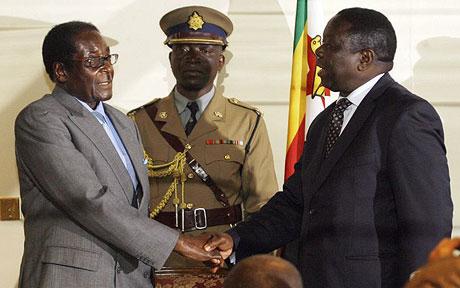
This option is very unlikely for a number of reasons. First of all, the international coalition has emphatically declared that Gaddafi cannot be part of any government and that he must face justice. The international community, would also likely have to commit to monitoring any such agreement for the forseeable future. Secondly, the rebels have already rejected a power-sharing agreement that would include any Gaddafi. Thirdly, given Gaddafi’s track record, there is little reason to trust that he would be sincere in implementing a power-sharing peace agreement rather than, for example, taking the time to re-arm. Fourthly, as Doug Saunders pointed out to me and as Christine Cheng cogently argues, a power-sharing agreement with Gaddafi risks turning Libya into another Zimbabwe:

“In Libya, any power-sharing deal will likely see Gaddafi’s supporters retain de facto control over the military and the police, while rebel leaders will be given cabinet positions with little actual influence over how the country is governed.

Zimbabwe’s experience suggests that if a leader is so desperate to cling to power that he is willing to use lethal force on opposition members, then power-sharing is unlikely to lead to true democratic reforms.

Indeed, the failure of power-sharing in Zimbabwe should not be surprising. Having led the country for 28 years, Mugabe clearly had the upper hand. Gaddafi, having ruled for nearly 42 years, wields just as much influence, if not more. Consequently, the rebels know that as soon as the international spotlight shifts away from Libya, Gaddafi will quietly re-cement control over security forces and gradually eliminate key political opponents.”

Justice Zimbabwe

There are concerns by some observers that a power-sharing agreement in Libya could result in a similar situation as in Zimbabwe (Photo: Getty Images)

Option B: Negotiate the exile/asylum of Gaddafi and family + Power-sharing between rebels and pro-Gaddafi forces

It has come to light that various actors, including the US and the AU, have been looking for states to accept Gaddafi and offer him exile or asylum. It remains unclear, however, whether Gaddafi would, in fact, accept such a deal. He has said on many occasions that he will stay in Libya until the day he dies.

Importantly, as noted above, the rebels did not reject the idea of a power-sharing agreement. When they rejected the peace plan negotiated by the AU, their response was:

“The African Union initiative does not include the departure of Gaddafi and his sons from the Libyan political scene; therefore it is outdated”

This appears to leave open the possibility of accepting a power-sharing agreement with individuals loyal to Gaddafi. However, it remains unclear what the strength of pro-Gaddafi factions are in Libya. One commentator suggests that “There is really only one side in this conflict, as far as the general population of Libya – and that is the Libyan people.”

Of course, this option is problematic in that it constitutes a violation of the principles of international criminal justice. If the International Criminal Court issues arrest warrants for Gaddafi and/or his sons, there will be expectations and widespread demands that he is detained and delivered to the Hague.

The fighting in Libya has been described as "see-sawing" (Photo: rssbroadcast.com)

Option C: Declare Gaddafi a legitimate military target.

In other words, Gaddafi could be targeted by military forces and killed. Morally and legally this seems a questionable approach. There is also an understandable resistance by actors in the international community to be seen to enforce regime change militarily.

Option D: Put “boots on the ground” and take over Libya

The EU is awaiting UN approval to send in a contingent of troops to Misrata. France, Italy and Britain are set to send small contingents to Libya to advise the rebels. While they would not have a combat role, there is something to say about slippery slopes.

Continue reading

Posted in African Union (AU), European Union (EU), Human Rights, International Criminal Court (ICC), Libya, Peace Negotiations, Transitional Justice | 2 Comments

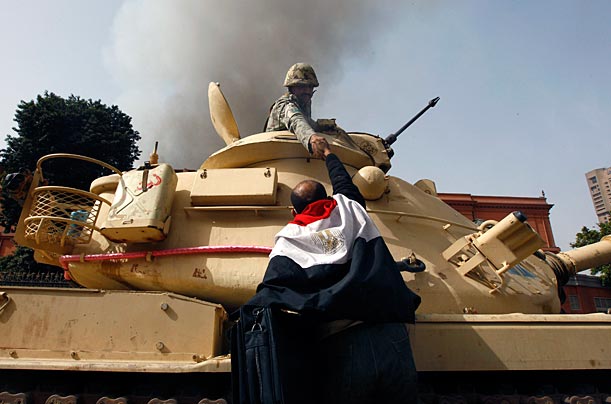
The Tides of Justice: Egypt set to join the ICC

Egypt has declared its intentions to join the ICC (Photo: Peter MacDiarmid/Getty Images)

Oh, how things change!

Today Egypt declared its intentions to join the ICC. Its position towards Sudanese President Omar al-Bashir remains conflicted and problematic. Nevertheless, Egypt’s turn towards international justice is a significant and positive development for proponents of international criminal justice.

Just a few weeks ago, claims that the Middle East and Arab world would be swept up by the cause of international criminal justice would have been laughed off. Then again, for better or worse, international politics has always kept us on our toes. Prediction has always been a risky game.

The invocation and support for international criminal justice marks a dramatic shift for Middle Eastern and Arab states. It has been a rare occasion that the rhetoric of international criminal justice has been employed by these states towards themselves. Yet, the surge of regional democratic movements and the so-called ‘Arab Spring’ has been complimented by a demand, and now supply, of justice and accountability. Indeed, international criminal justice seems to be sweeping through the region.

Egypt’s zest for the rule of law in recent days has been dramatic to say the least: ousted President Hosni Mubarak’s former political party was ordered to be dismantled by a court; a former prime minister and a number of ministers are facing trial on charges of corruption; if his health does not deteriorate, it is a distinct possibility that Mubarak himself will be brought to trial.

Egypt justice

(Photo: Yannis Behrakis/Reuters)

Not to be overshadowed by domestic efforts to achieve justice, today Egypt declared its intention to join the ICC. As part of Egypt’s desire to become a “legally constituted state,” Foreign Minister Nabil El-Arabi declared the following:

“Egypt is currently taking the required steps to join all United Nations agreements on human rights and to join the International Criminal Court…I think the events that have taken place in Egypt in recent days and the arrest of senior officials is evidence that the state wishes to follow the rule of law… domestically and internationally.”

To date, Arab and Middle Eastern states have been conspicuously absent from developments in international criminal justice. While numerous states in the region engaged positively in the negotiations to establish the ICC, with the lone exception of Jordan, none became member-states of the Court. The Arab League has been amongst the sharpest critics of efforts bring President Bashir to trial.

The question of Bashir’s arrest warrant will continue to pose a political quandary for Egypt. Despite Egypt’s desire to join the Court, another Egyptian diplomat clarified that it would not affect Egypt’s support of Bashir and that the Sudanese President could visit at any time without fear of detainment.

Two years ago, advocates of international criminal justice bemoaned Egypt for accepting a visit by Sudanese President Omar al-Bashir, who is wanted by the ICC to face charges of war crimes, crimes against humanity and genocide in Darfur. At some point, Egypt will have to clarify how it expects to have its cake and eat it too.

Today’s announcement that Egypt will join the ICC reflects an incredible turn of events and turn of attitudes. Many Egyptians will no doubt be celebrating their country’s new-found commitment to human rights and justice. Those who support the international criminal justice project too can celebrate. Having Arab and Middle Eastern states engage as member-states of the ICC can only enrich our debates and strengthen the cause.

Posted in Arab League, Darfur, Egypt, Human Rights, International Criminal Court (ICC), Middle East, Sudan, Transitional Justice | 6 Comments

Working at the ICC Linked to Hair Loss?

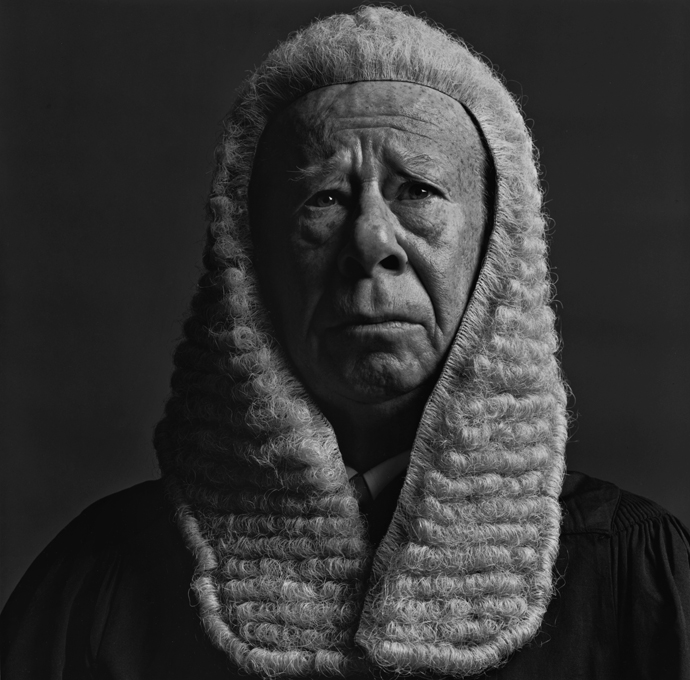
law wigKind of. Here’s the latest. According to Opinio Juris’ Twitter Account, next up the International Criminal Court will declare ‘Casual Fridays’. Nothing like practicing international criminal justice in a pair of slacks.

Just a bit of light justice humour for another long Monday. From the Associated Press:

Hair-raising ruling at international court: lawyers, lose your wigs

THE HAGUE, Netherlands — Hair today, gone tomorrow.

A judge has asked lawyers to shed their wigs next time they appear before her at the International Criminal Court.

A handful of attorneys appeared Monday in traditional black gowns and white horsehair wigs for a preliminary hearing in a case dealing with violence after Kenya’s disputed 2007 presidential election.

Justice Ekaterina Trendafilova paused briefly at the end of the hearing to pass a hair-raising judgment.

“This is not the dress code of this institution,” she said.

“In this quite warm weather maybe it will be more convenient to be without wigs,” she added with a smile.

Posted in Humour, International Criminal Court (ICC) | 3 Comments