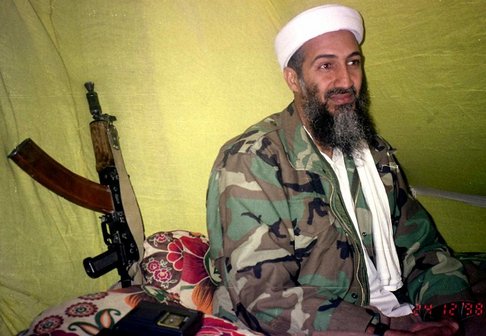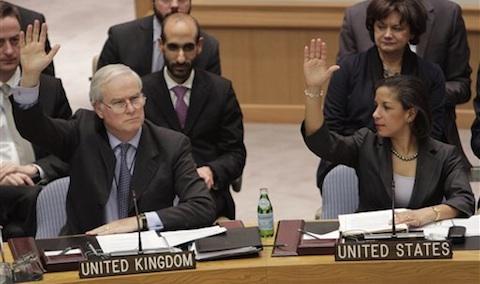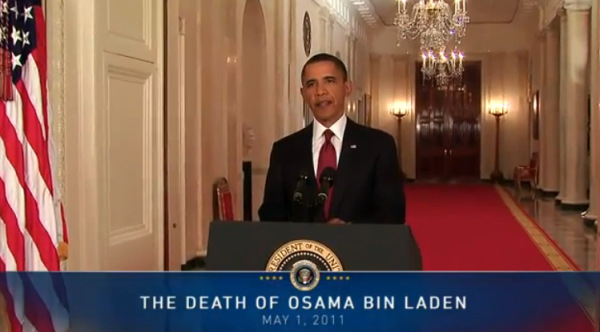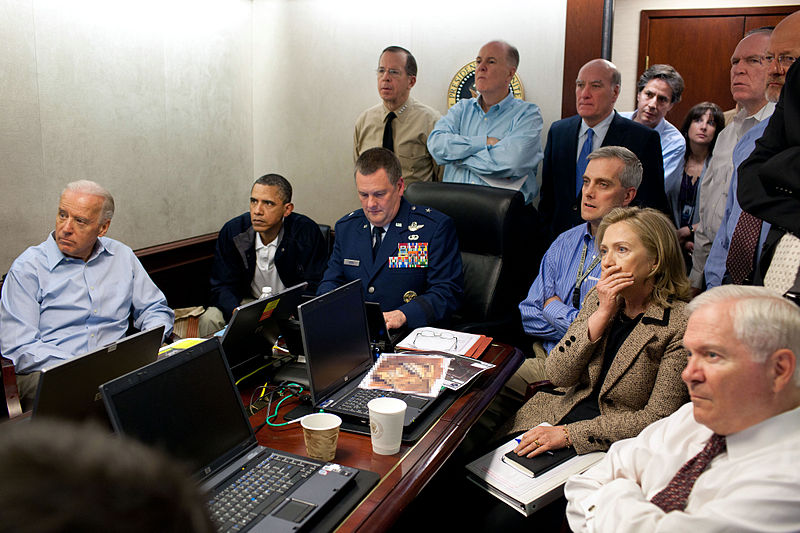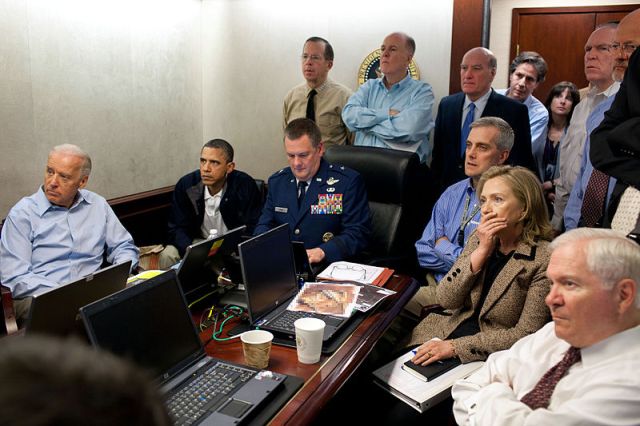
US officials including President Obama, VP Joe Biden, Secretary of State Hilary Clinton and Secretary of Defense Robert Gates watch as the bin Laden mission unfolds. The mission was to kill bin Laden, not to capture him.
A debate regarding the legality of killing Osama bin Laden is raging across the internet. Everyone wants to know: was the assassination of bin Laden in accordance with international law? Yesterday, I weighed in on the broader question of whether it was in fact an act of “justice” to kill bin Laden.
It strikes me that if assassinating bin Laden was, in fact, illegal (note there is no consensus on this question), then the prescription that follows would be that the US should have captured, detained and subsequently tried bin Laden for violations of international law.
Lindsay Beyerstein sums up the views of those uncomfortable with the assassination who would have prefered that bin Laden had been brought to trial:
I see his killing as a lost opportunity to capture and try him…Americans have just decided that it’s okay to kill suspects without trial if it seems obvious enough that they’re guilty of terrorism.
This post is an attempt to think through the kinds of issues that a trial of bin Laden would encounter. While there is no doubt an argument that putting bin Laden on trial would better serve the interests of justice than his assassination, it is not entirely clear just how “just” such a trial would be. Human rights expert, Joe Hoover, for example, commented that there is a need to be skeptical about what trials of this nature can offer:
“trials, especially international ones, are political acts and the desire to legalise the act of holding to account, of delivering justice, is hardly innocent or unproblematic.”
In what ways would a trial be problematic? I suggest four major challenges that a trial of bin Laden would have had: its fundamentally political (rather than impartial, judicial) nature, the question of where his trial would have taken place, which crimes would have been adjudicated, and, more practically, the cost of trying him. In the end, the debate about justice that has been instigated by bin Laden’s death is critically important for how we conceive of justice and the legitimacy and appropriateness of future action against individuals like bin Laden.
Politics of Law
Would bin Laden have received a fair trial? If justice was to be served and achieved by a trial, impartiality would have been absolutely necessary.
Greg Barns, a former Australian MP, writes that, if the leader of al-Qaeda had been put in front of a tribunal,
“Bin Laden could then have been tried according to law and given all the resources that every human being is entitled to in defending themselves against criminal charges.”
It isn’t entirely clear, however, that bin Laden would have been given all those resources. For example, individuals being prosecuted are granted the benefit of the doubt: they are assumed innocent until proven guilty. I don’t think it is controversial to maintain that bin Laden would have undoubtedly been presumed guilty. In 2001, when the Taliban offered to hand over bin Laden to a third country for trial, President Bush replied:
“When I said no negotiations I meant no negotiations…We know he’s guilty. Turn him over. There’s no need to discuss innocence or guilt.”
While bin Laden’s responsibility in terrorist attacks is clear, even by bin Laden’s own admission, with regards to the standards of international criminal law, he would have had to be presumed innocent nonetheless.
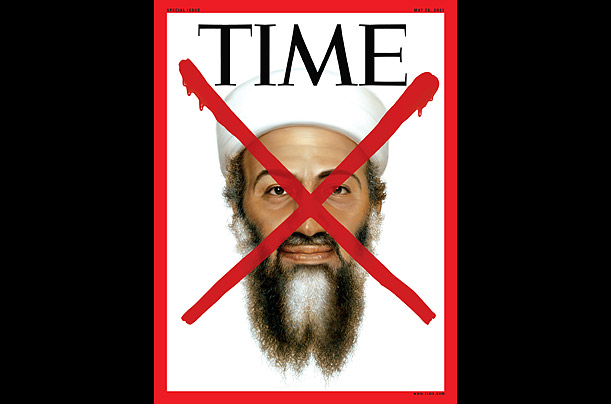
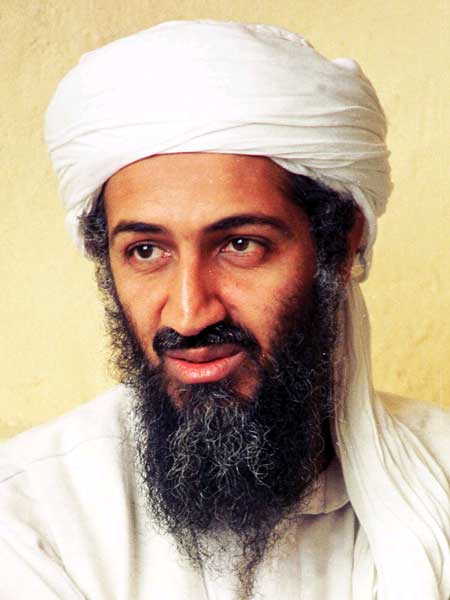
The upcoming cover of Time Magazine
There would also have been the risk that bin Laden’s trial might have become a show trial, intended to illustrate the moral superiority of America rather than guarantee an even-handed, fair judicial prosecution. It is entirely possible, given the precedence of past high-profile cases, that bin Laden himself would have used a trial as a pulpit to spread propaganda.
In this context, it’s not obvious that bin Laden would have received a fair defense. Would the US be have been willing to hand over evidence against him as well as the names of witnesses who would have testified against him? If the trial were to be fair, they would have had to.
One problem that bin Laden may not have had is with finding legal representation. While some have suggested that bin Laden would have had a difficult time finding representation, this seems very unlikely. There is no shortage of lawyers who would dream to make their career defending individuals like bin Laden. A lawyer like Jacques Verges would seem a logical candidate. Dubbed the “Devil’s Advocate”, Verges has represented the likes of Slobodan Milosevic, Carlos the Jackal and Klaus Barbie.
Where would he have been tried?
Yesterday, Jan Triska commented that:
“the…big unspoken issue here, as well: whether bin Laden or even one of his lieutenants could have ever received a fair trial, anywhere”
Triska is right to point out that it remains unclear where bin Laden would have been tried. The initial presumption may have been that bin Laden would be tried in the US. If bin Laden had, however, been brought to Guantanamo first, a very possible scenario, he would be unable to be tried in the US, as Congress has virtually barred any Gitmo detainees from having trials on US soil.
Even if he had not been transferred to Gitmo, there has been little to suggest an appetite for a trial of bin Laden in the US. Last year, Eric Holder Jr., the US Attorney General, declared that bin Laden:
“will never appear in an American courtroom…Let’s deal with the reality here. The reality is, we will be reading Miranda rights to a corpse.”
It also seems unlikely that bin Laden could have been tried at the ICC. The ICC does not have jurisdiction over the events of 9/11 as they occurred prior to the Court’s creation in 2002. It also does not have jurisdiction of bin Laden’s prior terrorist attacks.
Continue reading →